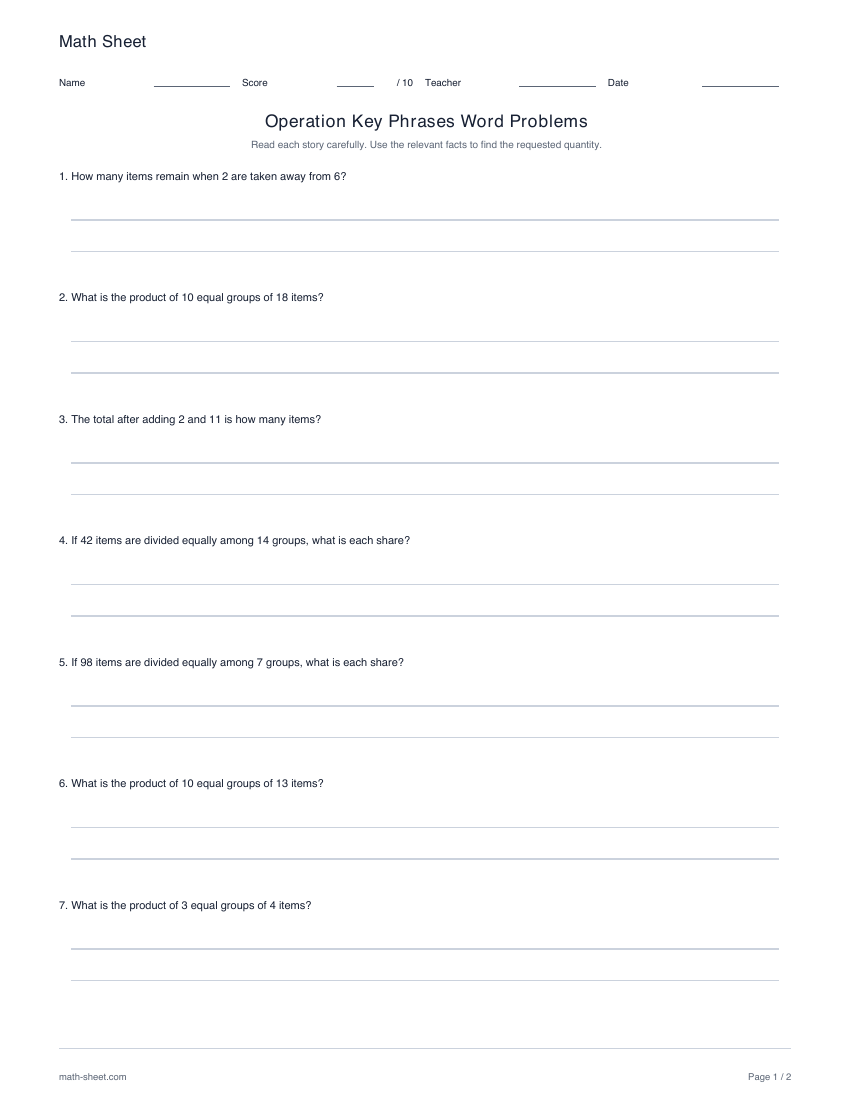
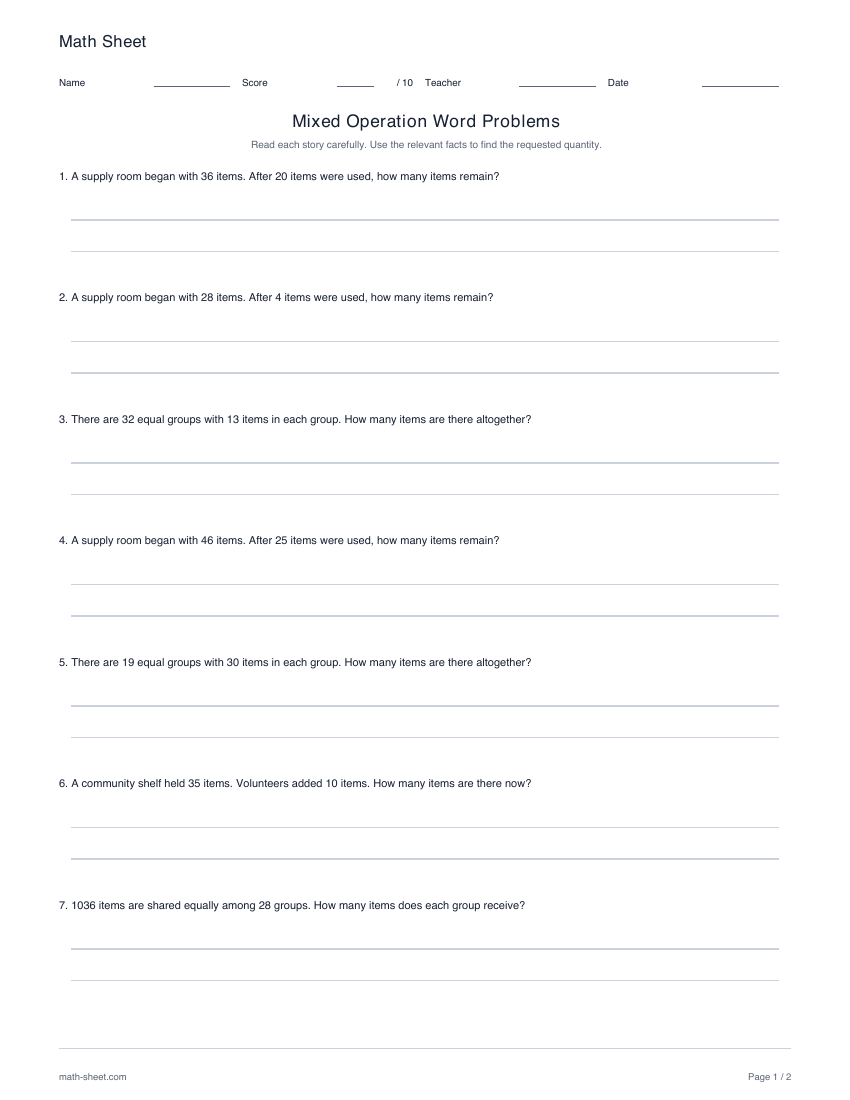
Practice reading mathematical language in ten mixed-operation stories. Select the operation pool, number wording and extra information while checking the meaning of each question.
Ask learners to identify what is known and what the question asks. A drawing, timeline or equation can make the relationship visible before they calculate. Check the answer against the original story and keep its unit.
The ready-made English downloads include practice alone or a separate answer key. The generator keeps the same questions in the preview and PDF, and a saved link reproduces the selected set.
Learning objective
What this activity builds
Use mathematical vocabulary as reading support without treating it as an automatic operation rule.
Worked example
A gardener has 32 seedlings. That is 8 fewer than last week. How many seedlings were there last week?
32 + 8 = 40 seedlings.
“Fewer” compares the current smaller amount with an unknown earlier amount. Finding that larger amount requires addition.
Teaching notes
Make the practice count
Ask which quantity a comparison describes.
Rewrite a story with a different unknown and compare the equations.
Use the vocabulary reference after discussing a concrete example.
Make it yours
Customize the practice
Choose your options, update the preview, then download the exact same pages.
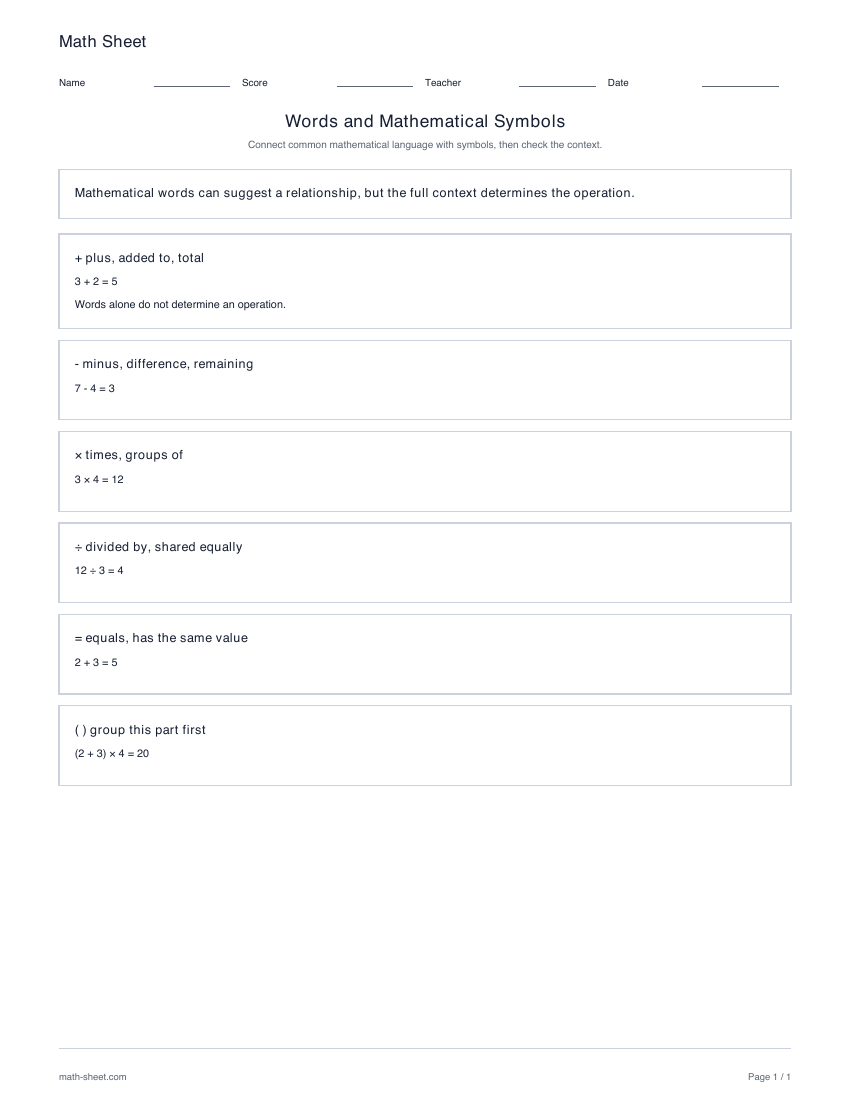
Connect mathematical language with addition, subtraction, multiplication, division, equality and grouping. Print a reference with contextual examples that goes beyond memorizing keywords.
Choose addition/subtraction, addition/multiplication, multiplication/division or all four operations. Set the digit range, number wording and extra information for ten stories.
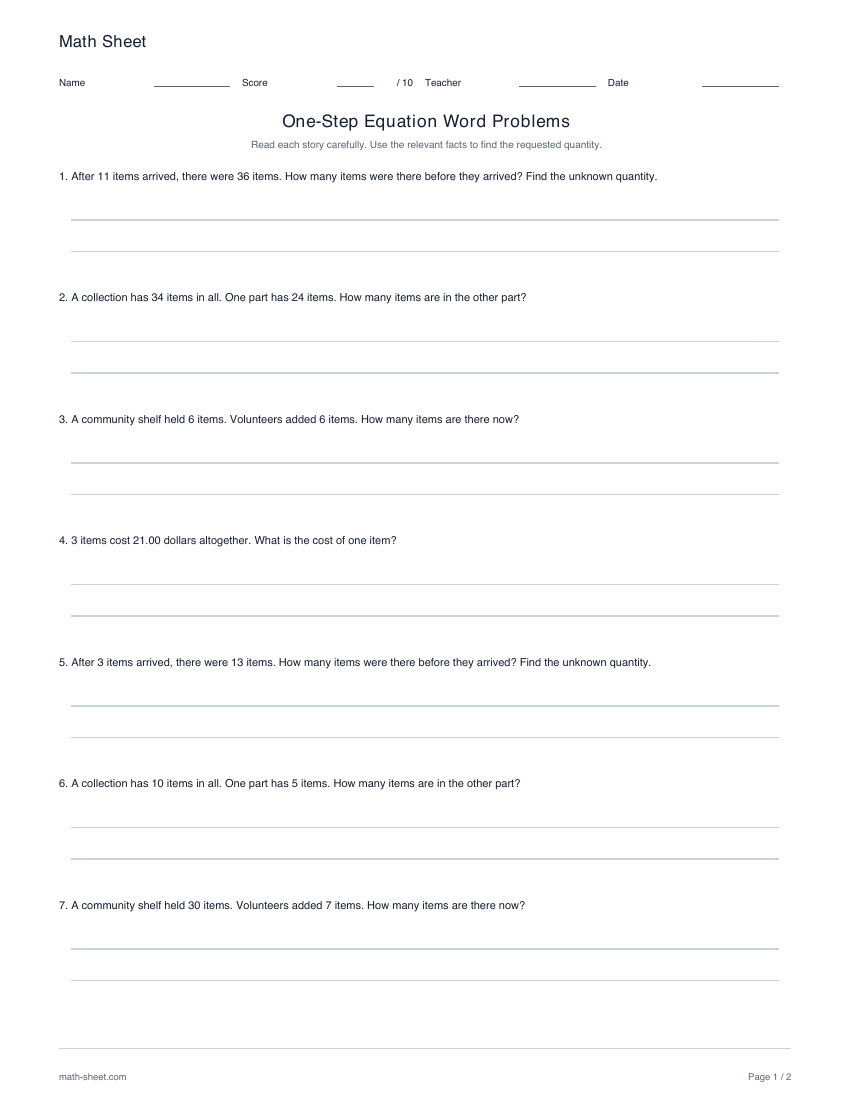
Find a missing starting amount, part, total or unit cost in ten short stories. Choose digits, number words or a mixture, and optional irrelevant information.