
Geometry
Classifying angles worksheets
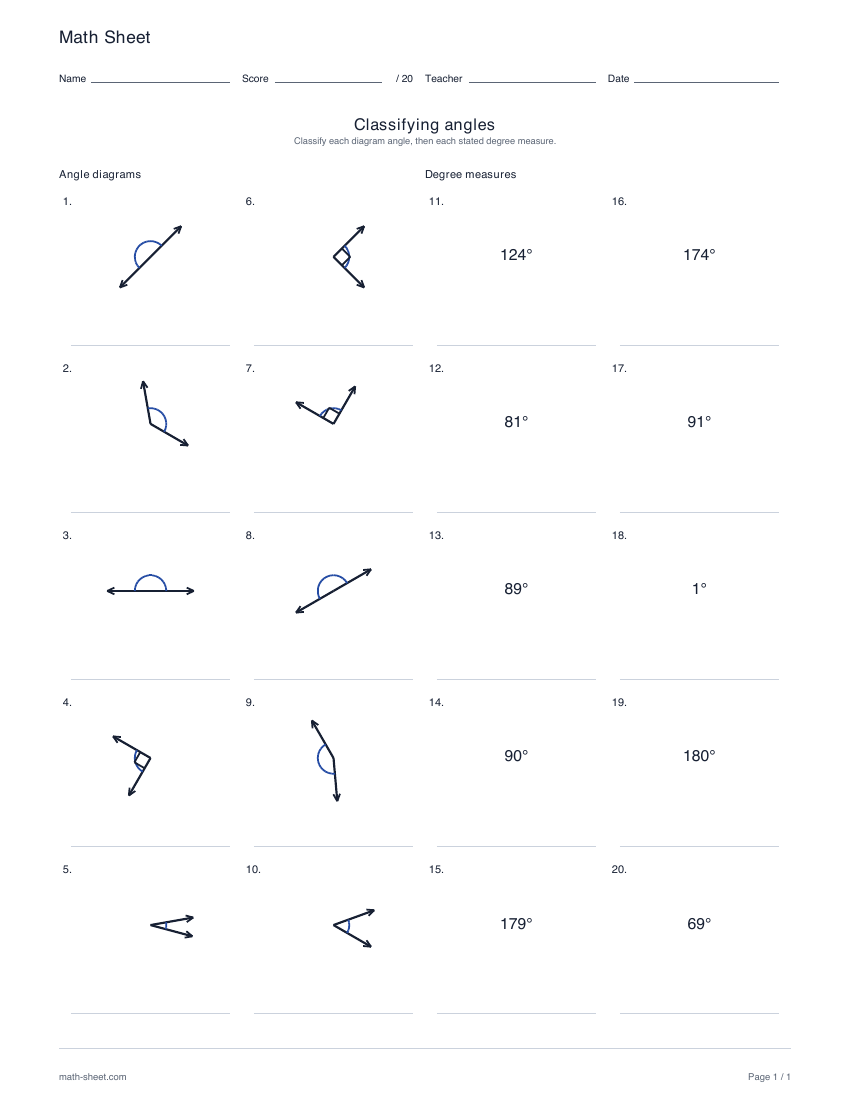
Classify 20 angles as acute, right, obtuse or straight. Ten questions use unlabelled diagrams and ten use exact degree measures, followed by a separate answer key.
Preview and downloadGeometry practice
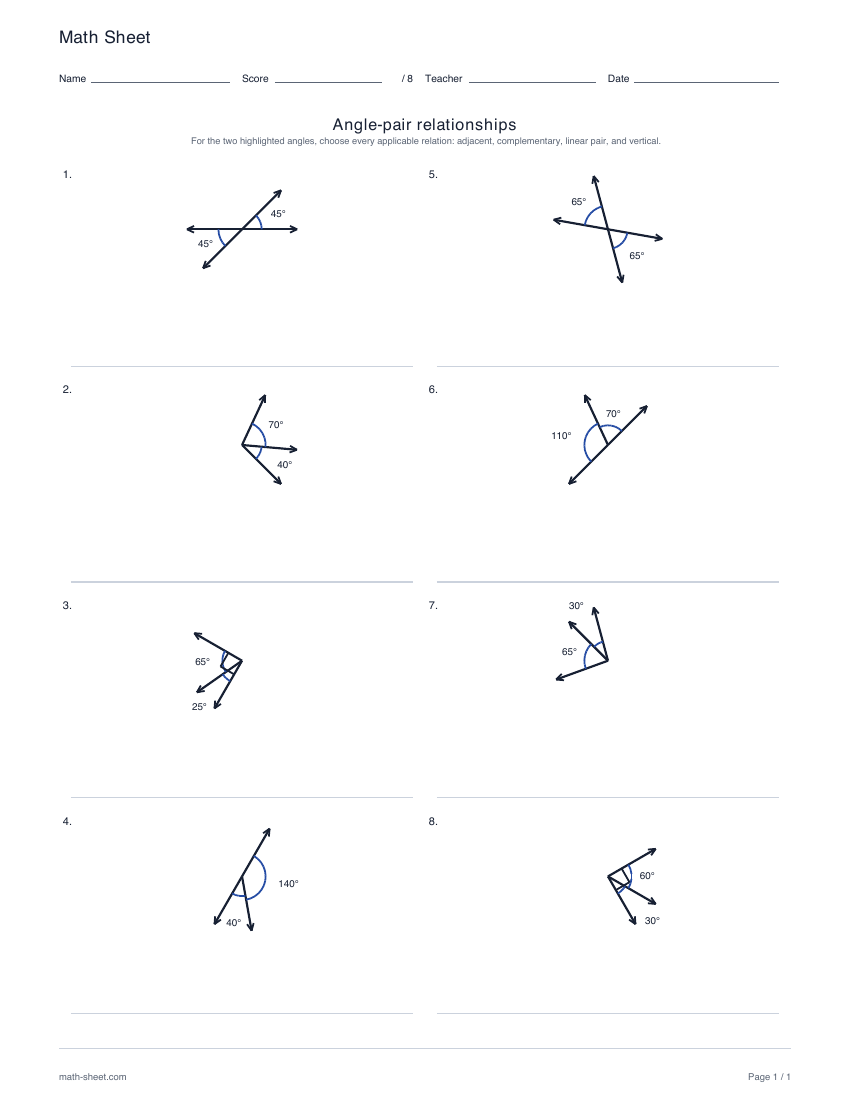
Identify every relationship that applies to two marked angles: adjacent, complementary, a linear pair or vertical. Eight diagrams show both exact measures and a separate checked answer key.
Ready-made English PDF · fixed settings
Customization below makes a separate PDF.
Fixed English ready-made files. Custom settings below apply only to the configured PDF.
Ready to print
For each pair of marked angles, choose all relationships that apply: adjacent, complementary, linear pair and vertical. More than one answer can be correct.
Download the practice pages alone, or include a separate answer key or teacher model. Longer activities may use more than one page.
Customize this worksheetAngles keep the same measure when a diagram is rotated. A right-angle square is an exact fact; otherwise use the stated degree measures when they are supplied. The first ten questions on the classification sheet intentionally omit measures so learners reason from the picture.
Naming practice uses directed rays. Read ray BA from vertex B through A. In a multi-ray figure, every pair of rays determines an angle, including a larger angle that spans smaller sectors.
Learning objective
Use shared rays, opposite rays and exact measures together instead of treating angle-pair labels as mutually exclusive.
Worked example
Vertical and complementary.
The angles are opposite, so they are vertical angles. Their stated measures add to 90 degrees, so they are also complementary. They are not adjacent and do not form a linear pair.
Teaching notes
Make it yours
Choose your options, update the preview, then download the exact same pages.
A useful next step
Geometry
Classify 20 angles as acute, right, obtuse or straight. Ten questions use unlabelled diagrams and ten use exact degree measures, followed by a separate answer key.
Preview and download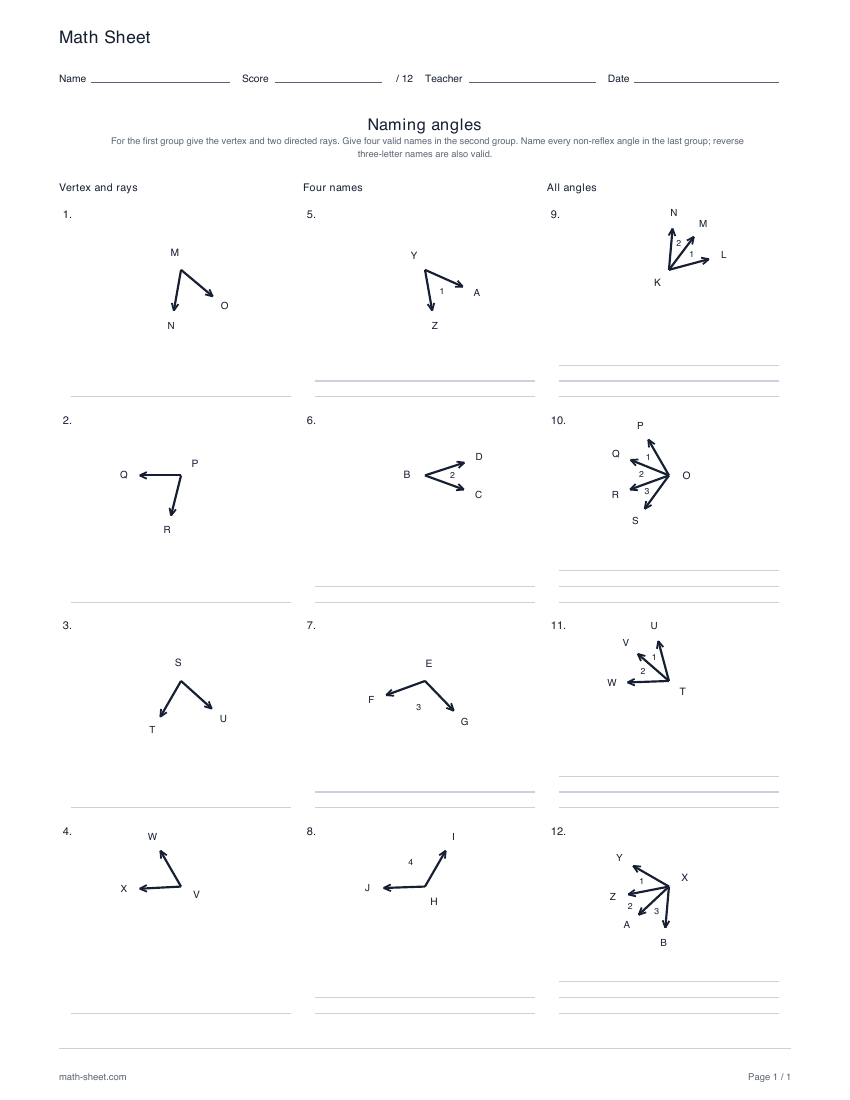
Geometry
Identify vertices and directed rays, give four valid names for a single angle, and name every angle formed by three or four rays. Twelve questions include complete answer lists.
Preview and download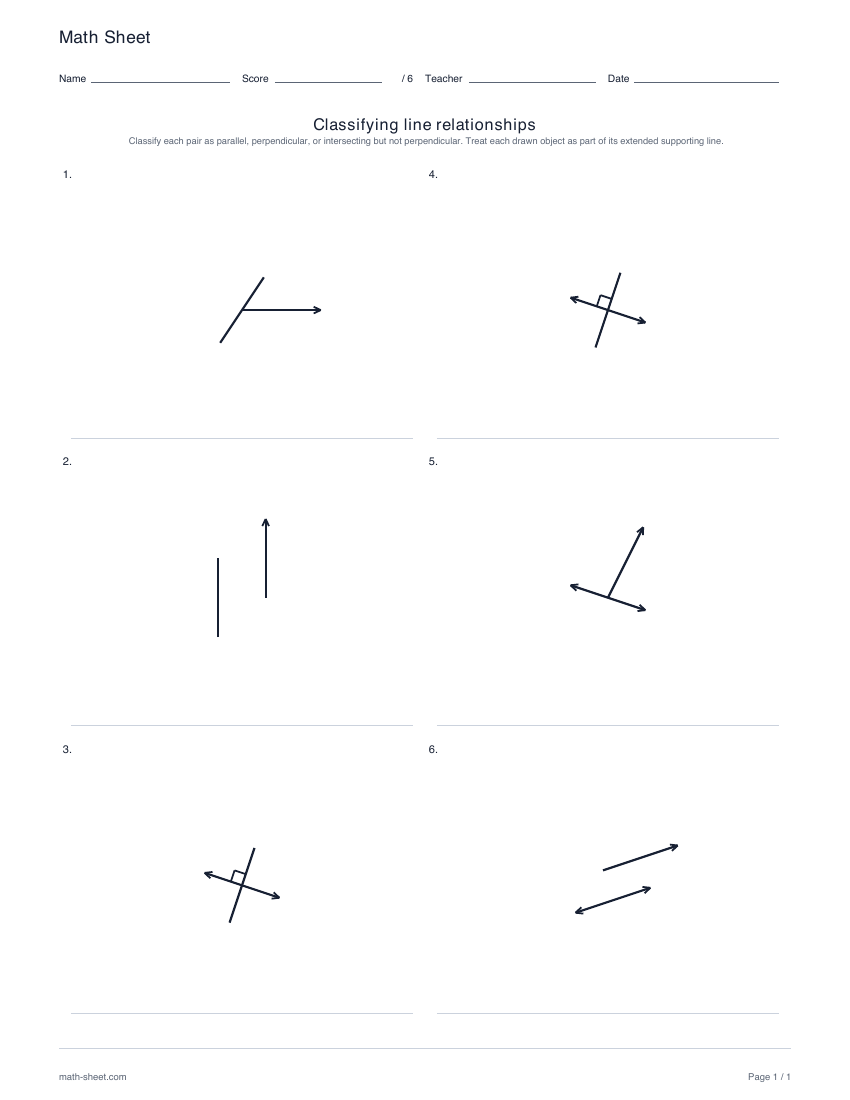
Geometry
Classify six pairs of extended supporting lines as parallel, perpendicular or intersecting but not perpendicular. Each worksheet balances two examples of every relationship.
Preview and download