Probability practice

Playing card probability worksheets

Calculate probabilities in a standard 52-card deck. Choose single draws or independent draws with replacement, with explicit card conventions and an explained answer key.

Ready-made English PDF · fixed settings

Customization below makes a separate PDF.

Fixed English ready-made files. Custom settings below apply only to the configured PDF.

Ready to print

Start with a ready-made worksheet

Use a standard 52-card deck without jokers. For multiple draws, replace the card and shuffle before the next draw. Follow the stated order and card conditions.

Download the practice pages alone, or include a separate answer key or teacher model. Longer activities may use more than one page.

Customize this worksheet

Paper sizes and printing help · More probability activities

State what happens between draws

Use a standard 52-card deck without jokers. Single-draw questions count the cards satisfying an event. The two-draw questions replace and shuffle the first card, making the second draw independent.

Face cards mean J, Q and K. An ace is a separate rank. Read and/or conditions carefully: an overlapping card belongs only once in a union.

Learning objective

What this activity builds

Count card events accurately and multiply probabilities for ordered independent draws with replacement.

Worked example

Draw a heart, replace it and shuffle, then draw an ace. What is the probability of this ordered event?

(13/52) × (4/52) = 1/52.

Thirteen cards are hearts, and four cards are aces. Replacing the first card restores all 52 cards, so the second draw is independent. There are 13 × 4 favorable ordered pairs among 52 × 52 possible pairs.

Teaching notes

Make the practice count

  • Review that J, Q and K are face cards; an ace is not a face card.
  • Use the words and, or, first and then precisely.
  • For a union, count an overlapping card only once.
  • Model replacement physically before multiplying fractions.

Make it yours

Customize the practice

Choose your options, update the preview, then download the exact same pages.

Uses a standard 52-card deck without jokers. Multi-draw questions replace and shuffle the first card before the second draw.

Worksheet settings

Experiments
Page note and reproducible seed

The same settings and seed make the same questions. Shared links include your page note; leave personal information out. Notes use the selected language’s supported characters; English accepts basic Latin text.

Configured PDF · Playing Card Probability · US Letter

Preview ready. Download includes these exact pages.

1 student page
Enlarged pages scroll. PDF size stays the same.
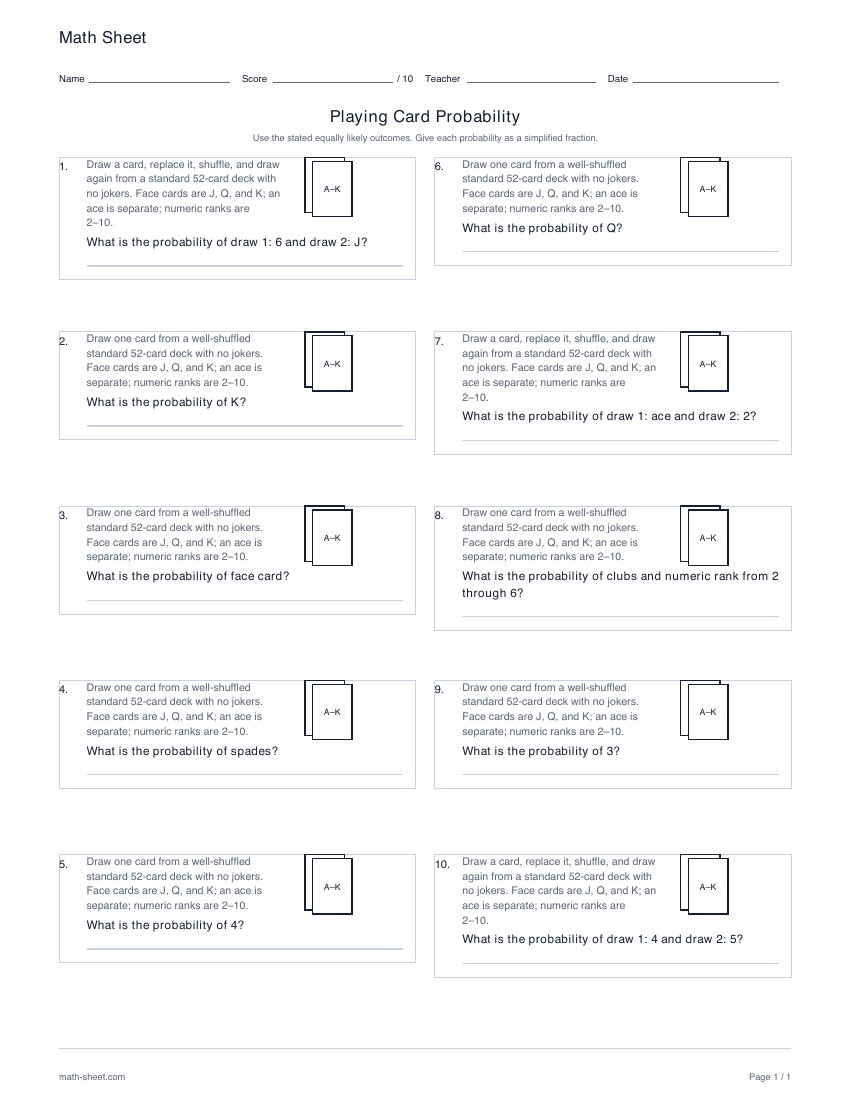
Math SheetNameScore/ 10TeacherDatePlaying Card ProbabilityUse the stated equally likely outcomes. Give each probability as a simplified fraction.1.A–KDraw a card, replace it, shuffle, and drawagain from a standard 52-card deck withno jokers. Face cards are J, Q, and K; anace is separate; numeric ranks are2–10.What is the probability of draw 1: 6 and draw 2: J?2.A–KDraw one card from a well-shuffledstandard 52-card deck with no jokers.Face cards are J, Q, and K; an ace isseparate; numeric ranks are 2–10.What is the probability of K?3.A–KDraw one card from a well-shuffledstandard 52-card deck with no jokers.Face cards are J, Q, and K; an ace isseparate; numeric ranks are 2–10.What is the probability of face card?4.A–KDraw one card from a well-shuffledstandard 52-card deck with no jokers.Face cards are J, Q, and K; an ace isseparate; numeric ranks are 2–10.What is the probability of spades?5.A–KDraw one card from a well-shuffledstandard 52-card deck with no jokers.Face cards are J, Q, and K; an ace isseparate; numeric ranks are 2–10.What is the probability of 4?6.A–KDraw one card from a well-shuffledstandard 52-card deck with no jokers.Face cards are J, Q, and K; an ace isseparate; numeric ranks are 2–10.What is the probability of Q?7.A–KDraw a card, replace it, shuffle, and drawagain from a standard 52-card deck withno jokers. Face cards are J, Q, and K; anace is separate; numeric ranks are2–10.What is the probability of draw 1: ace and draw 2: 2?8.A–KDraw one card from a well-shuffledstandard 52-card deck with no jokers.Face cards are J, Q, and K; an ace isseparate; numeric ranks are 2–10.What is the probability of clubs and numeric rank from 2through 6?9.A–KDraw one card from a well-shuffledstandard 52-card deck with no jokers.Face cards are J, Q, and K; an ace isseparate; numeric ranks are 2–10.What is the probability of 3?10.A–KDraw a card, replace it, shuffle, and drawagain from a standard 52-card deck withno jokers. Face cards are J, Q, and K; anace is separate; numeric ranks are2–10.What is the probability of draw 1: 4 and draw 2: 5?math-sheet.comPage 1 / 1

A useful next step

Related activities

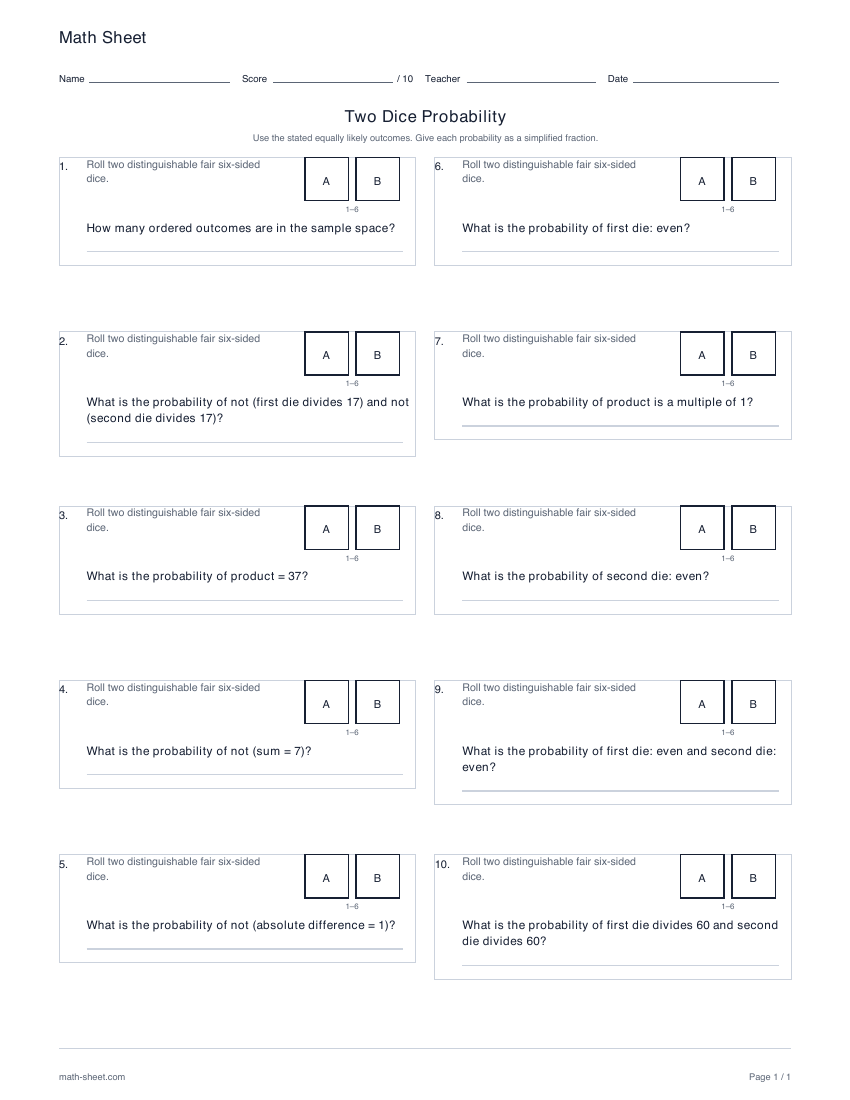
First page preview: Two dice probability worksheets

Probability

Two dice probability worksheets

Count ordered outcomes from two fair dice. Practice number events, sums, differences, products and factor relationships with probabilities derived from all 36 possible pairs.

Preview and download
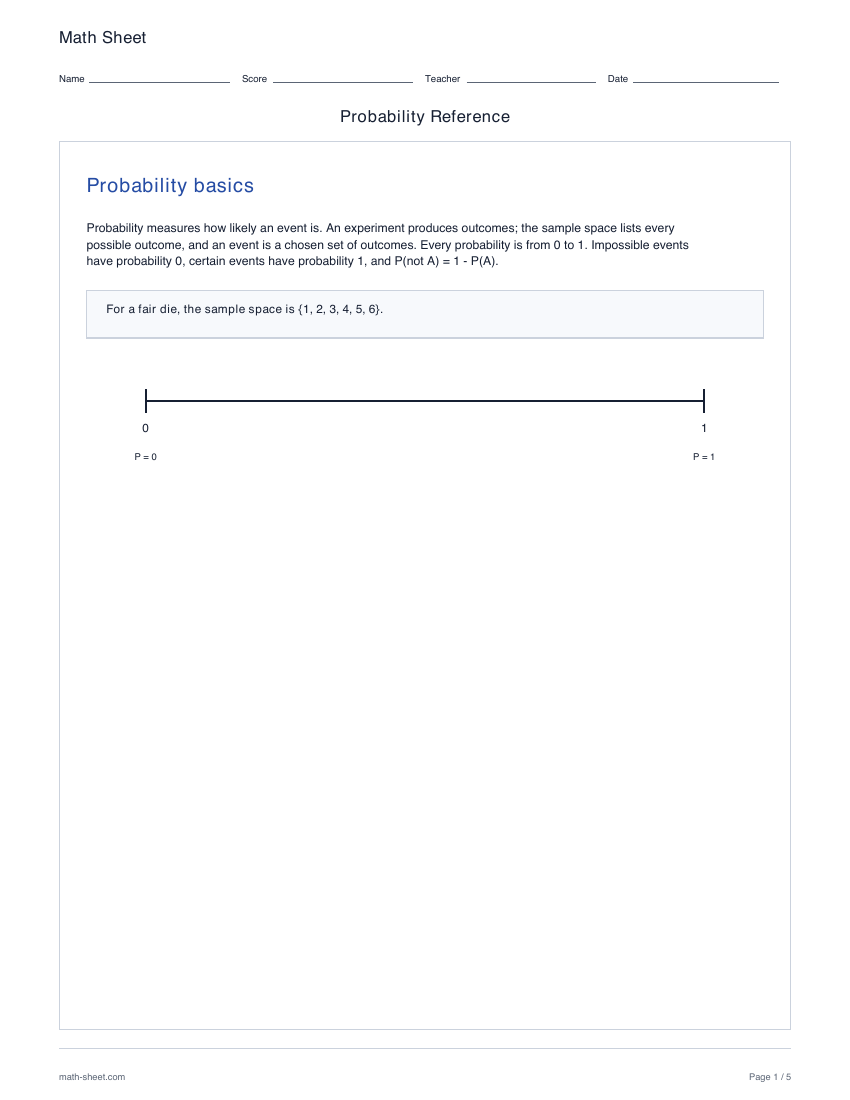
First page preview: Probability reference sheet

Probability

Probability reference sheet

A printable guide to probability, independent and dependent events, replacement and probability trees. Connect definitions with worked examples and conditional branch probabilities.

Preview and download
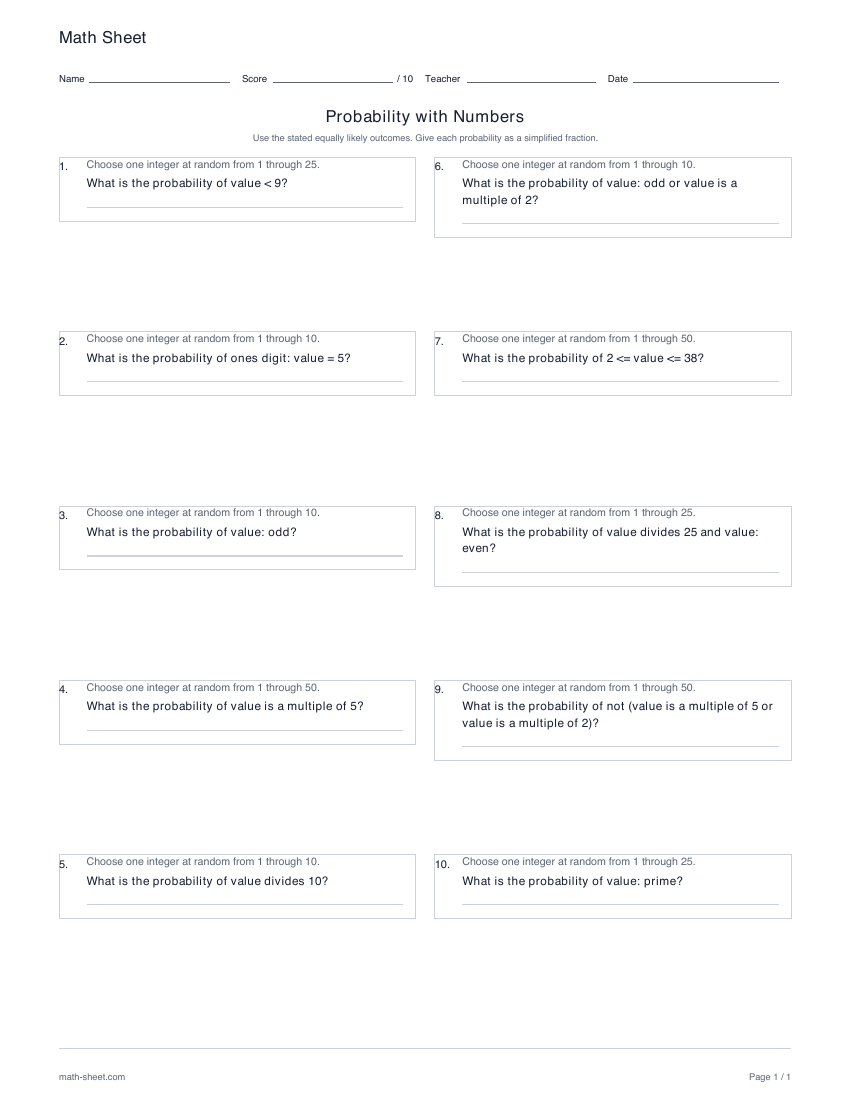
First page preview: Probability with numbers worksheets

Probability

Probability with numbers worksheets

Find the chance of selecting a number from a finite set. Practice ranges up to 10, 25 or 50, count favorable outcomes and simplify the probability with an explained answer key.

Preview and download