Pythagorean theorem reference

Pythagorean theorem reference and worked examples

A six-page printable guide to right-triangle parts, square areas, missing sides, irrational lengths and the coordinate distance formula.

Ready-made English PDF · fixed settings

Customization below makes a separate PDF.

Fixed English ready-made files. Custom settings below apply only to the configured PDF.

Ready to print

Print the reference handout

Read the diagrams and worked examples. Identify the hypotenuse each time, and explain why each calculation uses addition or subtraction.

Download the complete reference with its explanations and worked examples. This handout does not need a separate answer key.

Choose paper and language

Paper sizes and printing help · More pythagorean theorem activities

Six pages, from square areas to coordinate distance

The handout introduces the right triangle and its three side squares, then works through finding a hypotenuse, finding a leg, handling an irrational length and calculating the distance between two points. Each page has its own diagram and explanation.

Use it beside the matching practice and print the pages you need. The explanations are already included, so there is no separate answer key.

Learning objective

What this activity builds

Connect the area relationship a² + b² = c² to practical missing-side and coordinate-distance calculations.

Worked example

Why do the numbers in the Pythagorean theorem appear as squares?

They describe the areas of squares built on the three sides.

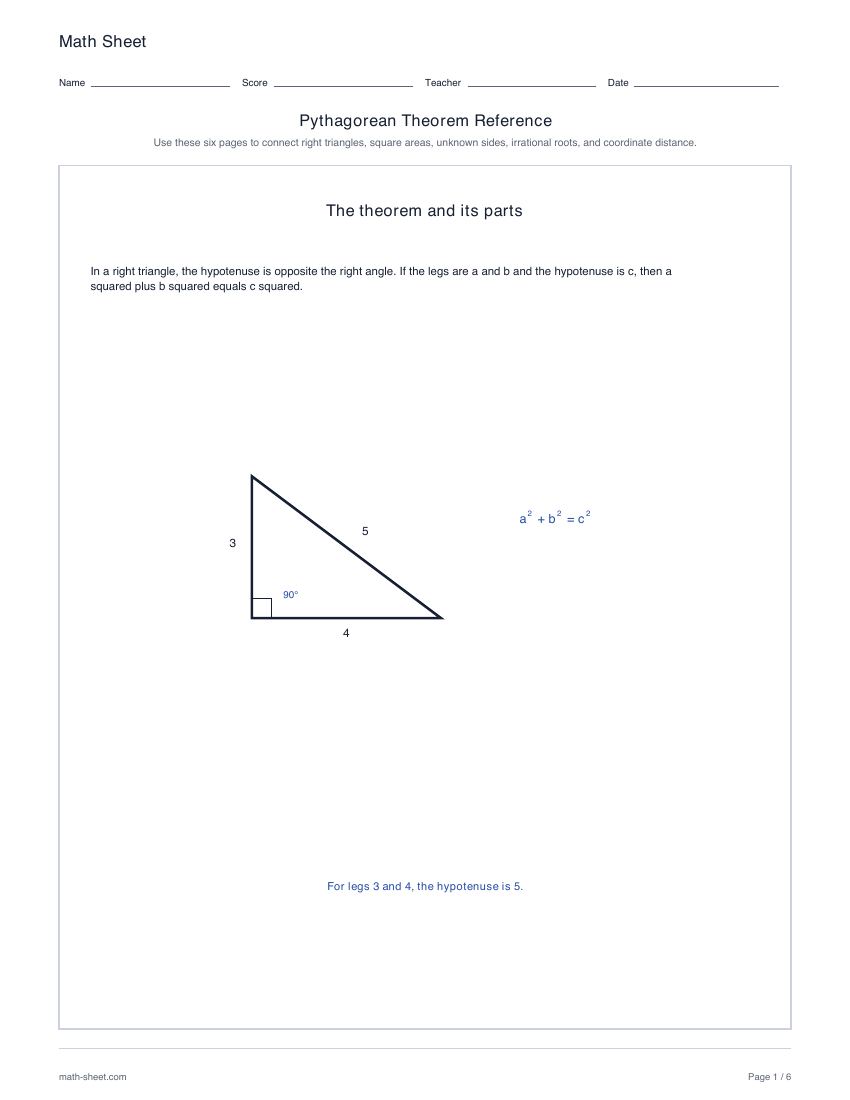
For a right triangle with legs 3 and 4, those square areas are 9 and 16. Their sum is 25, which is the area of the square on the hypotenuse. Its side length is 5, not 25.

Teaching notes

Make the practice count

  • Use one page beside the corresponding practice rather than introducing all six at once.
  • Distinguish side length from square area in every diagram.
  • Compare a missing-hypotenuse example with a missing-leg example.
  • Use the final coordinate example to connect algebra with a visible right triangle.

Make it yours

Customize the reference

Choose your options, update the preview, then download the exact same pages.

Worksheet settings

Page note

Add an optional note to the reference page. Shared links include your page note; leave personal information out. Notes use the selected language’s supported characters; English accepts basic Latin text.

Configured PDF · Pythagorean Theorem Reference · US Letter

Preview ready. Download includes these exact pages.

6 reference pages
Enlarged pages scroll. PDF size stays the same.
Math SheetNameScoreTeacherDatePythagorean Theorem ReferenceUse these six pages to connect right triangles, square areas, unknown sides, irrational roots, and coordinate distance.The theorem and its partsIn a right triangle, the hypotenuse is opposite the right angle. If the legs are a and b and the hypotenuse is c, then asquared plus b squared equals c squared.34590°a2 + b2 = c2For legs 3 and 4, the hypotenuse is 5.math-sheet.comPage 1 / 6
Math SheetNameScoreTeacherDatePythagorean Theorem ReferenceUse these six pages to connect right triangles, square areas, unknown sides, irrational roots, and coordinate distance.Squares on the three sidesA square built on each side has area equal to that side length squared. The two leg-square areas add to thehypotenuse-square area.91625A(a) + A(b) = A(c)9 + 16 = 25Areas 9 and 16 combine to make area 25.math-sheet.comPage 2 / 6
Math SheetNameScoreTeacherDatePythagorean Theorem ReferenceUse these six pages to connect right triangles, square areas, unknown sides, irrational roots, and coordinate distance.Finding the hypotenuseSquare both legs, add, and take the positive square root. A length cannot be negative.68?c2 = 62 + 82c2 = 36 + 64 = 100c = 100 = 10With legs 6 and 8: c squared is 36 plus 64, so c is 10.math-sheet.comPage 3 / 6
Math SheetNameScoreTeacherDatePythagorean Theorem ReferenceUse these six pages to connect right triangles, square areas, unknown sides, irrational roots, and coordinate distance.Finding a legStart with the hypotenuse square and subtract the known leg square. Then take the positive square root.?513a2 = 132 - 52a2 = 169 - 25 = 144a = 144 = 12With c equal to 13 and one leg 5: the other leg is 12.math-sheet.comPage 4 / 6
Math SheetNameScoreTeacherDatePythagorean Theorem ReferenceUse these six pages to connect right triangles, square areas, unknown sides, irrational roots, and coordinate distance.Irrational lengths and roundingSome radicands are not perfect squares. Keep the exact root during the work, then round only the final length to fourdecimal places.23?c2 = 22 + 32 = 13c = 13 ~ 3.6056With legs 2 and 3, the exact length is the positive root of 13, approximately 3.6056.math-sheet.comPage 5 / 6
Math SheetNameScoreTeacherDatePythagorean Theorem ReferenceUse these six pages to connect right triangles, square areas, unknown sides, irrational roots, and coordinate distance.Distance on a coordinate planeHorizontal and vertical distances are absolute differences. They form the legs of a right triangle between the two points.-5-5-4-4-2-200224455P1P2dx = 4 - (-2) = 6dy = 5 - 1 = 4d2 = 62 + 42 = 52d = 52 ~ 7.2111From (-2, 1) to (4, 5), the leg lengths are 6 and 4; the distance is the positive root of 52, approximately 7.2111.math-sheet.comPage 6 / 6

A useful next step

Related activities

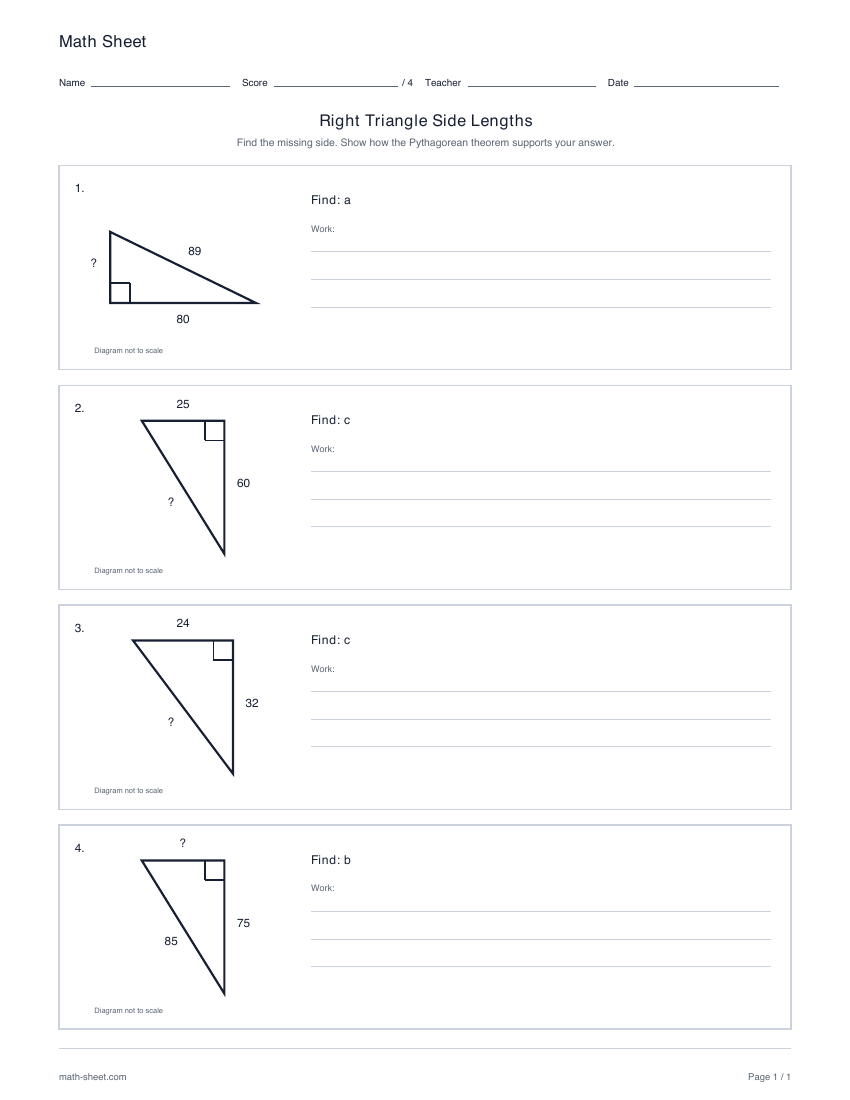
First page preview: Pythagorean theorem worksheet: missing side lengths

Pythagorean theorem

Pythagorean theorem worksheet: missing side lengths

Print a four-question Pythagorean theorem worksheet for missing hypotenuses or legs. Choose whole-number triples or irrational results from whole or decimal givens.

Preview and download
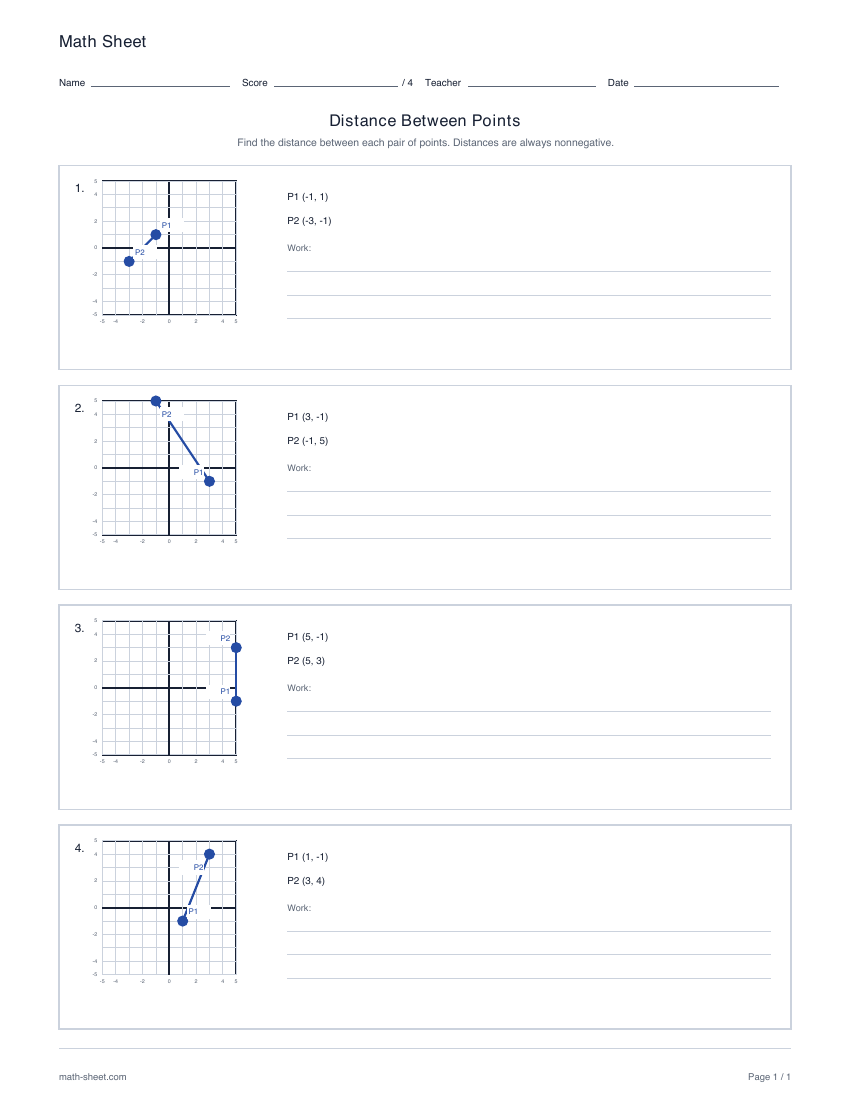
First page preview: Distance between two points worksheets

Pythagorean theorem

Distance between two points worksheets

Find distances on four coordinate grids with whole-number, decimal-tenths, radical or mixed coordinates. Choose first-quadrant or four-quadrant points and print separate worked solutions.

Preview and download
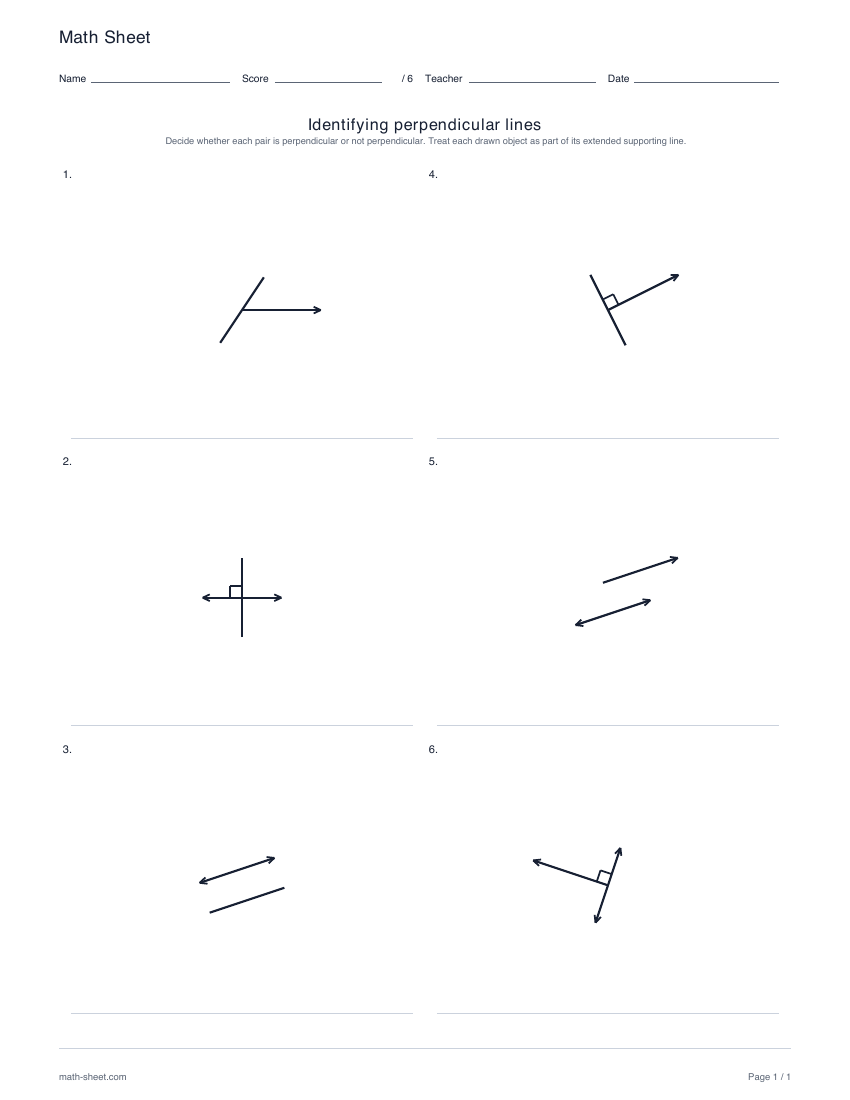
First page preview: Identifying perpendicular lines worksheets

Geometry

Identifying perpendicular lines worksheets

Decide whether six pairs of extended supporting lines are perpendicular. True examples include a right-angle mark; counterexamples include parallel and oblique pairs.

Preview and download