
Pythagorean theorem
Pythagorean theorem reference and worked examples
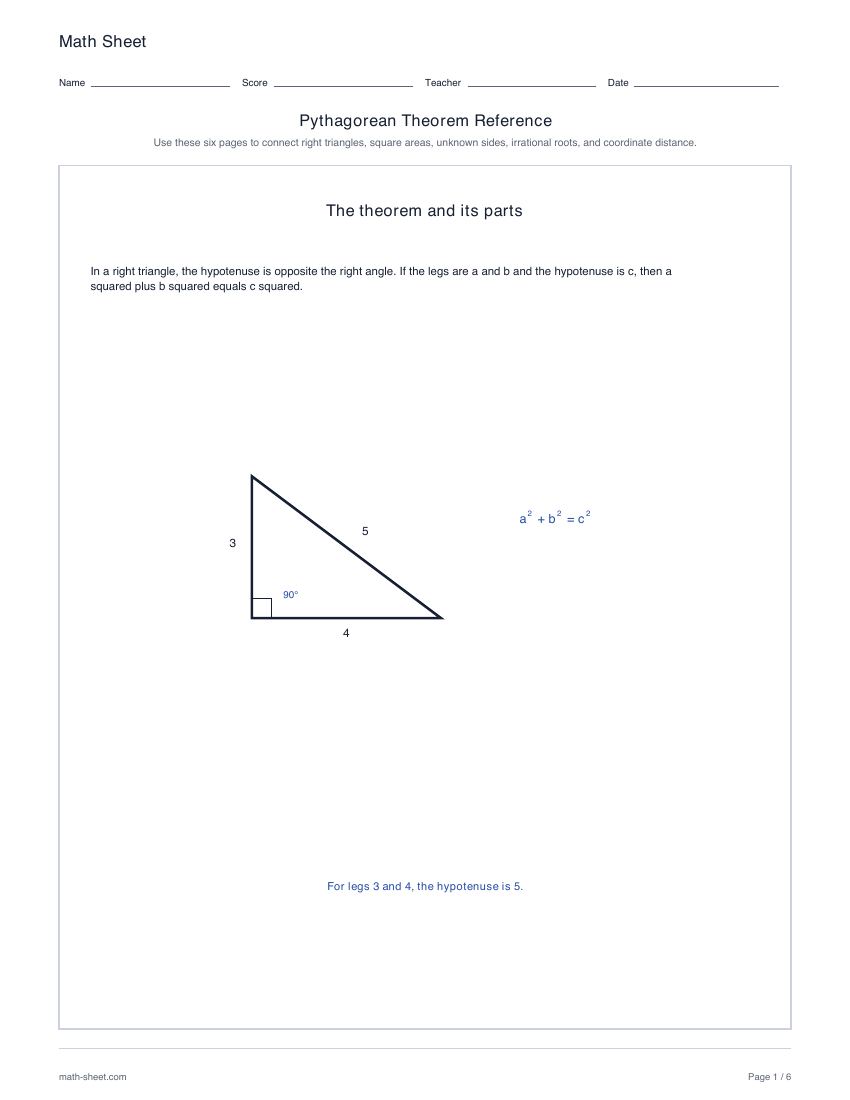
A six-page printable guide to right-triangle parts, square areas, missing sides, irrational lengths and the coordinate distance formula.
Preview and downloadPythagorean theorem practice
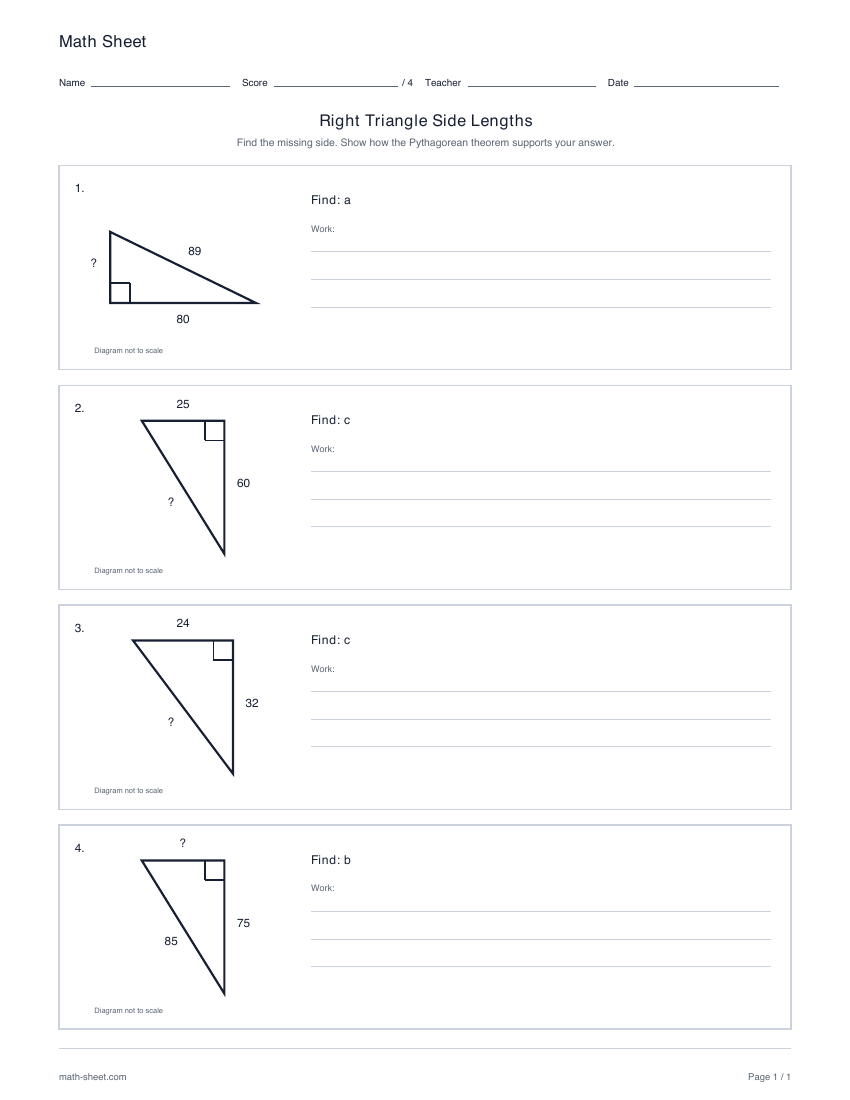
Print a four-question Pythagorean theorem worksheet for missing hypotenuses or legs. Choose whole-number triples or irrational results from whole or decimal givens.
Ready-made English PDF · fixed settings
Customization below makes a separate PDF.
Fixed English ready-made files. Custom settings below apply only to the configured PDF.
Ready to print
Find the missing length. Show the squared-length equation and your calculation. Round noninteger answers to four decimal places.
Download the practice pages alone, or include a separate answer key or teacher model. Longer activities may use more than one page.
Customize this worksheetPaper sizes and printing help · More pythagorean theorem activities
Whole-number practice uses exact Pythagorean triples. Decimal-answer practice keeps the given sides whole but requires a square root that is not an integer. Decimal-side practice introduces tenths. Choose a missing hypotenuse, a missing leg, or a mix of both.
Keep the squared calculations exact until the final step. The worked key distinguishes an exact answer from an approximation and rounds noninteger roots to four decimal places. Length and distance are always nonnegative.
Learning objective
Choose addition or subtraction of squared lengths from the position of the missing side, then take the positive square root.
Worked example
12 units.
The missing side is a leg, so subtract the known leg square from the hypotenuse square: 13² − 5² = 169 − 25 = 144. The positive square root of 144 is 12. Adding the squares here would solve the wrong problem.
Teaching notes
Start with Whole-number triples for exact integer answers. Move to Whole sides, decimal answer when learners are ready to calculate irrational lengths from whole-number givens, then use Decimal sides for givens in tenths. Every setting generates four right triangles.
Choose Hypotenuse for four addition problems or Leg for four subtraction problems. Mixed, the default, includes two missing hypotenuses and two missing legs so learners must identify the unknown side before choosing an operation.
Add the two leg squares when the hypotenuse is missing. When a leg is missing, subtract the known leg square from the hypotenuse square. Identify the hypotenuse opposite the right angle before writing the equation.
Whole-number triples produce exact integer answers. The Whole sides, decimal answer and Decimal sides settings both produce an irrational length: keep its square-root form exact during the work, then round the final length to four decimal places. The worked answer key shows both forms.
Make it yours
Choose your options, update the preview, then download the exact same pages.
Each sheet has four original right triangles. Whole-number mode uses generated Pythagorean triples. Decimal modes keep exact squared quantities and round only an irrational final length to four decimal places.
A useful next step
Pythagorean theorem
A six-page printable guide to right-triangle parts, square areas, missing sides, irrational lengths and the coordinate distance formula.
Preview and download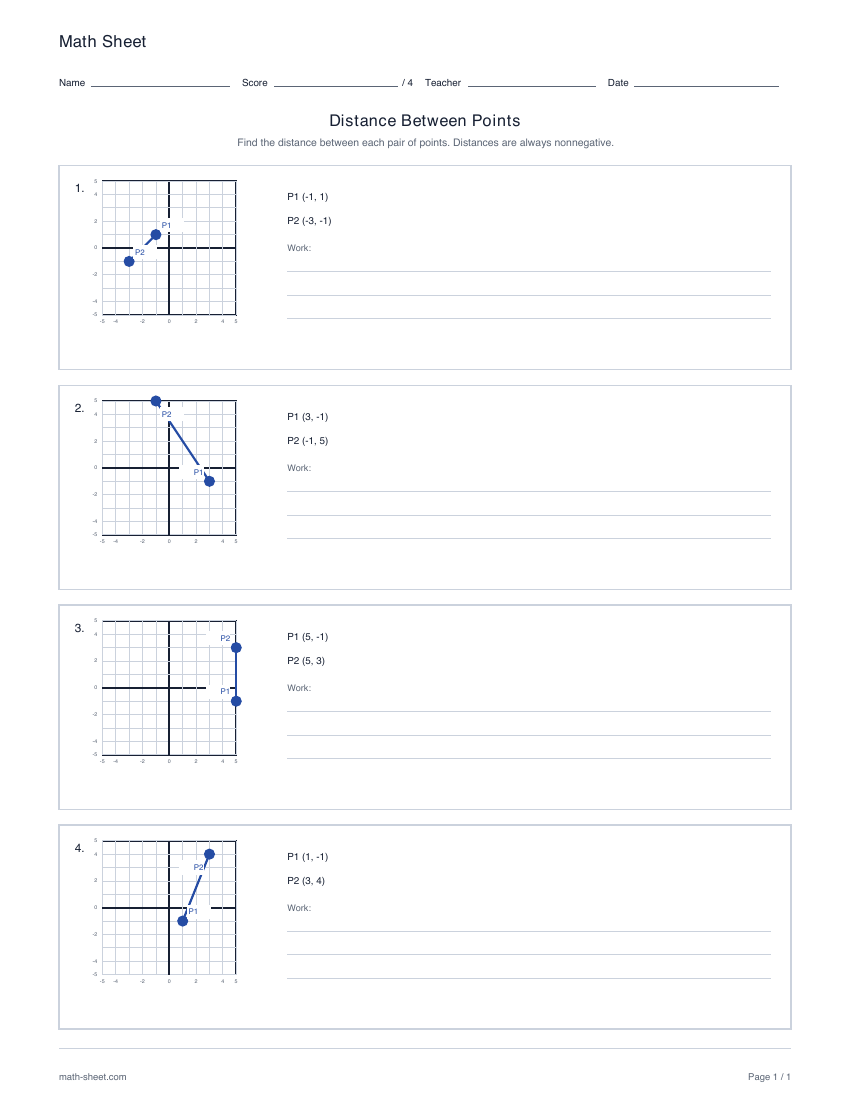
Pythagorean theorem
Find distances on four coordinate grids with whole-number, decimal-tenths, radical or mixed coordinates. Choose first-quadrant or four-quadrant points and print separate worked solutions.
Preview and download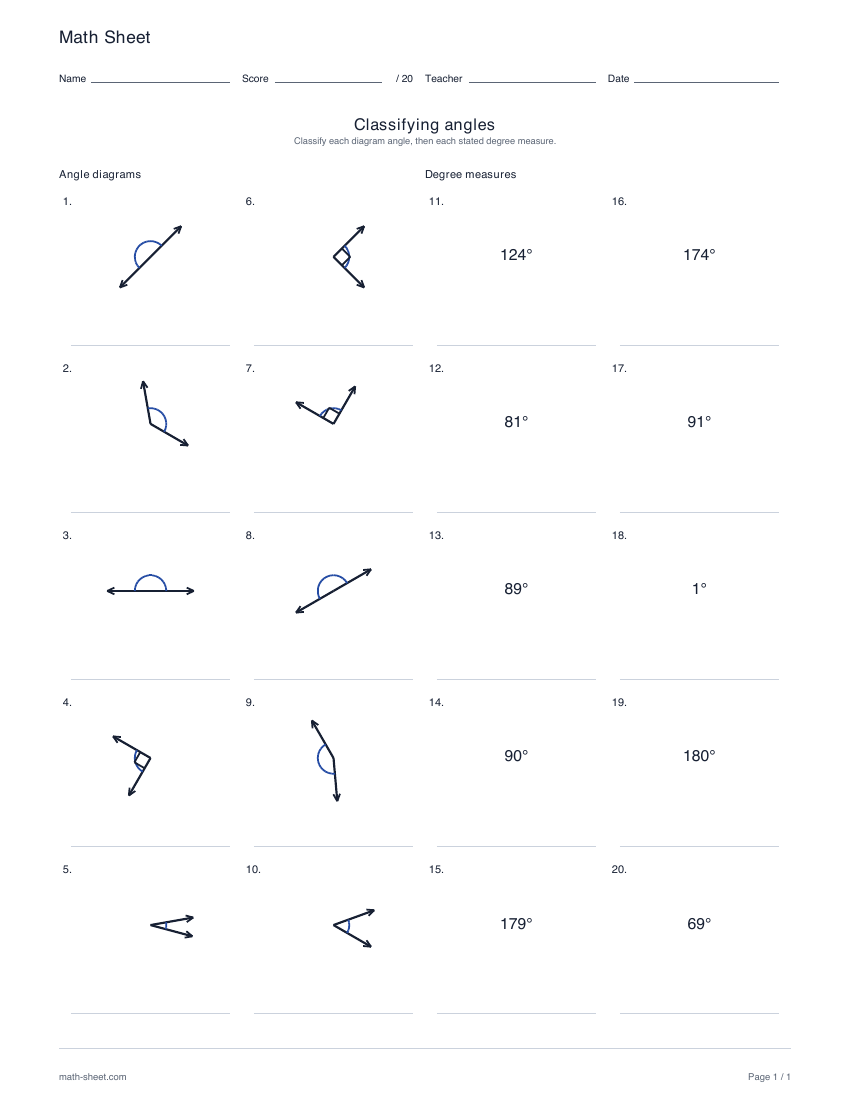
Geometry
Classify 20 angles as acute, right, obtuse or straight. Ten questions use unlabelled diagrams and ten use exact degree measures, followed by a separate answer key.
Preview and download