Right triangles. Exact relationships.

Pythagorean theorem worksheets

Find a missing side, calculate the distance between two points, or explore why the three square areas belong in one equation. Print focused practice with separate worked solutions.

Choose a worksheet
3459 + 16 = 25squared lengths
a² + b² = c², with c opposite the right angle.

See the relation. Show your work.

Solve lengths and distances

Choose a four-question practice sheet with diagrams, room to show work and a separate worked answer key.

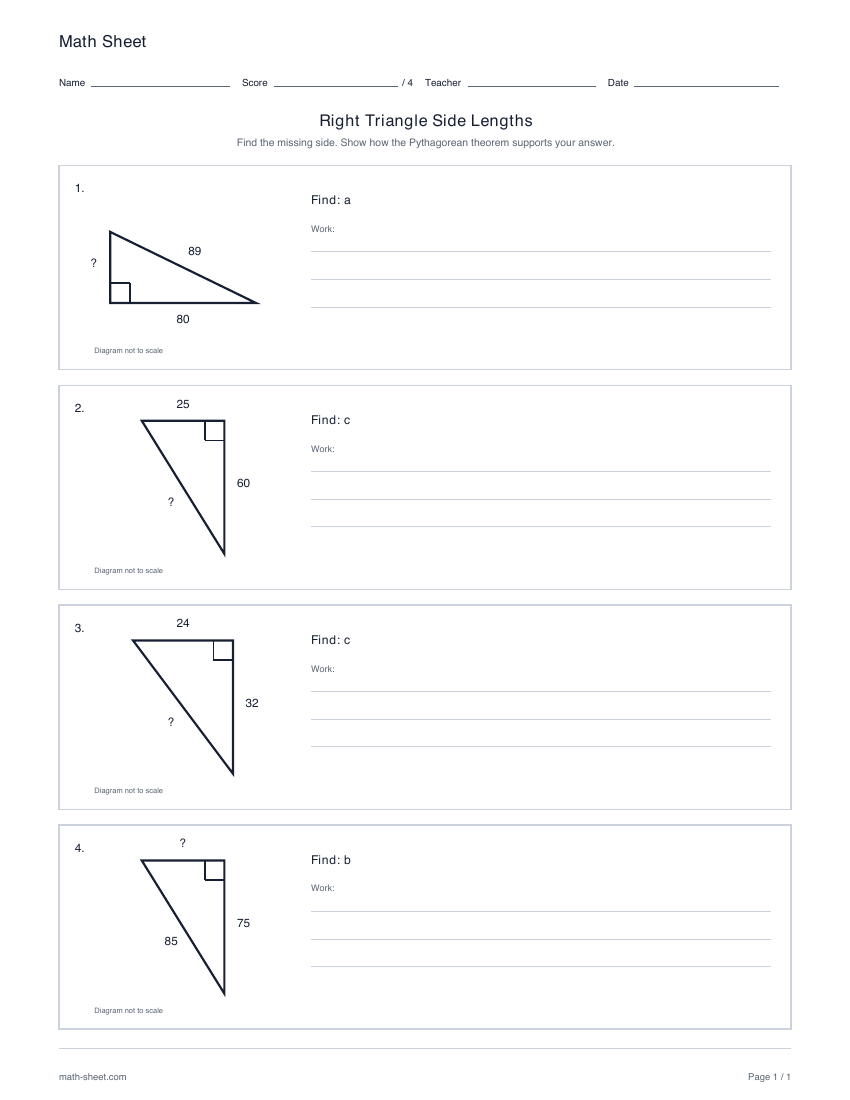
First page preview: Pythagorean theorem worksheet: missing side lengths

Pythagorean theorem

Pythagorean theorem worksheet: missing side lengths

Print a four-question Pythagorean theorem worksheet for missing hypotenuses or legs. Choose whole-number triples or irrational results from whole or decimal givens.

Preview and download
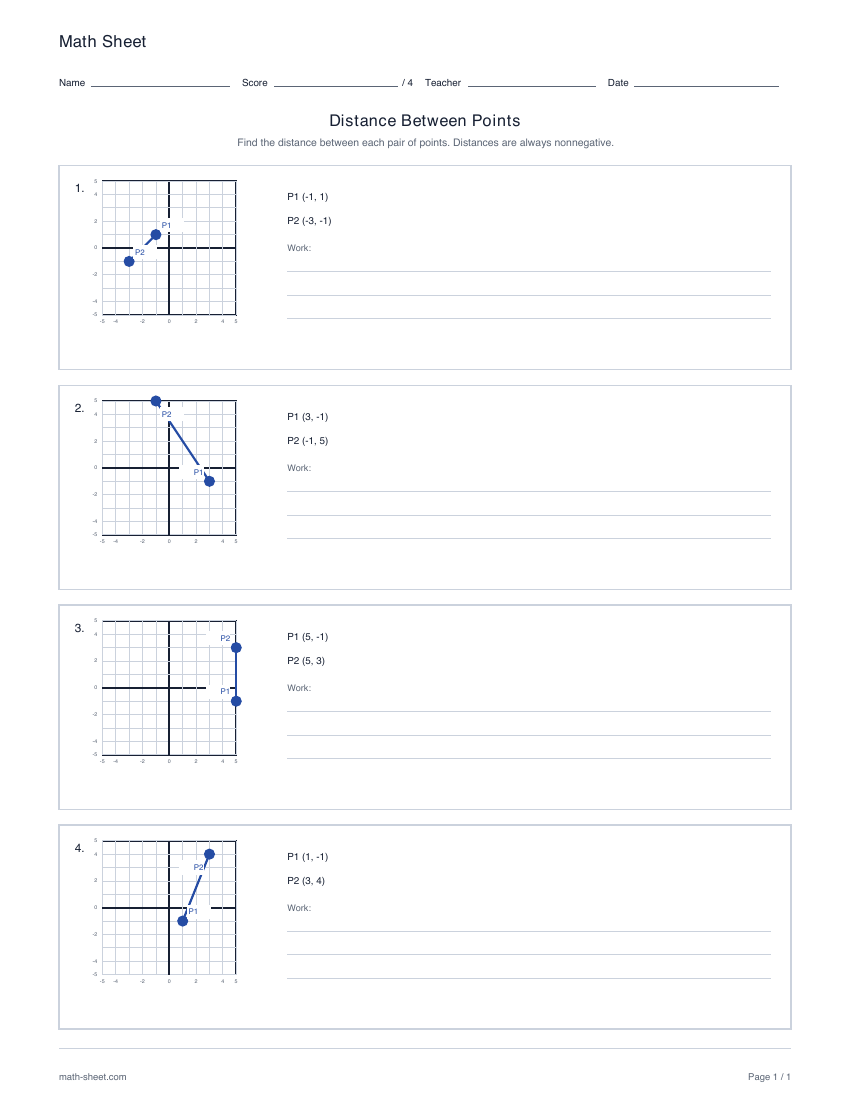
First page preview: Distance between two points worksheets

Pythagorean theorem

Distance between two points worksheets

Find distances on four coordinate grids with whole-number, decimal-tenths, radical or mixed coordinates. Choose first-quadrant or four-quadrant points and print separate worked solutions.

Preview and download

See the relation. Show your work.

Understand the theorem

Use six illustrated pages to connect the equation to square areas and follow each kind of calculation.

Find the hypotenuse before choosing an operation

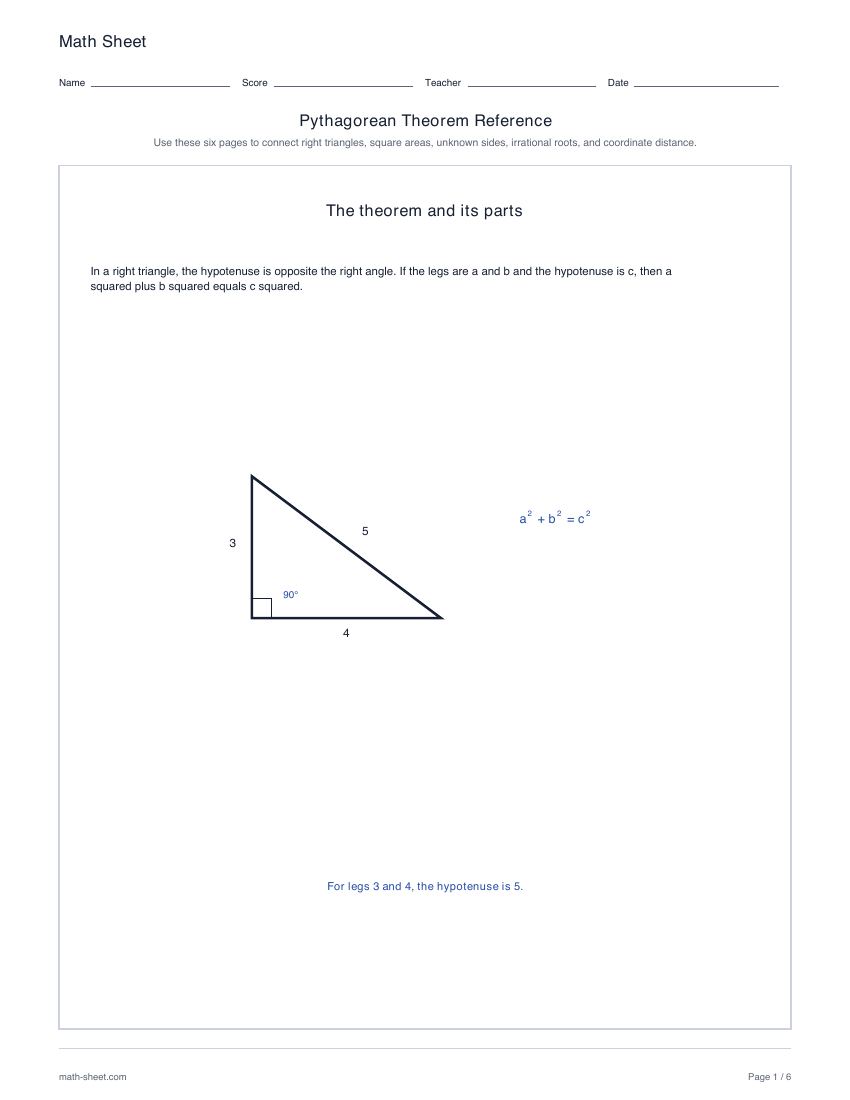
The hypotenuse is the side opposite the right angle. Its square equals the sum of the two leg squares. When the hypotenuse is missing, add the leg squares; when a leg is missing, subtract the known leg square from the hypotenuse square.

For legs 5 and 12, the sum is 25 + 144 = 169, so the hypotenuse is 13. With hypotenuse 13 and leg 5, the difference is 169 − 25 = 144, so the other leg is 12.

Progress from whole-number triples to decimal answers

Whole-number triples let learners verify each answer without a calculator. Next, keep the givens whole while introducing a noninteger square root. Finally, use given lengths with tenths to practice squaring decimals accurately.

The answer key keeps intermediate squares exact. A noninteger length is rounded only at the last step, to four decimal places, and is marked as an approximation.

The distance formula is the same relationship on a grid

Subtract the x coordinates to find horizontal change and the y coordinates to find vertical change. These changes form the two perpendicular legs; the straight line between the points is the hypotenuse.

From (−2, 1) to (1, 5), the changes are 3 and 4. Their squared sum is 25, giving a distance of 5 units. Either point can come first as long as the order stays consistent in both differences.

Choose by readiness

Begin with the prerequisite skills

These are enrichment entry points for learners ready for squares, roots and coordinate differences. Grade labels help navigation; they do not claim alignment to a country or curriculum. Many students study these skills later than Grade 6.

Connect squares and side lengths

Begin with the illustrated explanation after learners know square area and right angles.

Open this starting point →

Find a whole-number hypotenuse

An enrichment starting point for learners who can square numbers and recognize a positive square root.

Open this starting point →

Choose the missing-side equation

Mix hypotenuse and leg questions after learners can rearrange the squared-length relation.

Open this starting point →

Find distances on a first-quadrant grid

Connect coordinate differences to the two legs of a right triangle; introduce signed grids later.

Open this starting point →

Prepare for the next step

Review coordinates and perpendicular lines

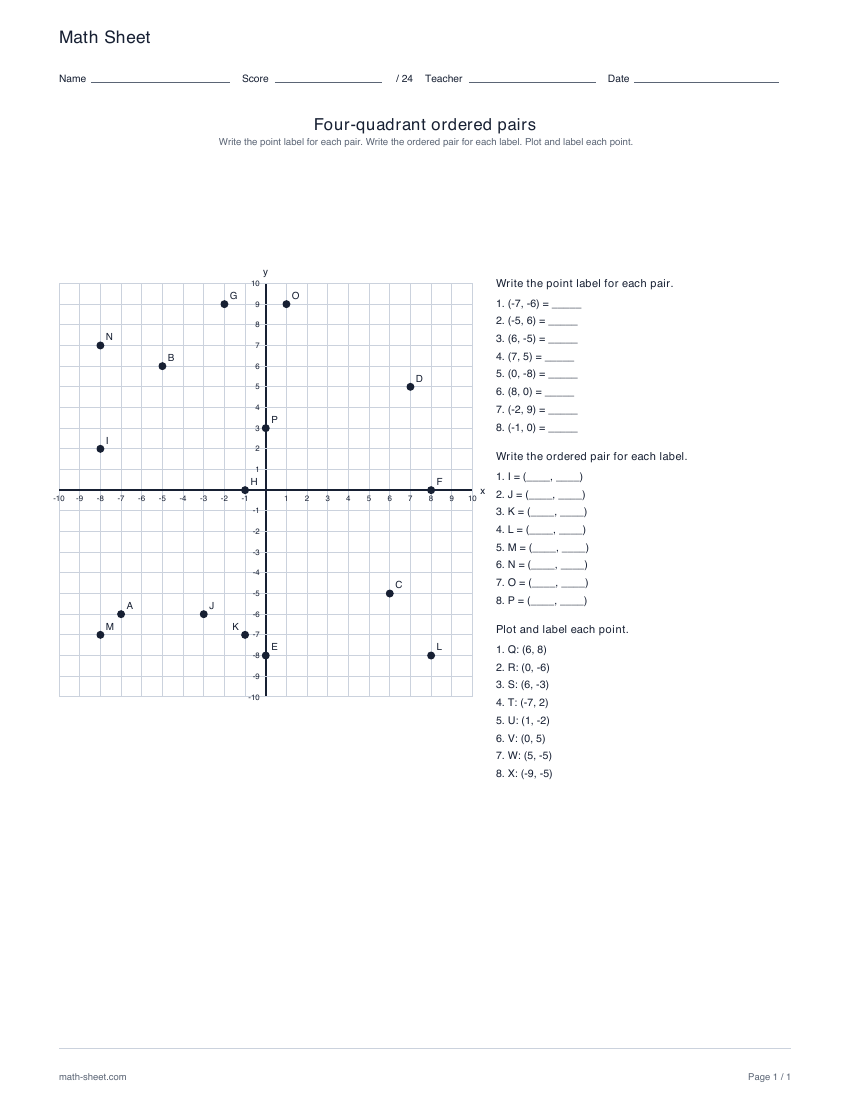
First page preview: Four-quadrant ordered pairs worksheets

Graphing

Four-quadrant ordered pairs worksheets

Practice signed coordinates with 24 reading and plotting questions. Identify labeled points, write ordered pairs and add new points across the four quadrants.

Preview and download
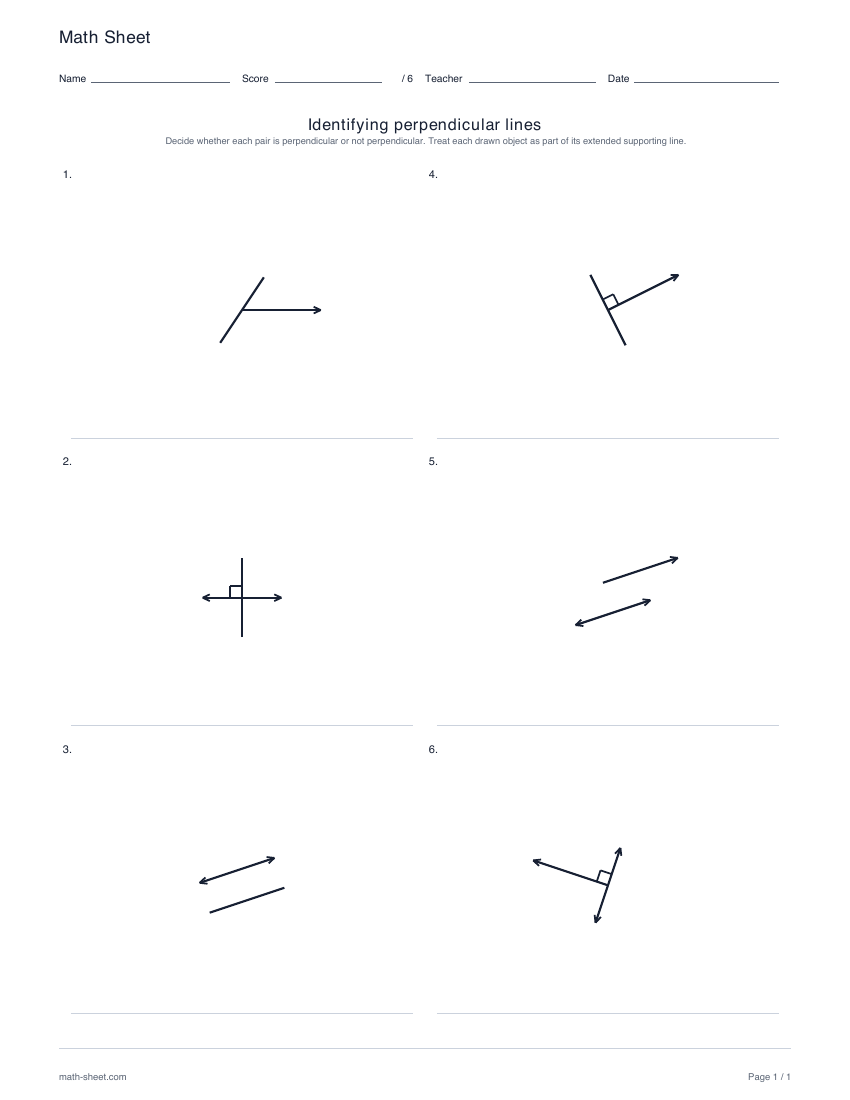
First page preview: Identifying perpendicular lines worksheets

Geometry

Identifying perpendicular lines worksheets

Decide whether six pairs of extended supporting lines are perpendicular. True examples include a right-angle mark; counterexamples include parallel and oblique pairs.

Preview and download
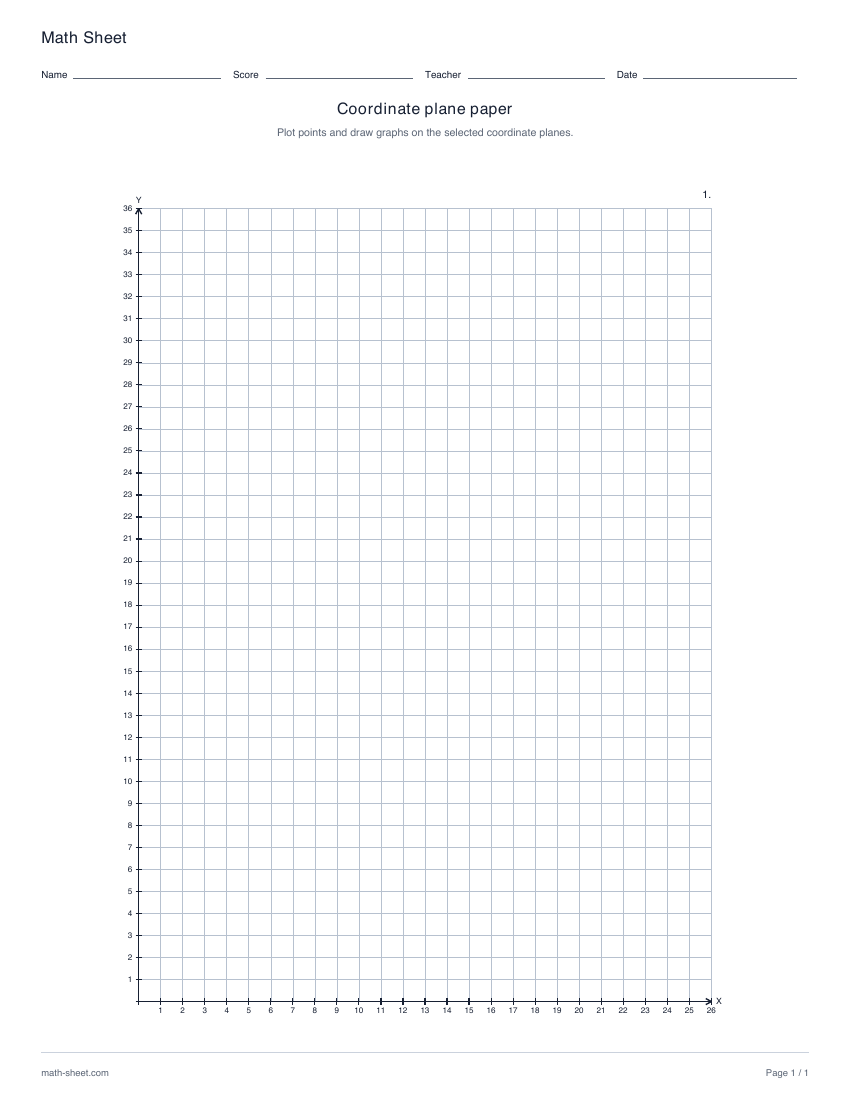
First page preview: Coordinate plane graph paper

Graph paper

Coordinate plane graph paper

Print first-quadrant or four-quadrant coordinate planes in seven layouts. Choose numbered or unnumbered axes while keeping the declared coordinate ranges.

Preview and download