
Geometry
Circle measurements worksheets
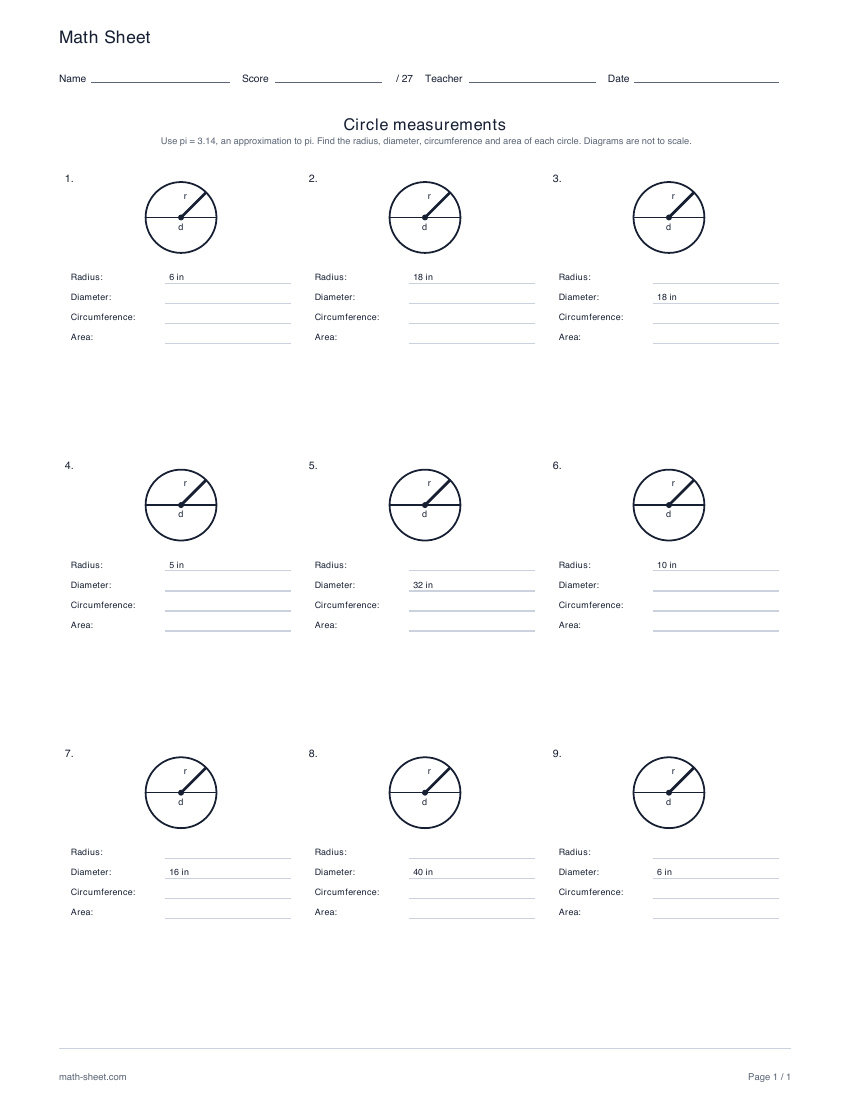
Find radius, diameter, circumference and area in nine circles from a supplied radius or diameter. Choose any of five units, use pi = 3.14, and optionally print the formulas.
Preview and downloadGeometry practice
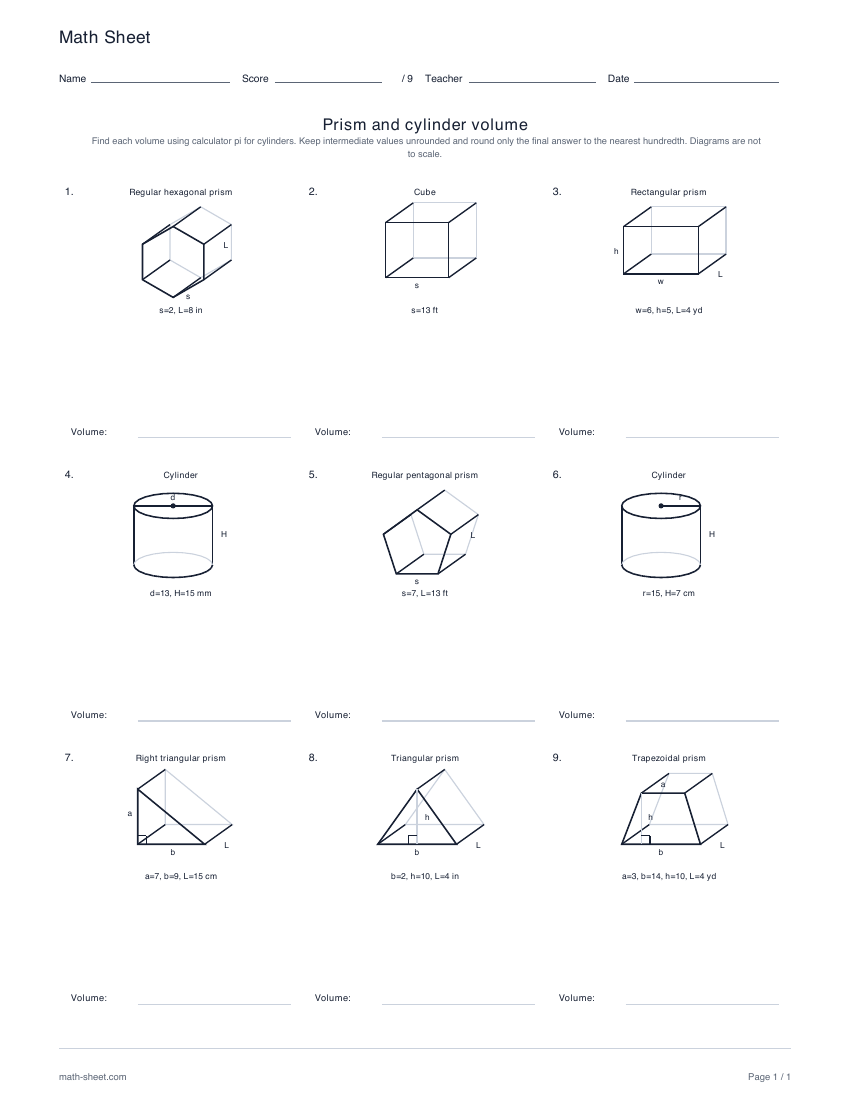
Find the volume of nine cubes, rectangular, triangular, trapezoidal, regular pentagonal or regular hexagonal prisms and cylinders, with selectable problem types and units.
Ready-made English PDF · fixed settings
Customization below makes a separate PDF.
Fixed English ready-made files. Custom settings below apply only to the configured PDF.
Ready to print
Find each volume using calculator pi for cylinders. Keep intermediate values unrounded and round only the final answer to the nearest hundredth. Diagrams are not to scale.
Download the practice pages alone, or include a separate answer key or teacher model. Longer activities may use more than one page.
Customize this worksheetEvery sheet has nine solids. Mixed practice includes all seven prism kinds plus one radius-given and one diameter-given cylinder. The legend uses L for the distance between prism bases and h for an altitude inside a triangular or trapezoidal base.
Compute each base area before multiplying by L or cylinder height H. For regular bases, use A = sqrt(25 + 10sqrt(5)) × s² / 4 for a pentagon and A = 3sqrt(3) × s² / 2 for a hexagon. Use full calculator pi for cylinders and round only the final volume to the nearest hundredth.
Learning objective
Identify a solid’s base area and multiply by the distance between parallel bases, using full calculator pi and rounding only the final volume to the nearest hundredth.
Worked example
226.19 cm³.
The radius is 3 cm. Use V = pi × 3² × 8 with the calculator value of pi, then round the final result 226.194... to 226.19 cm³.
Teaching notes
Make it yours
Choose your options, update the preview, then download the exact same pages.
A useful next step
Geometry
Find radius, diameter, circumference and area in nine circles from a supplied radius or diameter. Choose any of five units, use pi = 3.14, and optionally print the formulas.
Preview and download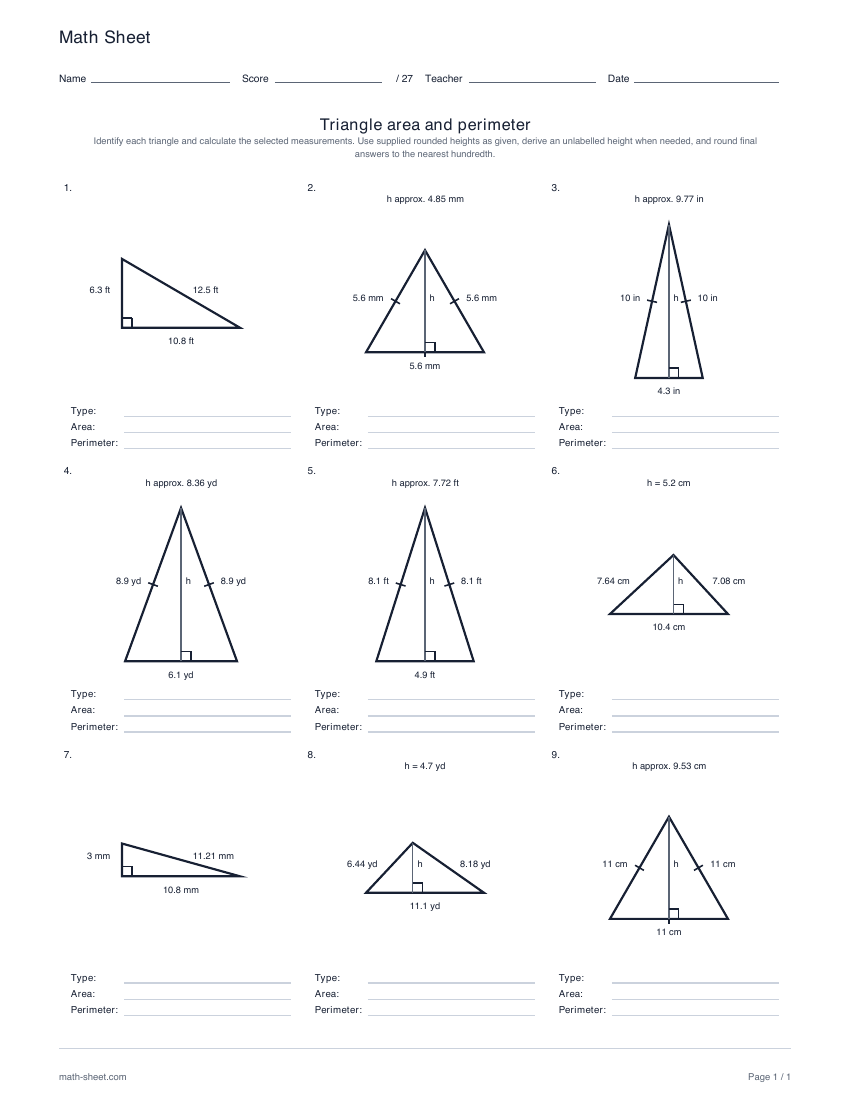
Geometry
Identify nine right, common scalene, equilateral and isosceles triangles, then calculate area, perimeter or both from visible whole-number or decimal measurements in five selectable units.
Preview and download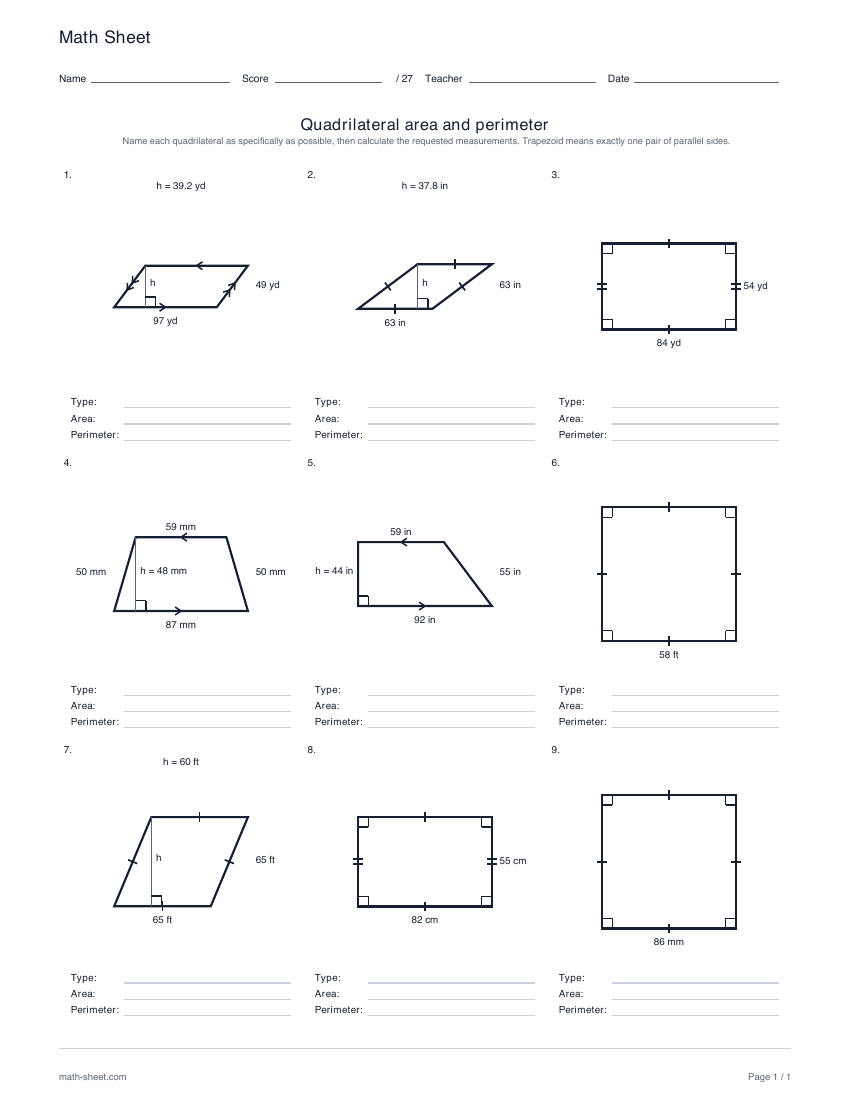
Geometry
Name nine marked squares, rectangles, parallelograms, rhombi and trapezoids, then calculate area, perimeter or both with exact whole-number or decimal dimensions in five selectable units.
Preview and download