
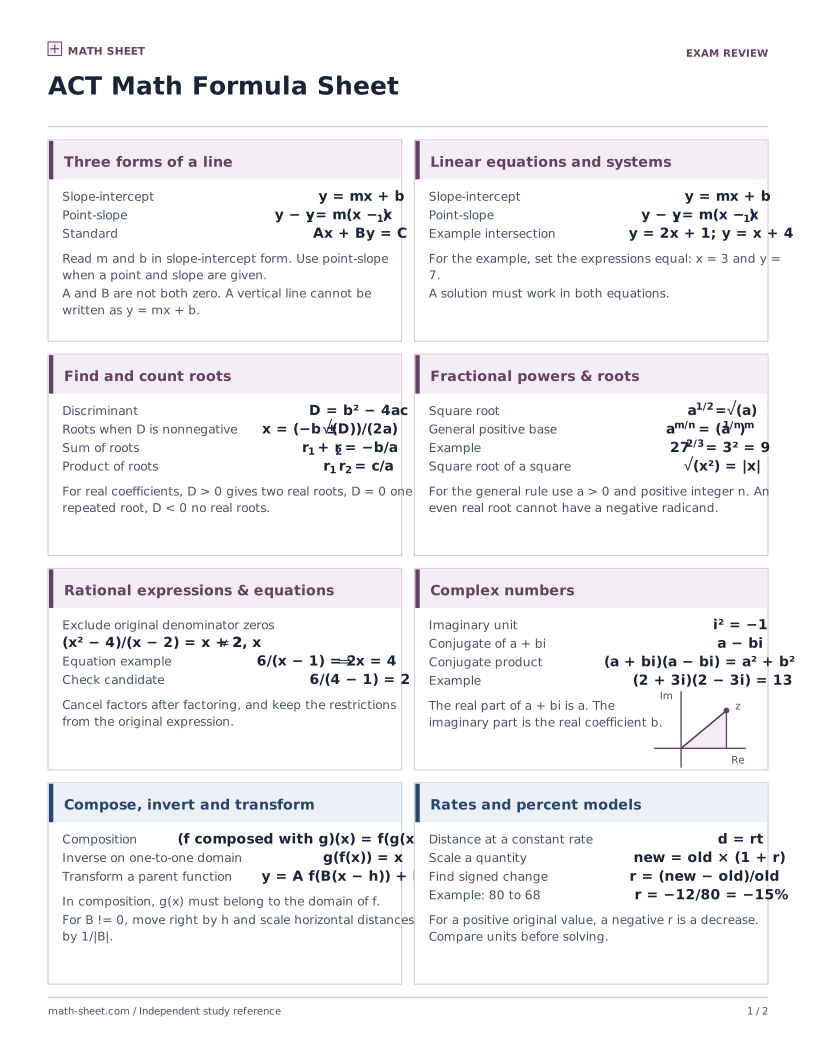
Preview page 2
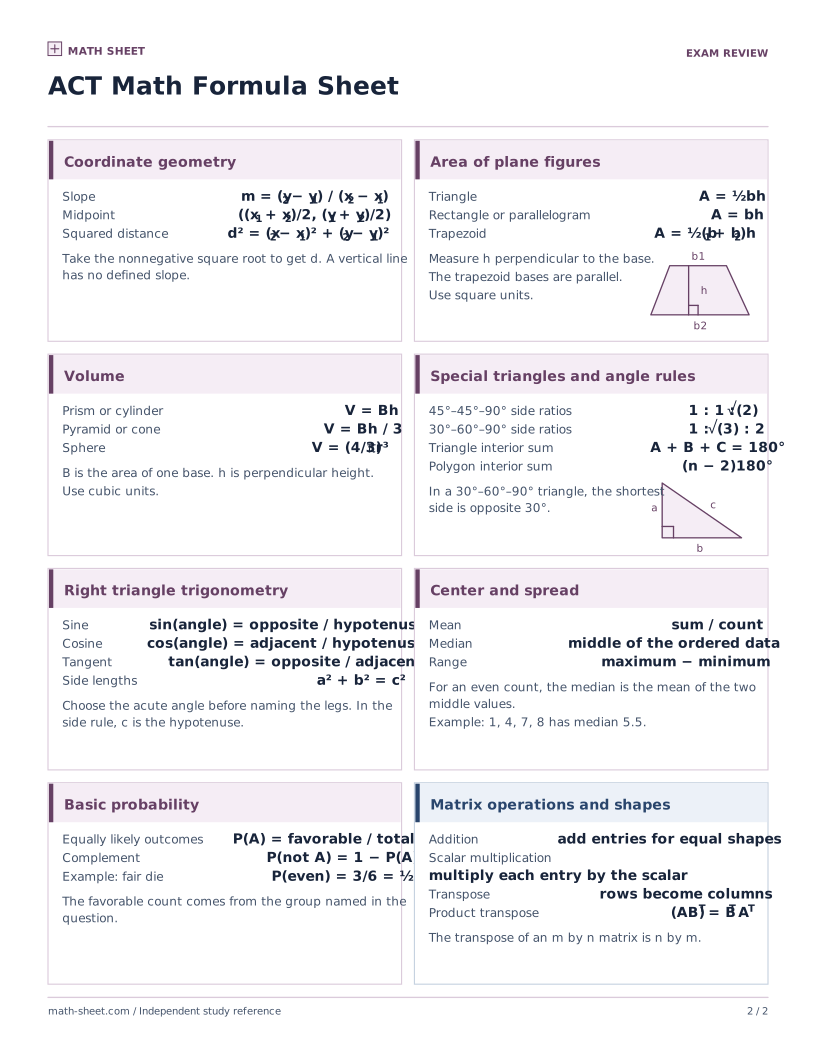
2 pages · US Letter / A4
ACT Math Formula Sheet
An independent printable ACT Math study sheet for algebra, functions, coordinate geometry, solids, trigonometry, statistics and probability.
ACT preparation
Review the formulas used across ACT math problems. Start with algebra and functions, then use the second page to review measurement, data and chance.
This is an independent Math Sheet study resource for preparation. See the exam provider’s resources below.
On this page
Open a formula for its definition and a worked example.
ACT Math Formula Sheet
What it does
An order of operations makes a multi-operation expression unambiguous. Work within grouping symbols first, then powers, multiplication and division, and addition and subtraction.
Worked example
Evaluate 18 ÷ 3 × (1 + 2)² − 4.
What it does
Percent change compares a signed difference with a nonzero starting value.
Worked example
A fare rises from $24 to $30. Find the percent change.
What it does
A percent is a rate per hundred. Convert it to a decimal or fraction before multiplying a total.
Worked example
Find 35% of 80.
What it does
The arithmetic mean is the equal share each observation would get if their total were redistributed.
Worked example
Find the mean of 6, 9, 10 and 15.
What it does
For constant speed, distance grows in proportion to elapsed time. Match the time units to the rate.
Worked example
A cyclist rides at 18 km/h for 40 minutes. How far?
What it does
A ratio compares two quantities in order. Its fraction form places the first quantity over the second, which must be nonzero.
Worked example
Write the ratio of 60 cm to 2 m in simplest form.
What it does
For a finite sample space with equally likely outcomes, probability is the fraction of outcomes meeting the event.
Worked example
What is the probability of rolling a prime on a fair six-sided die?
What it does
Integer powers with the same base combine by addition for products, subtraction for quotients and multiplication for powers of powers. The expressions must be defined.
Worked example
Simplify 2³·2⁴, 2⁴/2³ and (2³)⁴.
What it does
On a nonzero base, a negative power is a reciprocal and a zero power equals one.
Worked example
Evaluate 5−2 and 5⁰.
What it does
On a positive real base, a rational exponent uses the denominator as a root index and the numerator as a power.
Worked example
Evaluate 1252/3.
What it does
For a genuine quadratic with real coefficients, the discriminant controls the root type and the quadratic formula gives both roots.
Worked example
Solve 2x² + x − 6 = 0.
What it does
The root sum and product connect a quadratic to its coefficients, counting a repeated root twice.
Worked example
Find the root sum and product of 3x² − 7x + 2 = 0.
What it does
The difference of two squares factors into conjugate binomials. The square of a sum also includes twice the product of its two terms.
Worked example
Factor x² − 25 and expand (x + 5)².
What it does
Composition uses an inner function’s output as the input of an outer function. That output must fit the outer domain.
Worked example
For g(x) = x − 1 and f(t) = √t, find (f ∘ g)(5) and its real domain.
What it does
The imaginary unit squares to −1. Its integer powers cycle every four exponents.
Worked example
Simplify i⁷.
What it does
Slope is the change in vertical coordinate divided by the change in horizontal coordinate. It is undefined for a vertical line.
Worked example
Find the slope through (−2, 5) and (4, 2).
What it does
Point-slope form starts with any point and the slope. Slope-intercept form shows the y-coordinate where the line crosses the vertical axis.
Worked example
Write the line of slope −2 through (3, 7) in both forms.
What it does
Distance combines perpendicular changes by the Pythagorean theorem. A midpoint averages each matching coordinate.
Worked example
Find the distance and midpoint between (−1, 2) and (5, 10).
What it does
Equal slopes give parallel directions. Negative reciprocal slopes give perpendicular directions when both slopes are defined. Vertical lines pair with horizontal lines for perpendicularity.
Worked example
Compare y = 3x + 1 with y = 3x − 2 and y = −x/3 + 6.
What it does
A circle consists of all points at a fixed positive distance from its center. The constant in the center-radius equation is the radius squared.
Worked example
Find the center and radius of (x + 2)² + (y − 5)² = 49.
What it does
The Pythagorean relation uses the side opposite the right angle as the hypotenuse. Interior angles of any plane triangle sum to 180°.
Worked example
Find the hypotenuse of a right triangle with legs 5 and 12. In a separate right triangle, find the complement of 23°.
What it does
Areas with a base and height use the perpendicular height. A triangle halves the corresponding parallelogram, while a trapezoid uses the average of its parallel sides.
Worked example
Use height 4 to compare a triangle, rectangle and parallelogram of base 6 with a trapezoid of bases 6 and 10.
What it does
Circle area measures the interior in square units. Circumference measures the boundary in length units.
Worked example
Find both measurements for a circle of diameter 14 cm.
What it does
Triangulating a simple n-sided polygon gives n − 2 triangles, each contributing 180° to its interior angle sum.
Worked example
Find the interior angle sum of a nine-sided polygon.
What it does
Volume measures the space in a solid. A prism or cylinder multiplies base area by height, a cone uses one third of that cylinder volume, and a sphere uses its radius cubed.
Worked example
Compare volumes of a box 2 × 3 × 4, a cylinder and cone with radius 2 and height 3, and a sphere with radius 2.
What it does
A cube has six equal square faces. Sphere surface area is four times the area of a disk with the same radius.
Worked example
Find surface areas for a cube with side 3 and a sphere with radius 3.
What it does
A 45°–45°–90° triangle has equal legs. Its hypotenuse is √2 times either leg.
Worked example
A 45°–45°–90° triangle has hypotenuse 8√2. Find both legs.
What it does
In a 30°–60°–90° triangle, the side opposite 30° is half the hypotenuse. The side opposite 60° is √3 times that shorter leg.
Worked example
The shortest leg is 6 cm. Find the other two sides.
What it does
Sine, cosine and tangent compare sides relative to a chosen acute angle in a right triangle.
Worked example
For an acute angle with opposite leg 8, adjacent leg 15 and hypotenuse 17, find all three ratios.
What it does
The unit-circle relation and reciprocal identities convert between trig functions. Every denominator used must be nonzero.
Worked example
For an acute θ with sin θ = 5/13, find cos θ, tan θ, csc θ, sec θ and cot θ.
What it does
The law of sines connects a side with its opposite angle in a plane triangle.
Worked example
If A = 30°, B = 45° and a = 10, find b.
What it does
The law of cosines finds a third side from two sides and their included angle. A right included angle makes it the Pythagorean theorem.
Worked example
Two sides measure 5 and 8 and include a 60° angle. Find the opposite side.
Download the compact sheet for a quick review, or print the complete formula list from this page.
2 pages · US Letter / A4
An independent printable ACT Math study sheet for algebra, functions, coordinate geometry, solids, trigonometry, statistics and probability.
Math Sheet prepares original print materials. See how we check formulas and printouts.