
1 page · US Letter / A4
Trigonometry Formula Sheet
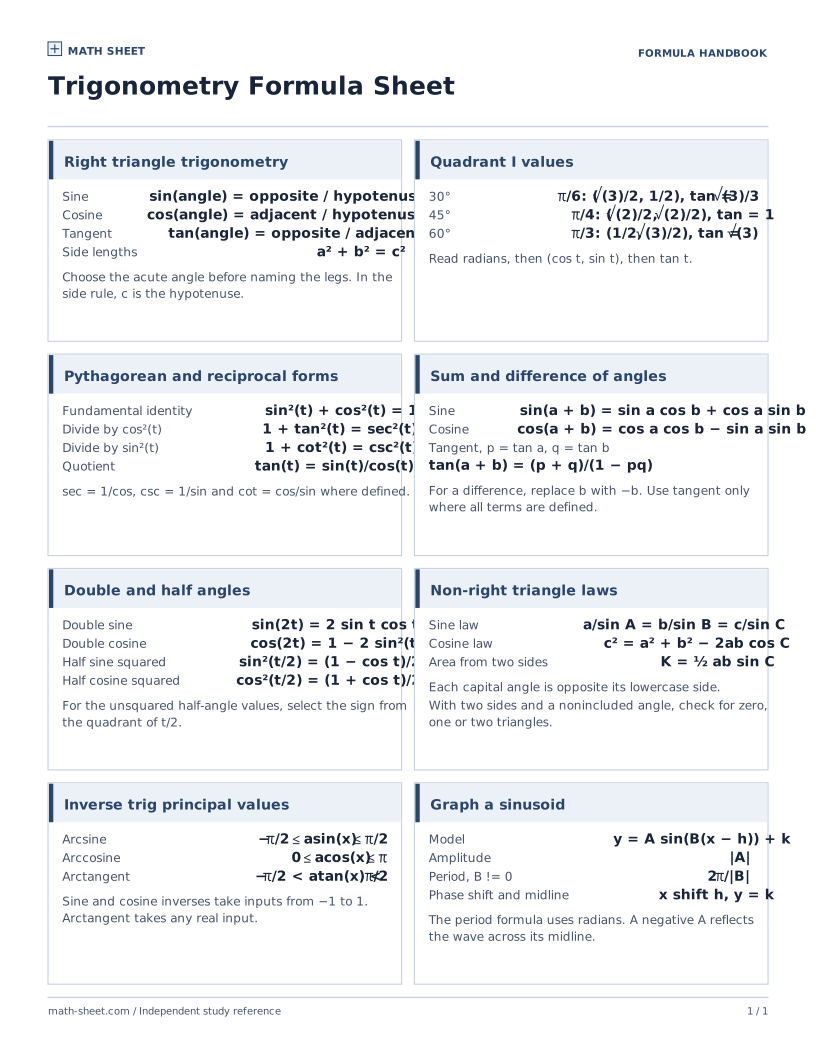
Printable trigonometry formula sheet for ratios, identities, sum and difference, half and double angles, triangle laws, inverse trig and graphing.
Geometry and precalculus
Choose the right tool for a triangle, a unit-circle angle, an identity or a graph. The sheet groups formulas by task and calls out where ratios and inverses are defined.
On this page
Open a formula for its definition and a worked example.
Trigonometry Formula Sheet
What it does
Relative to an acute angle, the opposite side faces it, the adjacent leg touches it, and the hypotenuse faces the right angle.
Worked example
Find the three main ratios if the opposite side is 7 and the adjacent leg is 24.
What it does
Cosecant and secant take reciprocals of sine and cosine. Cotangent divides cosine by sine. Each ratio requires a nonzero denominator.
Worked example
Given sin θ = 5/13 and cos θ = 12/13, find csc θ, sec θ, and cot θ.
What it does
The point (cos θ, sin θ) has distance one from the origin, so its squared coordinates add to one.
Worked example
If sin θ = 3/5 and θ lies in quadrant II, find cos θ.
What it does
Dividing sin² θ + cos² θ = 1 by cos² θ gives the tangent identity. Dividing by sin² θ gives the cotangent identity.
Worked example
Given tan θ = 2 and θ in quadrant I, find sec θ. Then use cot θ to find csc θ.
What it does
Angle-sum and angle-difference identities combine sine and cosine values at familiar angles to evaluate a less familiar angle.
Worked example
Find sin 75° and cos 15° using 45° and 30°.
What it does
The tangent addition formula comes from dividing the sine addition formula by the cosine addition formula. It requires both original tangents and the final quotient to exist.
Worked example
If tan A = 1/2 and tan B = 1/3, find tan(A + B).
What it does
Set both input angles equal in the addition formulas to get double-angle relations. The tangent relation requires a defined tangent on both sides.
Worked example
For sin θ = 3/5 and cos θ = 4/5, find sin 2θ, cos 2θ, and tan 2θ.
What it does
Half-angle formulas give a square root for each ratio. The quadrant of θ/2 determines whether the root takes a positive or negative sign.
Worked example
Given θ = 240°, find sin(θ/2) and cos(θ/2).
What it does
The law of sines uses a common ratio between each side and the sine of its opposite angle.
Worked example
In a triangle, A = 30°, B = 45°, and a = 6. Find side b.
What it does
With two sides and their included angle, the law of cosines finds the opposite side. Multiplying half the side product by the sine gives the area.
Worked example
Two sides have lengths 5 and 8, and their included angle is 60°. Find the third side and area.
What it does
The 30° unit-circle point comes from a 30°–60°–90° triangle with hypotenuse one. Its short leg is opposite 30°.
Worked example
Find the point at π/6 and the corresponding tangent.
What it does
A 45° unit-circle point comes from a right triangle with two equal legs and hypotenuse one.
Worked example
Find the point at π/4 from the equal-leg relation.
What it does
The 60° unit-circle point comes from the same special triangle as 30°. At 60°, the shorter leg is adjacent.
Worked example
Find the point at π/3 and its tangent.
Download the compact sheet for a quick review, or print the complete formula list from this page.
1 page · US Letter / A4
Printable trigonometry formula sheet for ratios, identities, sum and difference, half and double angles, triangle laws, inverse trig and graphing.
Math Sheet prepares original print materials. See how we check formulas and printouts.