
Preview page 2
2 pages · US Letter / A4
Sequences and Series Formula Sheet
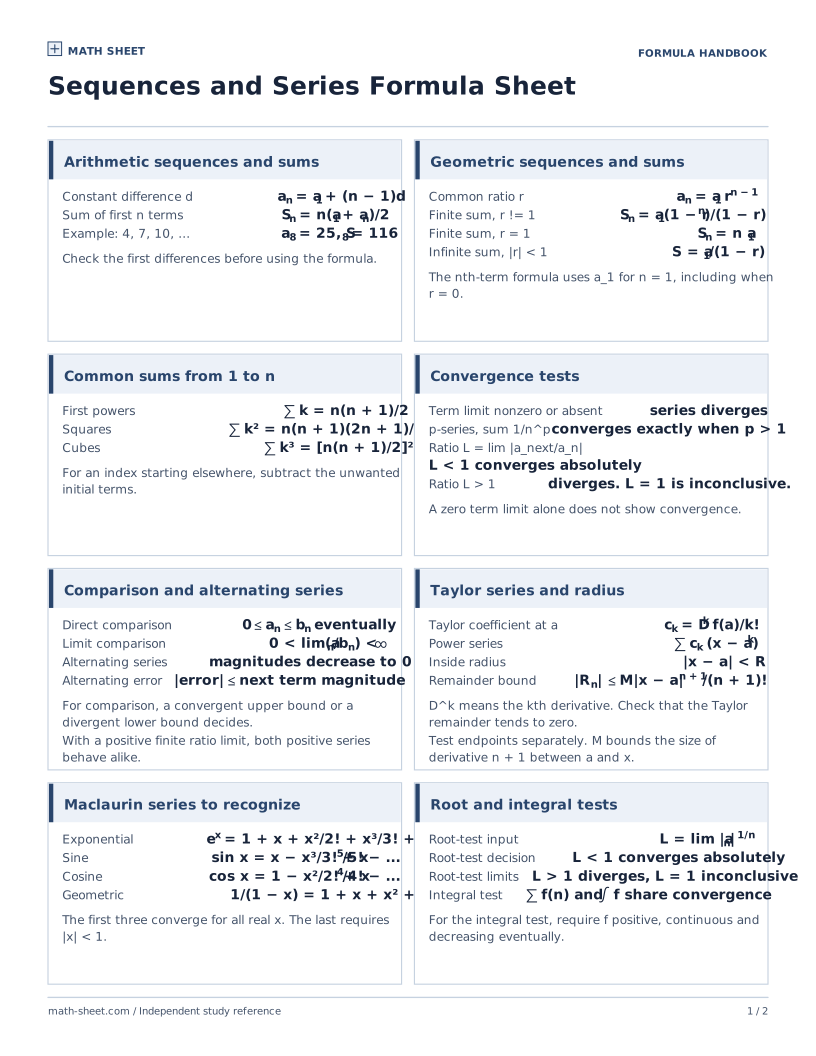
Print formulas for arithmetic and geometric sequences, common sums, convergence tests, Taylor and Maclaurin series, and error bounds.
Precalculus and Calculus II
Check the pattern first. An arithmetic sequence has constant differences. A geometric sequence has a constant multiplier. For an infinite series, use the conditions on the card to decide which test can answer the convergence question.
On this page
Open a formula for its definition and a worked example.
Sequences and Series Formula Sheet
What it does
An arithmetic sequence adds the same difference d at every step. An explicit rule counts the n − 1 steps from the first term.
Worked example
Find a₈ for the sequence 11, 7, 3, …
What it does
Pairing first with last in an arithmetic sequence gives a constant pair sum. The total is the number of terms times the average of the endpoints.
Worked example
Find the sum of the first ten terms of 3, 7, 11, …
What it does
A geometric sequence multiplies by the same ratio r at every step. Divide consecutive terms to find r when the earlier term is nonzero.
Worked example
Find a₅ for 6, −12, 24, …
What it does
A finite geometric sum follows by subtracting a scaled copy from itself. When |r| < 1 the powers of r tend to zero, giving an infinite sum.
Worked example
Add the first four terms and then all terms of 12, 6, 3, …
What it does
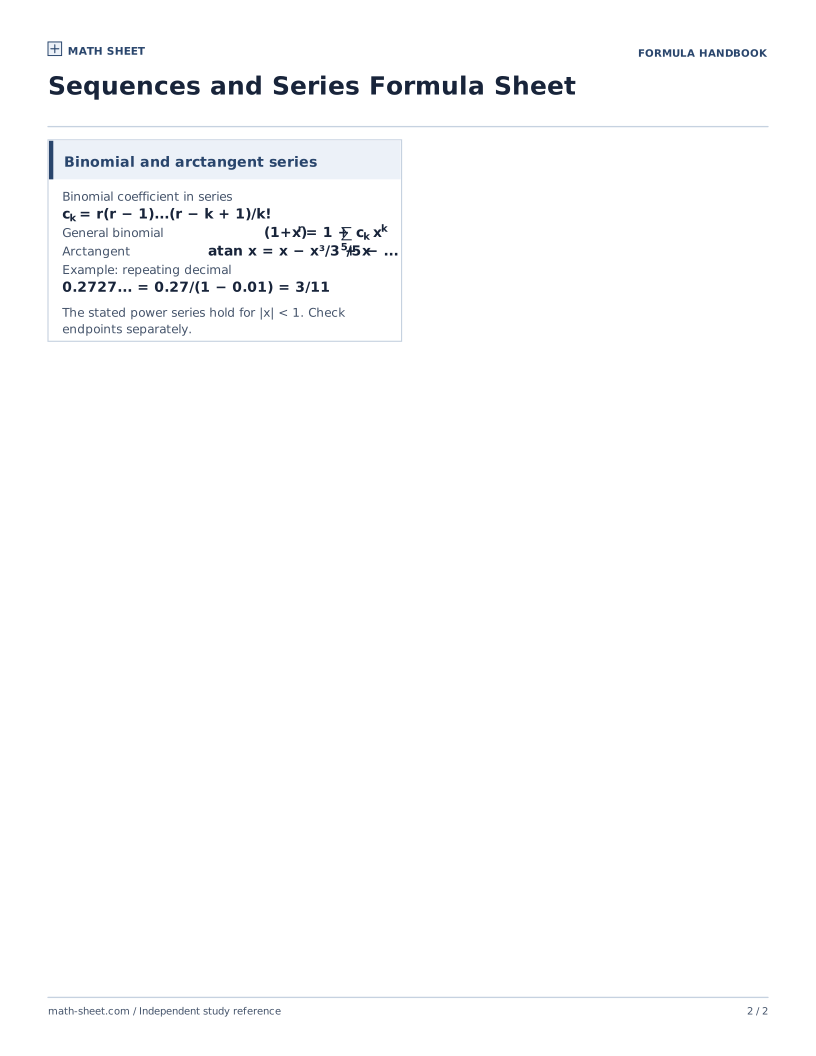
A decimal that repeats immediately gives a geometric sum with multiplier 10 raised to minus the block length.
Worked example
Write 0.454545… as a fraction.
What it does
The positive integers from 1 through n form an arithmetic sequence. Their average is (n + 1)/2.
Worked example
Add the integers from 1 through 24.
What it does
The sum-of-squares identity evaluates all squares from 1² through n² in a single expression.
Worked example
Evaluate 1² + 2² + ⋯ + 6².
What it does
The sum of the first n cubes equals the square of the sum of the first n positive integers.
Worked example
Evaluate 1³ + 2³ + ⋯ + 5³.
What it does
A constant sum adds the same value once for each index. Multiply the value by the number of terms.
Worked example
Evaluate ∑k=17 (−3).
What it does
The reciprocal 1/(1 − x) equals a geometric series with first term 1 and ratio x when |x| < 1.
Worked example
Evaluate 1 + 1/3 + 1/9 + 1/27 + ⋯
What it does
Every derivative of eˣ is eˣ, so its Maclaurin coefficients are 1/n!. This series converges for every real x.
Worked example
Approximate e1/2 using terms through degree 3.
What it does
The Maclaurin series for sine uses alternating odd powers. Cosine uses alternating even powers. The inputs are angles in radians.
Worked example
Approximate sin(0.2) through degree 3 and cos(0.2) through degree 2.
What it does
The series for ln(1 + x) can be obtained by integrating the geometric expansion of 1/(1 + x). Its real interval of convergence is −1 < x ≤ 1.
Worked example
Write the first three nonzero terms for ln(1.2).
What it does
The arctangent series integrates the geometric expansion of 1/(1 + x²). It also converges at x = ±1.
Worked example
Approximate arctan(1/2) with three nonzero terms.
What it does
A generalized binomial expansion uses falling products of k divided by n!. For nonnegative integer k it terminates, and for other real k the expansion holds for |x| < 1.
Worked example
Find the degree-two polynomial for √(1 + x) and evaluate it at x = 1/5.
What it does
Taylor coefficients come from derivatives evaluated at a. Centering at zero gives a Maclaurin series. Equality to the original function requires the remainder to tend to zero.
Worked example
Find the degree-two Taylor polynomial of f(x) = x³ centered at a = 2.
What it does
The Lagrange remainder uses the next derivative at an intermediate point. A bound on that derivative bounds the approximation error.
Worked example
Bound the error of approximating e0.1 by 1 + 0.1.
What it does
In an alternating series with decreasing magnitudes tending to zero, consecutive partial sums straddle the limit. The next omitted magnitude bounds the error.
Worked example
Bound the error when ln 2 is approximated by 1 − 1/2 + 1/3 − 1/4.
What it does
A convergent sum requires its terms to approach zero. A nonzero term limit or a missing term limit proves divergence.
Worked example
Decide whether ∑n=1∞ n/(n + 3) converges.
What it does
The ratio and root tests compare absolute term sizes against geometric decay. A limit below one proves absolute convergence, while a limit above one proves divergence.
Worked example
Test ∑n=1∞ 3ⁿ/n! and ∑n=1∞ (n/(2n+1))ⁿ.
What it does
For a positive continuous decreasing function, the corresponding sum and improper integral share convergence behavior. Applying this to x−p gives the p-series cutoff at p = 1.
Worked example
Decide whether ∑n=1∞ n−3/2 converges.
What it does
An alternating series converges when its unsigned terms decrease to zero. It can still fail to converge absolutely.
Worked example
Classify ∑n=1∞ (−1)n−1/√n.
Download the compact sheet for a quick review, or print the complete formula list from this page.
2 pages · US Letter / A4
Print formulas for arithmetic and geometric sequences, common sums, convergence tests, Taylor and Maclaurin series, and error bounds.
Math Sheet prepares original print materials. See how we check formulas and printouts.