Precalculus

Precalculus Formula Sheet

Look up a rule by the kind of function in front of you. Use the first page to review function families, conics and limits, then turn to trig and sequences.

On this page

Find a formula

Open a formula for its definition and a worked example.

Compose, undo and transform functions

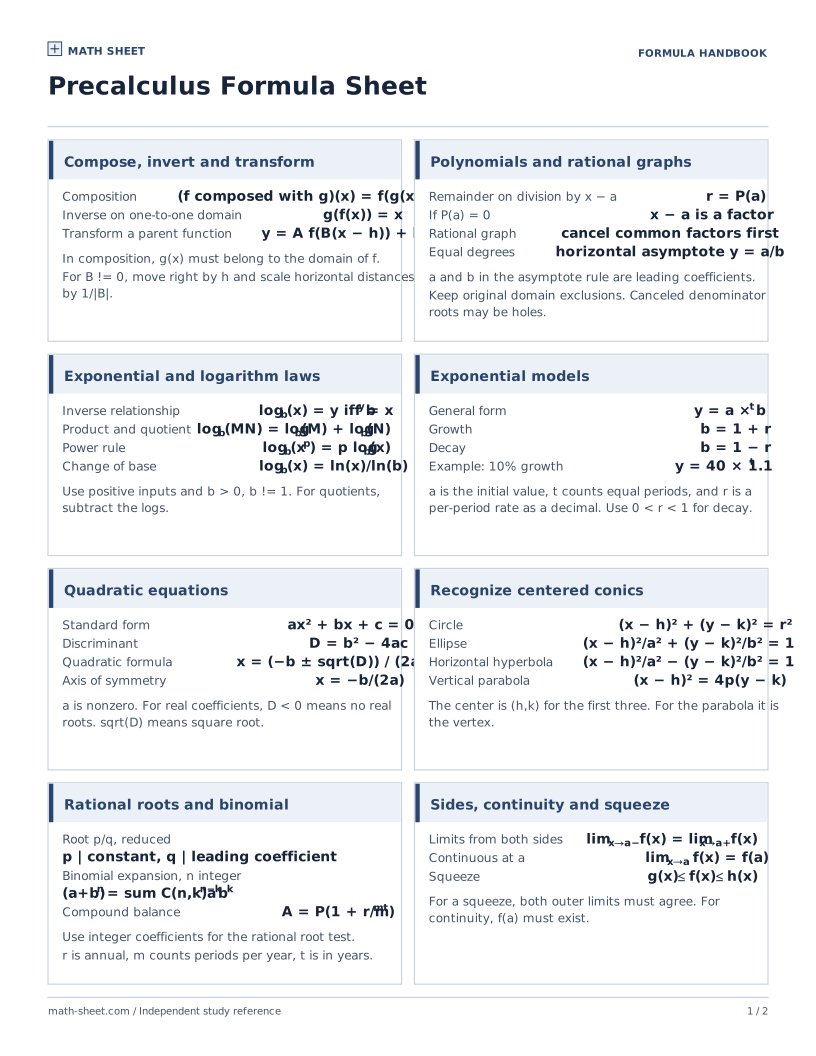
  • Apply the inner function first(f ∘ g)(x) = f(g(x))g(x) must belong to the domain of f.

    What it does

    Composition sends an input through the inner function before using its output as input to the outer function.

    Worked example

    Let f(x) = x² and g(x) = x + 3. Find (f ∘ g)(2) and (g ∘ f)(2).

    1. First compute g(2) = 5, then f(5) = 25.
    2. In the other order, f(2) = 4 and g(4) = 7.
    Link to this example
  • Undo a one-to-one functionf−1(f(x)) = xUse a domain where f is one-to-one. Its range becomes the domain of the inverse.

    What it does

    A one-to-one function pairs each output with a unique input, which allows the inverse to recover the input.

    Worked example

    Find the inverse of f(x) = 3x − 5 and check it at f(4).

    1. From y = 3x − 5, solve x = (y + 5)/3.
    2. Since f(4) = 7, applying the inverse gives (7 + 5)/3 = 4.
    Link to this example
  • Move the graphy = f(x − h) + kFor h > 0 move right by h. For k > 0 move up by k. A negative shift goes the other way.

    What it does

    Subtracting h inside the input shifts a graph right by h. Adding k to the output shifts it up by k.

    Worked example

    Where does the vertex of y = x² move in y = (x − 4)² − 2?

    1. The squared term is zero at x = 4, a rightward shift of 4.
    2. At x = 4 the output is −2, so the new vertex is (4,−2).
    Link to this example
  • Scale the outputsy = af(x)The vertical stretch factor is |a| if |a| > 1. Values 0 < |a| < 1 compress, and a < 0 also reflects.

    What it does

    Multiplying outputs by a scales their vertical distances from the x-axis by |a|. A negative a also reflects the graph.

    Worked example

    Where does (2,5) on y = f(x) go on y = −3f(x)?

    1. The x-coordinate stays 2, and the output’s magnitude triples.
    2. The negative sign gives the reflected point (2,−15).
    Link to this example
  • Reflect across an axisAcross the x-axis: y = −f(x). Across the y-axis: y = f(−x).

    What it does

    Reflection over the x-axis changes the output sign. Reflection over the y-axis changes the input sign.

    Worked example

    Track (2,5) on y = f(x) under each reflection.

    1. For y = −f(x), its image is (2,−5).
    2. For y = f(−x), its image is (−2,5) because −(−2) = 2.
    Link to this example

Read polynomial and rational graphs

  • Roots and turning point of ax² + bx + cΔ = b² − 4ac, x = (−b ± √Δ)/(2a), vertex x = −b/(2a)a ≠ 0. Substitute the vertex x-value to get its height. Real roots require Δ ≥ 0.

    What it does

    The discriminant gives the real-root count and enters the quadratic formula. The axis of symmetry passes through the vertex.

    Worked example

    Find the roots and vertex of y = x² − 6x + 5.

    1. Δ = 36 − 20 = 16, so the roots are (6 ± 4)/2, namely 1 and 5.
    2. The vertex is at x = 6/2 = 3, where y = −4.
    Link to this example
  • List possible rational zerosA reduced rational zero p/q has p dividing the constant term and q dividing the leading coefficient.For integer coefficients. If the constant term is zero, factor out x first. Check candidates by substitution.

    What it does

    For a polynomial with integer coefficients, a rational root in lowest terms uses a numerator dividing the constant term and a denominator dividing the leading coefficient.

    Worked example

    Find the possible rational zeros of 2x² + x − 3 and test x = 1.

    1. The candidates are ±1, ±3, ±1/2 and ±3/2.
    2. At x = 1 the polynomial equals 2 + 1 − 3 = 0, so 1 is a root.
    Link to this example
  • Vertical asymptote or a hole?Cancel common factors in P(x)/Q(x). A remaining real denominator zero gives a vertical asymptote.An excluded x-value with no remaining denominator zero gives a hole instead.

    What it does

    A remaining denominator zero after cancellation gives a vertical asymptote. An original excluded value where the reduced expression is finite gives a hole.

    Worked example

    Locate the hole and vertical asymptote of (x² − 1)/[(x − 1)(x − 3)].

    1. Cancel x − 1 to get (x + 1)/(x − 3) for x ≠ 1,3.
    2. At x = 1 the reduced value is −1, giving a hole at (1,−1). At x = 3 the remaining denominator is zero, giving an asymptote.
    Link to this example
  • Equal numerator and denominator degreesHorizontal asymptote: y = (leading numerator coefficient)/(leading denominator coefficient)

    What it does

    A rational function with equal numerator and denominator degrees tends to the ratio of leading coefficients as x moves far in either direction.

    Worked example

    Find the horizontal asymptote of (5x² − 2)/(2x² + 7x).

    1. Divide both numerator and denominator by x².
    2. All lower-degree terms vanish at infinity, leaving the asymptote y = 5/2.
    Link to this example
See Factoring Rules Cheat Sheet

Trig functions and triangles

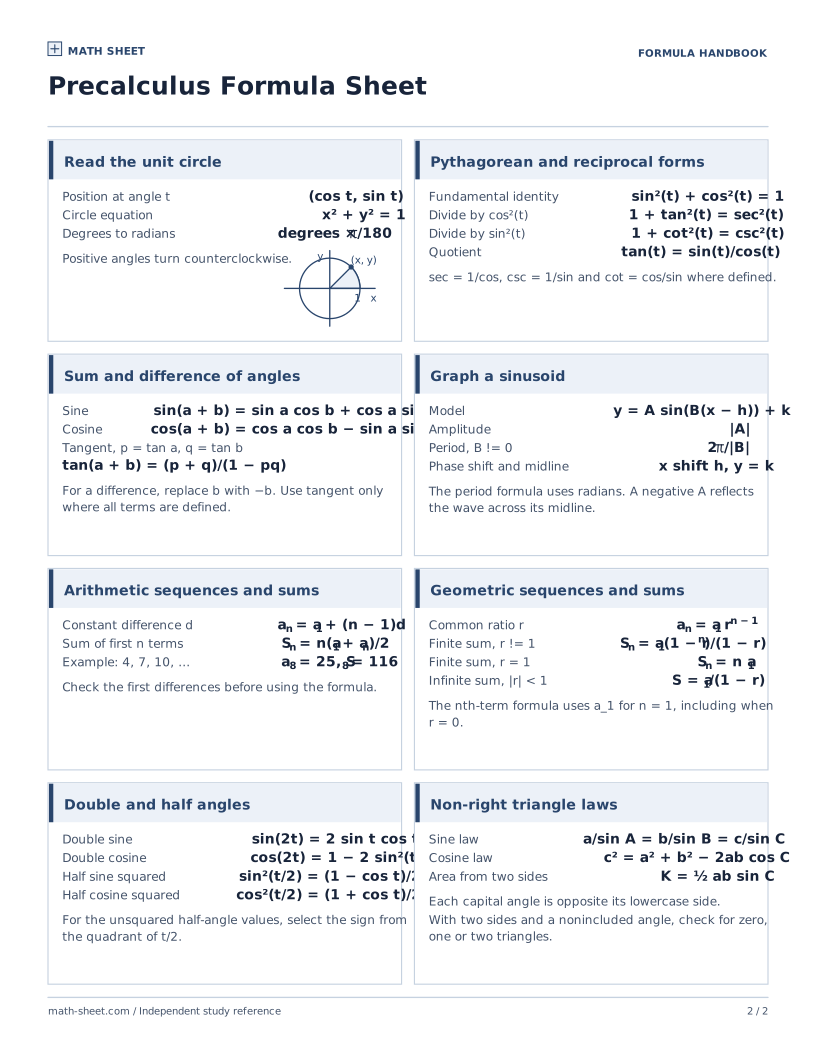
  • Unit-circle identitysin² x + cos² x = 1

    What it does

    Cosine and sine are the coordinates of a point on the unit circle, so their squares add to 1.

    Worked example

    If sin x = 3/5 and x is in quadrant II, find cos x.

    1. cos² x = 1 − 9/25 = 16/25.
    2. Cosine is negative in quadrant II, so cos x = −4/5.
    Link to this example
  • Reciprocal functionscsc x = 1/sin x, sec x = 1/cos x, cot x = cos x/sin x = 1/tan xUse the last equality where both cot and tan are defined and tan x ≠ 0.

    What it does

    Cosecant and secant invert sine and cosine, and cotangent is cosine divided by sine. Reciprocal formulas need nonzero denominators.

    Worked example

    If sin x = 3/5 and cos x = 4/5, find csc x, sec x and cot x.

    1. Invert sine and cosine to get 5/3 and 5/4 respectively.
    2. Divide cosine by sine to get cot x = 4/3.
    Link to this example
  • Double an anglesin(2x) = 2 sin x cos x, cos(2x) = cos² x − sin² x

    What it does

    Double-angle formulas compute sine and cosine of twice an angle from the original sine and cosine.

    Worked example

    If sin x = 3/5 and cos x = 4/5, find sin(2x) and cos(2x).

    1. sin(2x) = 2(3/5)(4/5) = 24/25.
    2. cos(2x) = 16/25 − 9/25 = 7/25.
    Link to this example
  • Sine of a sumsin(A + B) = sin A cos B + cos A sin B

    What it does

    The sine sum identity rewrites the sine of two added angles as a sum of sine-cosine products.

    Worked example

    Find sin 75° exactly using 45° and 30°.

    1. Use (√2/2)(√3/2) + (√2/2)(1/2).
    2. The value simplifies to (√6 + √2)/4.
    Link to this example
  • Solve an oblique trianglea/sin A = b/sin B = c/sin C, c² = a² + b² − 2ab cos CUse capital letters for the angles opposite the corresponding lowercase sides.

    What it does

    The sine rule connects opposite side-angle pairs. The cosine rule connects a side to the two edges enclosing its opposite angle.

    Worked example

    Use the sine rule with a = 2, A = 30°, B = 45°. Then find c in a different triangle with a = 4, b = 6 and C = 60°.

    1. The first triangle gives b = 2 sin 45°/sin 30° = 2√2.
    2. In the second, c² = 16 + 36 − 48 cos 60° = 28, so c = 2√7.
    Link to this example
See Unit Circle Chart

Exponential and log models

  • Identify a logarithm as an exponentax = y ⇔ loga y = xRequire a > 0, a ≠ 1 and y > 0.

    What it does

    A real logarithm reverses exponentiation when its base is positive and different from 1 and its argument is positive.

    Worked example

    Solve 5x = 125 by using a logarithm.

    1. Rewrite as x = log5 125.
    2. Since 125 = 5³, the answer is x = 3.
    Link to this example
  • Separate products, ratios and powersloga(MN) = loga M + loga N, loga(M/N) = loga M − loga N, loga(Mp) = p loga MUse positive arguments M and N.

    What it does

    Logs turn products into sums, quotients into differences and exponents into multipliers for positive arguments.

    Worked example

    Expand log2(8² × 4/16) and evaluate.

    1. Write 2 log2 8 + log2 4 − log2 16.
    2. The result is 2(3) + 2 − 4 = 4.
    Link to this example
  • Calculate using natural logsloga x = ln x/ln aUse x > 0 and a > 0, a ≠ 1.

    What it does

    A logarithm in any valid base can be found using natural logs of the argument and original base.

    Worked example

    Calculate log9 27 using natural logs.

    1. Write ln 27/ln 9.
    2. Since 27 = 3³ and 9 = 3², the ratio is 3 ln 3/(2 ln 3) = 3/2.
    Link to this example
  • Continuous growth and growth per compounding periody = y₀ekt, A = P(1 + r/n)ntk > 0 gives growth and k < 0 gives decay when y₀ > 0. For periodic interest, n counts compounds per year and t is years.

    What it does

    Continuous models use an exponential rate k. Scheduled compounding uses a rate per compounding period raised to the total period count.

    Worked example

    Compare $200 growing at 10% for one year continuously and with annual compounding.

    1. Continuous growth gives 200e0.10 ≈ $221.03.
    2. With one annual period, 200(1 + 0.10) = $220.
    Link to this example
See Logarithm Rules Cheat Sheet

Terms and sums

  • Constant difference dan = a₁ + (n − 1)d, Sn = n(a₁ + an)/2

    What it does

    An arithmetic sequence adds a constant difference each step. Its finite sum equals its term count times the average of the first and last terms.

    Worked example

    For first term 3 and difference 4, find the fifth term and sum of the first five.

    1. The fifth term is 3 + (5 − 1)4 = 19.
    2. The sum is 5(3 + 19)/2 = 55.
    Link to this example
  • Constant ratio ran = a₁rn−1, Sn = a₁(1 − rn)/(1 − r) when r ≠ 1, S∞ = a₁/(1 − r) when |r| < 1.When r = 1 the finite sum is na₁. The infinite-sum formula assumes the geometric series converges.

    What it does

    A geometric sequence multiplies by the same ratio at each step. Its infinite sum converges when the absolute ratio is less than 1.

    Worked example

    For first term 8 and ratio 1/2, find the fourth term, first four-term sum and infinite sum.

    1. The terms are 8, 4, 2, 1, so the fourth term is 1 and the finite sum is 15.
    2. The infinite sum is 8/(1 − 1/2) = 16.
    Link to this example
  • Expand a binomial power(a + b)n = Σk=0n C(n,k) an−kbkUse a nonnegative integer n.

    What it does

    The binomial theorem expands a nonnegative integer power by counting how many times each choice of factors occurs.

    Worked example

    Expand (x + 2)³.

    1. The coefficients for k = 0 through 3 are 1, 3, 3, 1.
    2. The expansion is x³ + 6x² + 12x + 8.
    Link to this example
See Sequences and Series Formula Sheet

Recognize a shifted conic

  • Circle with center (h, k)(x − h)² + (y − k)² = r²r > 0.

    What it does

    A circle is the set of points a fixed positive distance r from its center.

    Worked example

    Find the center and radius of (x − 3)² + (y + 2)² = 25.

    1. The differences are x − 3 and y − (−2), giving center (3,−2).
    2. The positive radius is √25 = 5.
    Link to this example
  • Ellipse with horizontal and vertical semiaxes(x − h)²/a² + (y − k)²/b² = 1a and b are both positive. The larger one gives the direction of the major axis.

    What it does

    An axis-aligned ellipse uses squared horizontal and vertical semiaxes as denominators. The larger semiaxis sets the major-axis direction.

    Worked example

    Read the center, semiaxes and major-axis direction of (x + 1)²/9 + (y − 2)²/25 = 1.

    1. The center is (−1,2). The horizontal semiaxis is 3 and the vertical one is 5.
    2. The major axis is vertical.
    Link to this example
  • Vertical parabola with vertex (h, k)y − k = a(x − h)²It opens up for a > 0 and down for a < 0.

    What it does

    A vertical parabola’s vertex is (h,k). The sign of a gives the direction and its magnitude controls width.

    Worked example

    Read the vertex and opening of y + 1 = −2(x − 3)².

    1. The squared term vanishes at x = 3, where y = −1.
    2. The vertex is (3,−1) and the negative coefficient makes it open down.
    Link to this example
  • Hyperbola opening left and right(x − h)²/a² − (y − k)²/b² = 1a and b are positive.

    What it does

    For a horizontal hyperbola in standard form, the x-term is positive and the vertices sit a units left and right of the center.

    Worked example

    Find the center and vertices of (x − 1)²/16 − (y + 2)²/9 = 1.

    1. The center is (1,−2) and a = 4.
    2. Set y = −2 and take x = 1 ± 4, giving vertices (−3,−2) and (5,−2).
    Link to this example
See Conic Sections Formula Sheet

Preview limits and continuity

  • Separate an approach value from the point valuelimx→a f(x) = L, f is continuous at a if L = f(a).For a finite limit, f(x) gets arbitrarily close to L as x approaches a through nearby domain points other than a.

    What it does

    A limit describes nearby outputs. Continuity requires the nearby limit to equal the actual function value at the point.

    Worked example

    Let f(x) = 2x + 1 except that f(2) = 8. Is it continuous at 2?

    1. Nearby values follow 2x + 1 and tend to 5.
    2. The function value is 8, so it is discontinuous at 2.
    Link to this example
  • Sine close to zerolimx→0 sin(x)/x = 1Use radians.

    What it does

    In radians, sin x behaves like x near zero, so their ratio tends to 1.

    Worked example

    Evaluate limx→0 sin(5x)/x.

    1. Rewrite as 5[sin(5x)/(5x)].
    2. The bracket tends to 1 and the limit is 5.
    Link to this example
  • A defining limit for elimn→∞ (1 + 1/n)n = e

    What it does

    The defining limit of e describes compound growth with a rate of 1 split into increasingly many periods.

    Worked example

    Find limn→∞ (1 + 1/n)3n.

    1. Regroup as [(1 + 1/n)n]³.
    2. The inner limit is e, so the answer is e³.
    Link to this example
See Limits Cheat Sheet

Preview the printable

Download the compact sheet for a quick review, or print the complete formula list from this page.

Practice these skills

Related references

Sources and review

Math Sheet prepares original print materials. See how we check formulas and printouts.

Browse all formula sheets →