Calculus I

Limits Cheat Sheet

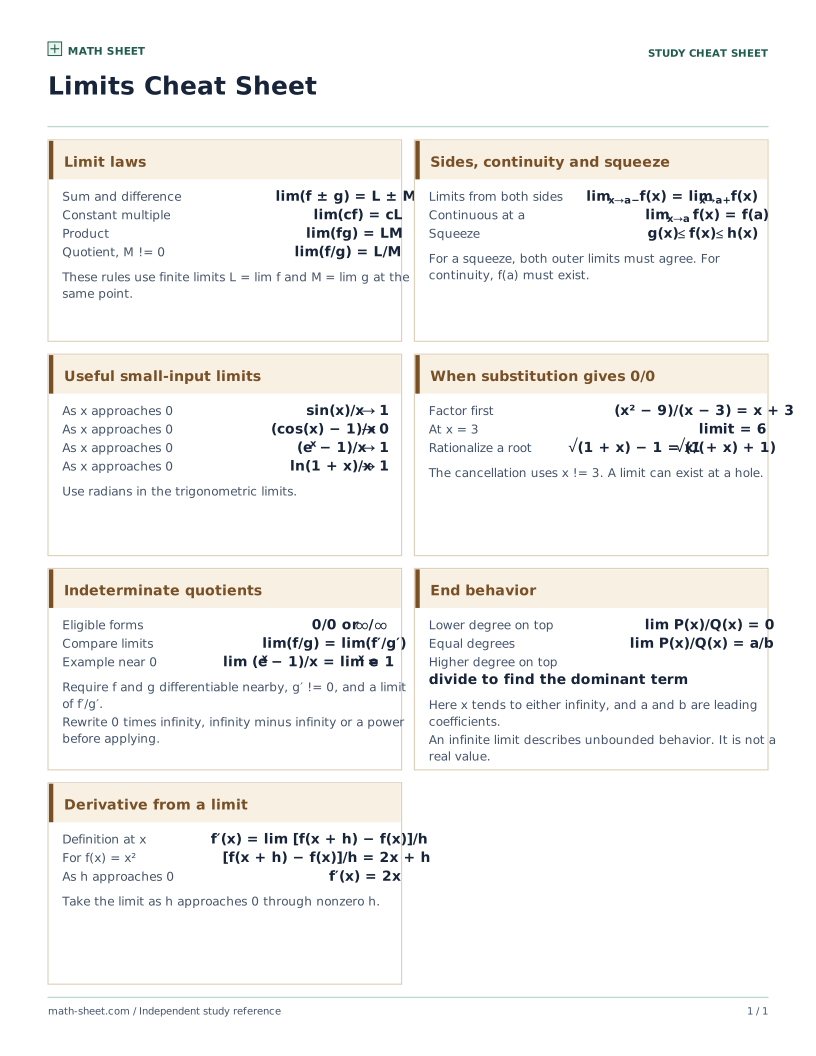
Start with substitution. When it gives an indeterminate form, decide whether factoring, a known limit or L’Hôpital’s rule fits. Check both sides before claiming a two-sided limit.

On this page

Find a formula

Open a formula for its definition and a worked example.

Build limits from simpler pieces

  • Constant and identitylimx→a c = c, limx→a x = a

    What it does

    A constant stays fixed during an approach. The identity function approaches the same number as its input.

    Worked example

    Find the limits of 7 and of x as x → −3.

    1. The constant has value 7 throughout the approach.
    2. The identity’s output follows x and tends to −3.
    Link to this example
  • Add and scalelim(αf + βg) = αL + βML = lim f and M = lim g are finite limits taken at the same point. Use β = −1 for subtraction.

    What it does

    The limit of a linear combination equals the same combination of the individual finite limits at that point.

    Worked example

    If lim f = 2 and lim g = −1 at x = 4, find lim(3f − 2g).

    1. Substitute 2 for the limit of f and −1 for that of g.
    2. The result is 3(2) − 2(−1) = 8.
    Link to this example
  • Multiply or dividelim(fg) = LM, lim(f/g) = L/M if M ≠ 0Both L and M are finite.

    What it does

    Finite limits can be multiplied. For a quotient, the denominator limit must also be nonzero.

    Worked example

    At one point, lim f = 6 and lim g = −2. Find lim(fg) and lim(f/g).

    1. Multiply 6 by −2 for the product limit, −12.
    2. Divide 6 by −2 for the quotient limit, −3.
    Link to this example
  • Take a positive integer powerlim fn = LnFor a negative integer power, also require L ≠ 0.

    What it does

    A positive integer power is continuous, so it can be applied after finding a finite limit.

    Worked example

    If f(x) tends to −2, find the limit of f(x)³.

    1. Use the limit value as the base and keep the exponent 3.
    2. The result is (−2)³ = −8.
    Link to this example

Useful limits to recognize

  • Sine and tangent near zerolimx→0 (sin x)/x = 1, limx→0 (tan x)/x = 1Use radians.

    What it does

    In radians, sin x and tan x approach zero at the same first-order rate as x.

    Worked example

    Find limx→0 tan(4x)/x.

    1. Rewrite as 4[tan(4x)/(4x)].
    2. The bracket tends to 1, so the limit is 4.
    Link to this example
  • Cosine differences near zerolimx→0 (1 − cos x)/x = 0, limx→0 (1 − cos x)/x² = 1/2Use radians.

    What it does

    Near zero, 1 − cos x behaves like x²/2 in radians. Dividing by x gives zero, while dividing by x² gives one half.

    Worked example

    Find limx→0 (1 − cos(3x))/x² and limx→0 (1 − cos(3x))/x.

    1. The first is 9 times the standard squared-denominator limit, so it is 9/2.
    2. The second is x times the first expression and therefore tends to 0.
    Link to this example
  • A sequence converging to elimn→∞ (1 + 1/n)n = e

    What it does

    The sequence (1 + 1/n)n tends to e as the positive integer n grows.

    Worked example

    Find limn→∞ (1 + 1/n)2n.

    1. Rewrite as the square of (1 + 1/n)n.
    2. The limit is e².
    Link to this example
  • Exponential and logarithmic incrementslimx→0 (ex − 1)/x = 1, limx→0 ln(1 + x)/x = 1

    What it does

    Near zero, ex − 1 and ln(1 + x) have first-order slope 1.

    Worked example

    Find limx→0 (e3x − 1)/x and limx→0 ln(1 + 2x)/x.

    1. Factor 3 out of the exponential quotient as 3(e3x − 1)/(3x), giving 3.
    2. Factor 2 out of the logarithmic quotient the same way, giving 2.
    Link to this example
  • First-order change of a powerlimx→0 [(1 + x)n − 1]/x = n

    What it does

    The power difference quotient near zero measures the derivative of (1 + x)n at zero, which is n.

    Worked example

    Evaluate limx→0 [(1 + x)³ − 1]/x.

    1. Expand the numerator to 3x + 3x² + x³.
    2. Divide by x and take the limit of 3 + 3x + x² to get 3.
    Link to this example
See Trigonometry Formula Sheet

Rework indeterminate quotients

  • Apply L’Hôpital to 0/0 or ∞/∞lim f/g = lim f′/g′Require differentiability and g′ ≠ 0 throughout the nearby approach interval, excluding the point itself. The derivative quotient needs a finite or infinite limit.

    What it does

    L’Hôpital’s rule can replace a 0/0 or ∞/∞ limit with the derivative quotient if its differentiability and limit conditions hold.

    Worked example

    Find limx→0 (ex − 1)/(2x) and limx→∞ ln(x)/x.

    1. For the 0/0 form, the derivative quotient is ex/2, which tends to 1/2.
    2. For the ∞/∞ form, the derivative quotient is 1/x, which tends to 0.
    Link to this example
  • Convert a zero-times-infinity productfg = f/(1/g) where g ≠ 0The rewrite can give 0/0 when f → 0 and |g| → ∞.

    What it does

    An indeterminate product can become a quotient by replacing a factor with division by its reciprocal.

    Worked example

    Evaluate limx→0⁺ x ln x.

    1. Write the product as ln x/(1/x), an infinite-over-infinite form with signed numerator.
    2. The derivative quotient is (1/x)/(−1/x²) = −x, which tends to 0.
    Link to this example
  • Combine a difference with divergent termsf − g = (1/g − 1/f)/(1/(fg)) when fg ≠ 0A common denominator or conjugate often simplifies the expression directly.

    What it does

    A difference of two unbounded expressions needs rewriting to expose how their leading parts cancel.

    Worked example

    Evaluate limx→∞ (√(x² + 4x) − x).

    1. Multiply by the conjugate to get 4x/[√(x² + 4x) + x].
    2. For x > 0, divide by x to get 4/[√(1 + 4/x) + 1], which tends to 2.
    Link to this example
See Derivatives cheat sheet

Indeterminate forms signal more work

  • Forms that do not decide the result0/0, ∞/∞, 0 · ∞, ∞ − ∞, 00, 1∞, ∞0

    What it does

    The same indeterminate form can yield different limits. The expressions and their rates determine the result.

    Worked example

    Compare x/x and x²/x as x → 0.

    1. Both expressions give the symbolic form 0/0.
    2. Away from zero they simplify to 1 and x respectively. Their limits are 1 and 0.
    Link to this example
  • Move a variable exponent outside a logarithmln(f(x)g(x)) = g(x) ln f(x)Require a positive base near the approach point. Find the limit of the logarithm, then exponentiate if it has a limit.

    What it does

    With positive base, logging a variable power turns the exponent into a multiplier. Find the log limit and exponentiate.

    Worked example

    Find limx→∞ (1 + 2/x)x.

    1. Put t = 2/x. The log is x ln(1 + 2/x) = 2 ln(1 + t)/t.
    2. It tends to 2, so the original limit is e².
    Link to this example

Behavior far to the right

  • Compare the leading terms in a rational functionlimx→∞ P(x)/Q(x) is 0 if deg P < deg Q, a/b if equal, and sign(a/b) · ∞ if deg P > deg Q.a and b are the leading coefficients. At −∞ also consider whether the degree difference is odd or even.

    What it does

    At positive infinity, the ratio of leading terms determines a rational function’s limit.

    Worked example

    Find limx→∞ (3x² − 1)/(2x² + 5x).

    1. Divide numerator and denominator by x².
    2. The lower-order terms tend to zero and the limit is 3/2.
    Link to this example
  • Order common growth rateslimx→∞ xn/ex = 0, limx→∞ ln(x)/xn = 0 for n > 0

    What it does

    At positive infinity, an exponential with base greater than one outgrows any fixed positive power, and a positive power outgrows a logarithm.

    Worked example

    Find the limits of x²/ex and ln(x)/x² as x → ∞.

    1. Differentiate top and bottom twice for x²/ex to obtain the limit of 2/ex, or 0.
    2. For ln(x)/x², one application gives the limit of 1/(2x³), also 0.
    Link to this example

Approach from either side

  • Left and right limitslimx→a⁻ f(x) and limx→a⁺ f(x)For the first, approach with x < a. For the second, use x > a.

    What it does

    One-sided limits track what f approaches along values strictly to one side of the target input.

    Worked example

    Let f(x) = −1 for x < 0 and f(x) = 2 for x ≥ 0. Find both one-sided limits at zero.

    1. From the left every nearby value is −1, giving a left-hand limit of −1.
    2. From the right every nearby value is 2, giving a right-hand limit of 2.
    Link to this example
  • Join one-sided limitslimx→a f(x) = L when both one-sided limits exist and equal L.

    What it does

    A two-sided limit exists when both one-sided limits exist and agree.

    Worked example

    Find limx→2 |x − 2|.

    1. On the left, |x − 2| = 2 − x, tending to 0. On the right, x − 2 also tends to 0.
    2. The one-sided values match, so the two-sided limit is 0.
    Link to this example
  • Match the function valuef is continuous at a if f(a) exists and limx→a f(x) = f(a).

    What it does

    Continuity at a point requires a function value, a limit and agreement between them.

    Worked example

    Set f(x) = (x² − 9)/(x − 3) when x ≠ 3. Choose f(3) for continuity.

    1. For x ≠ 3, cancellation gives f(x) = x + 3. The limit at 3 is 6.
    2. Set f(3) = 6.
    Link to this example
  • Squeeze theoremg ≤ f ≤ h near a and limx→a g = limx→a h = L ⇒ limx→a f = L

    What it does

    If two functions bound a third near a point and share a limit there, the bounded function has that same limit.

    Worked example

    Evaluate limx→0 x² cos(1/x).

    1. Because |cos(1/x)| ≤ 1, this expression lies between −x² and x².
    2. Both bounds tend to 0, so the middle expression tends to 0.
    Link to this example

Preview the printable

Download the compact sheet for a quick review, or print the complete formula list from this page.

Practice these skills

Related references

Sources and review

Math Sheet prepares original print materials. See how we check formulas and printouts.

Browse all formula sheets →