
Preview page 2
2 pages · US Letter / A4
Derivative Rules: Expanded
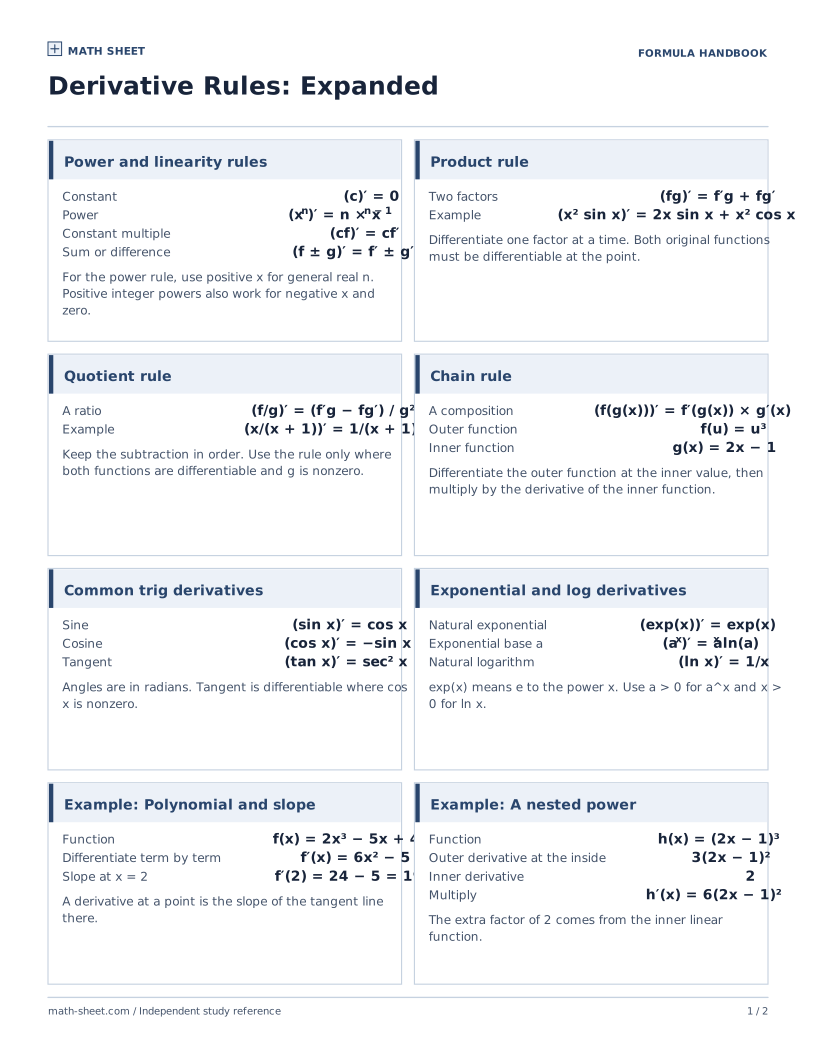
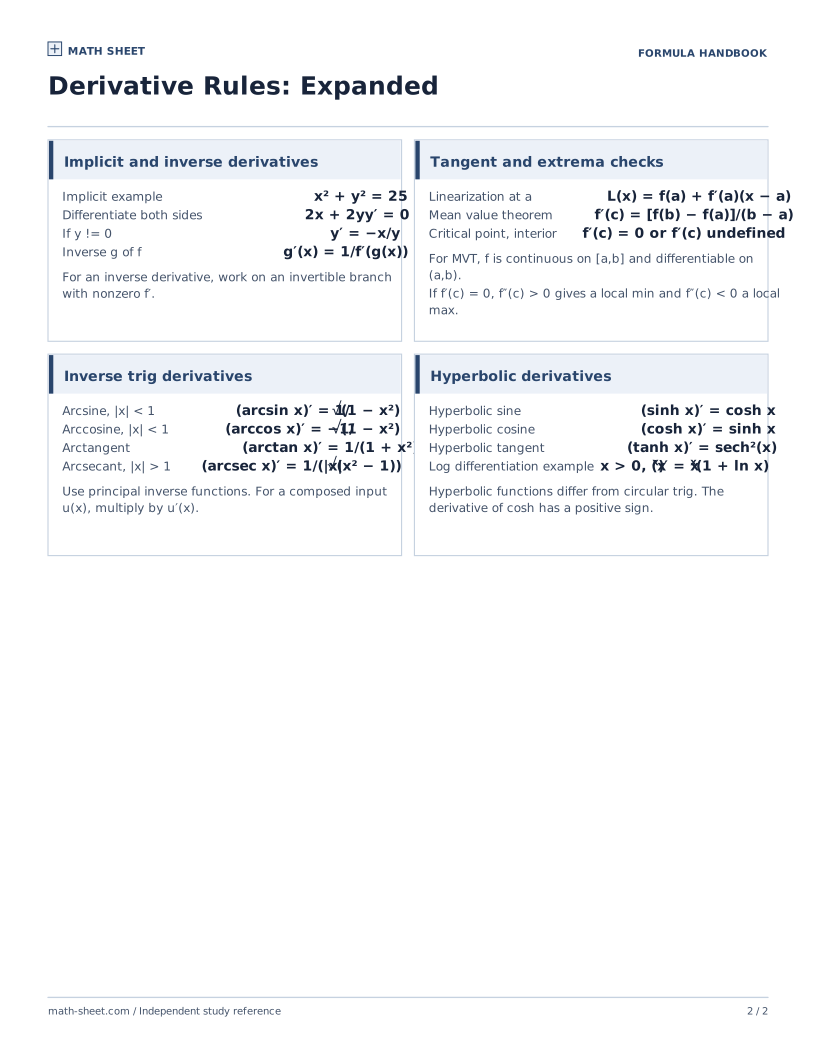
A two-page derivative reference including basic, exponential, trigonometric, inverse and hyperbolic rules plus implicit differentiation.
Calculus reference
Identify the outer operation before taking the derivative. Use this printable reference to tell a product from a composition, then check the formula and its domain.
On this page
Open a formula for its definition and a worked example.
Derivatives Cheat Sheet
What it does
A constant has zero rate of change. For a differentiable power, multiply by the current exponent and lower it by one.
Worked example
Differentiate 9 + x⁵.
What it does
Differentiation distributes over sums and differences and carries constant multipliers through.
Worked example
Let f(x) = x² and g(x) = x³. Differentiate 3f + 2g and 3f − 2g.
What it does
For a product, differentiate each factor in turn and add. For a quotient, subtract the cross terms in order and divide by the original denominator squared.
Worked example
Let f(x) = x² and g(x) = x + 1. Find (fg)′ and (f/g)′.
What it does
The chain rule differentiates the outer function at the inner input, then multiplies by the inner input’s derivative.
Worked example
Differentiate (5x − 2)⁴.
What it does
A positive-base exponential retains its own value as a factor when differentiated. Multiply by ln a and by the derivative of the exponent.
Worked example
Differentiate 2x + ex².
What it does
The derivative of loga u is u′ divided by u ln a. The input must be positive, and the positive base cannot equal one.
Worked example
Differentiate log3(x² + 1) + ln x for x > 0.
What it does
With angles in radians, sine differentiates to cosine and cosine to negative sine.
Worked example
Differentiate sin x − 2 cos x and evaluate at x = 0.
What it does
Tangent differentiates to secant squared wherever cosine is nonzero. Cotangent differentiates to negative cosecant squared wherever sine is nonzero.
Worked example
Differentiate tan x − cot x at π/4.
What it does
Secant and cosecant derivatives each retain the original function as a factor. The second factors are tangent and negative cotangent respectively.
Worked example
Differentiate sec x + csc x and evaluate at π/4.
What it does
On their principal branches, arcsine increases and arccosine decreases. Their derivatives have equal magnitudes and require |x| < 1.
Worked example
Compare the derivatives of arcsin x and arccos x at x = 1/2.
What it does
Arctangent’s derivative is positive. With arccotangent taking values in (0, π), its derivative has the same magnitude and opposite sign.
Worked example
Find the two derivatives at x = 2.
What it does
For the branches defined by arccos(1/x) and arcsin(1/x), arcsec and arccsc derivatives have opposite signs and require |x| > 1.
Worked example
Compare the derivatives of arcsec x and arccsc x at x = −2.
What it does
Hyperbolic sine and cosine are built from exponentials. Their derivatives switch the function without a sign change.
Worked example
Differentiate 2 sinh x − cosh x and evaluate at zero.
What it does
The hyperbolic tangent derivative is hyperbolic secant squared. The derivative of hyperbolic secant is negative hyperbolic secant times hyperbolic tangent.
Worked example
Find the derivative of tanh x + sech x at x = 0.
What it does
For a differentiable curve F(x, y) = 0, the chain rule gives a linear equation in y′. A nonzero coefficient of y′ lets you solve for the slope.
Worked example
Find y′ for x² + xy + y² = 7 at (1, 2).
What it does
Logarithmic differentiation turns a variable exponent on a positive base into a product, which can then be differentiated.
Worked example
Find the derivative of y = xx for x > 0.
What it does
An inverse derivative is the reciprocal of the original derivative at the matching input, on an invertible branch with nonzero derivative there.
Worked example
For f(x) = x³ + 1, find the derivative of its inverse at y = 9.
What it does
For a parametric curve with nonzero x′, divide the y-derivative by the x-derivative. To differentiate the slope with respect to x, differentiate it with respect to the parameter and divide by x′ again.
Worked example
Let x = t² and y = t³ for t > 0. Find both derivatives at t = 2.
Download the compact sheet for a quick review, or print the complete formula list from this page.
2 pages · US Letter / A4
A two-page derivative reference including basic, exponential, trigonometric, inverse and hyperbolic rules plus implicit differentiation.
1 page · US Letter / A4
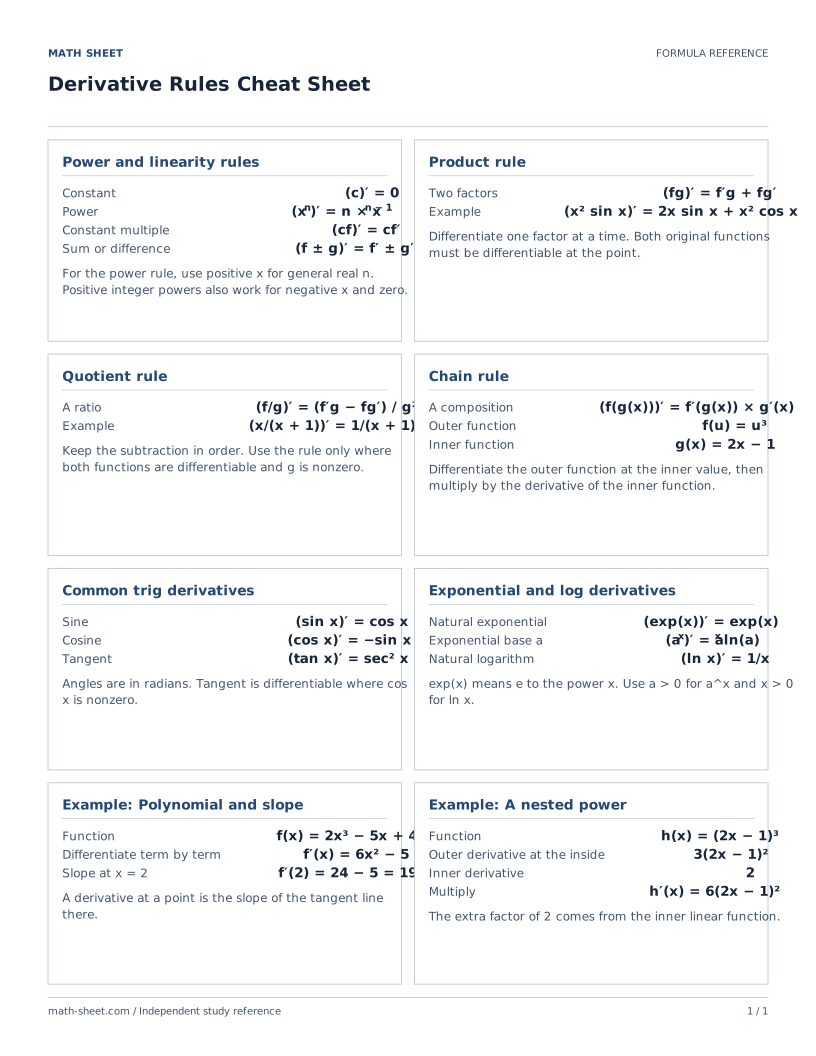
A Calculus I reference for the power, product, quotient and chain rules, plus common derivatives and worked examples.
Customize in the Cheat Sheet Maker →
For the power rule, use positive x for general real n. Positive integer powers also work for negative x and zero.
Differentiate one factor at a time. Both original functions must be differentiable at the point.
Keep the subtraction in order. Use the rule only where both functions are differentiable and g is nonzero.
Differentiate the outer function at the inner value, then multiply by the derivative of the inner function.
Angles are in radians. Tangent is differentiable where cos x is nonzero.
exp(x) means e to the power x. Use a > 0 for a^x and x > 0 for ln x.
A derivative at a point is the slope of the tangent line there.
The extra factor of 2 comes from the inner linear function.
Math Sheet prepares original print materials. See how we check formulas and printouts.