
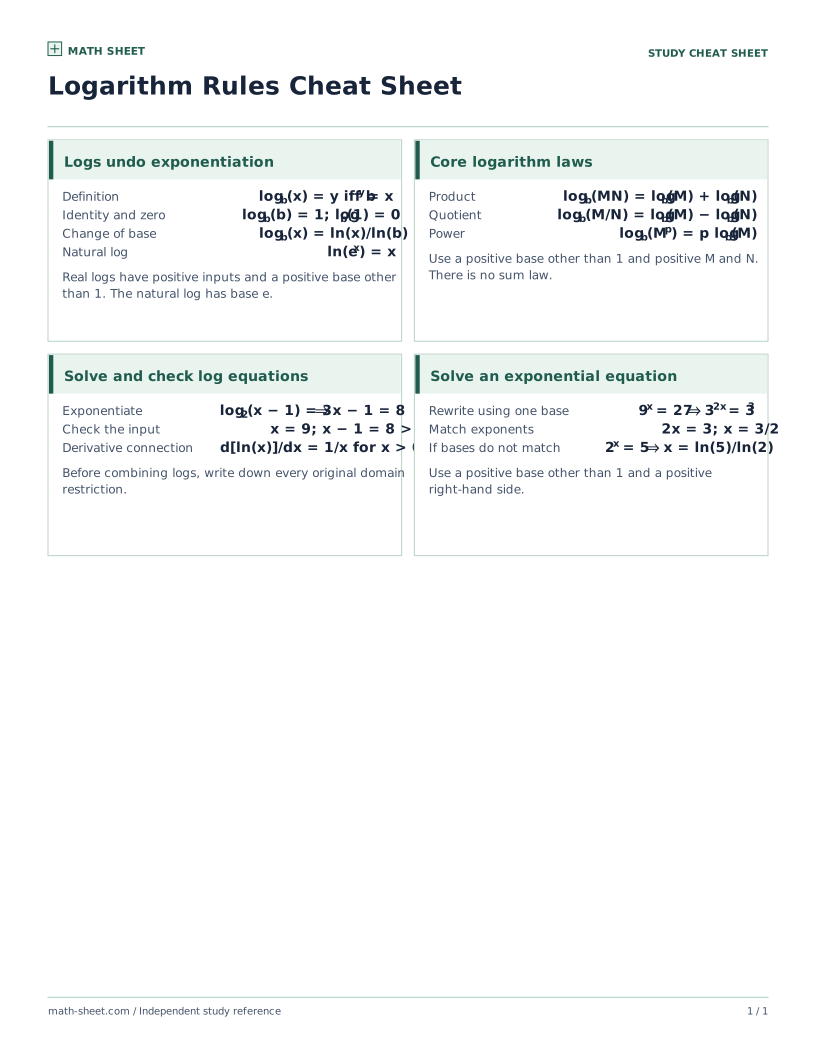
1 page · US Letter / A4
Logarithm Rules Cheat Sheet
Print logarithm rules, change of base, inverse relationships and a worked log equation with a domain check.
Algebra II & Precalculus
Check the domain before applying a logarithm law. Keep the inverse relationship beside the product, quotient and power rules.
On this page
Open a formula for its definition and a worked example.
Logarithm Rules Cheat Sheet
What it does
A real logarithm gives the exponent a positive base other than 1 needs to reach a positive argument.
Worked example
Find log3 81.
What it does
A nonzero base raised to zero gives 1, and to the first power gives the base itself.
Worked example
Evaluate log7 1 and log7 7.
What it does
Exponentiation and logarithms with the same allowed base undo each other.
Worked example
Evaluate log5(5−2) and 5log₅ 12.
What it does
The common logarithm uses base 10, and the natural logarithm uses base e.
Worked example
Evaluate log₁₀(0.01) and ln(e³).
What it does
The logarithm of a product of positive numbers equals the sum of their logarithms in the same base.
Worked example
Evaluate log2(4 × 8).
What it does
Dividing positive arguments subtracts their logs. A reciprocal is the special case with numerator 1.
Worked example
Evaluate log3(81/9) and log3(1/9).
What it does
A power on a positive argument becomes a coefficient multiplying its log.
Worked example
Evaluate log2(82/3).
What it does
Change of base divides the new-base log of the argument by the new-base log of the original base.
Worked example
Find log4 8 using base 2, and write the equivalent natural-log expression.
What it does
Exchanging the base and argument makes the two logarithms reciprocals when both are valid bases.
Worked example
Given log2 8 = 3, find log8 2.
What it does
The natural log equals 1 at e and zero at 1 because it counts the powers of e.
Worked example
Evaluate ln(e) − 2 ln(1).
What it does
A logarithm with a valid fixed base is one-to-one. Equal logs imply equal positive arguments.
Worked example
Solve log2(x + 1) = log2(7 − x).
What it does
Translate a logarithmic equation to an exponential one, or a positive exponential equation to a logarithmic one.
Worked example
Solve log4 x = 3 and 3t = 20.
What it does
Product and power rules combine or expand logarithms while preserving the original positive-argument restrictions.
Worked example
Combine 2 log3 x + log3 9 and solve when it equals 4.
What it does
The natural log’s derivative is 1/x. Other valid bases introduce an extra factor of 1/ln a.
Worked example
Differentiate ln x + log2 x for x > 0, then evaluate at x = 2.
What it does
On an interval excluding zero, ln|x| differentiates to 1/x.
Worked example
Evaluate ∫−4−2 dx/x.
What it does
The Maclaurin series of ln(1 + x) uses alternating powers with coefficients 1/n. Its terms shrink for |x| < 1.
Worked example
Approximate ln(1.1) using the first three nonzero terms.
Download the compact sheet for a quick review, or print the complete formula list from this page.
1 page · US Letter / A4
Print logarithm rules, change of base, inverse relationships and a worked log equation with a domain check.
Math Sheet prepares original print materials. See how we check formulas and printouts.