Algebra I & II

Algebra Formula Sheet

Choose a formula by the form you are starting from. Use the linked specialist sheets when you need more patterns or worked steps.

On this page

Find a formula

Open a formula for its definition and a worked example.

Forms and measurements for lines

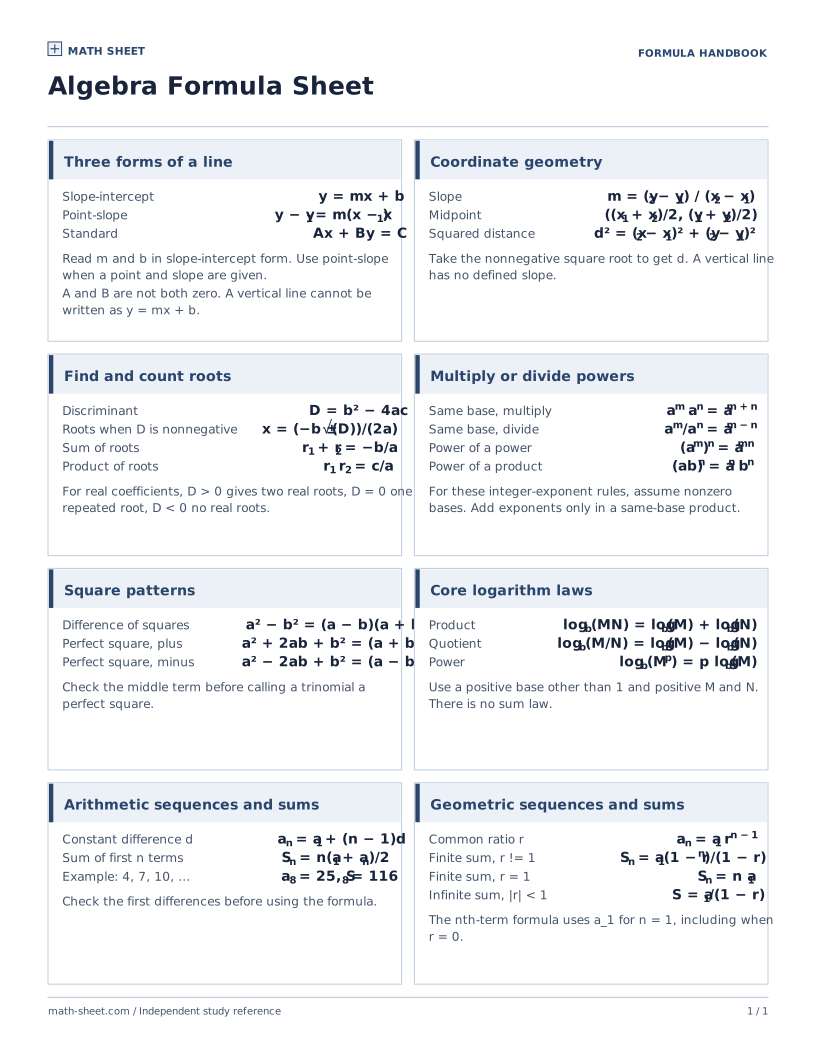
  • Slope from two pointsm = (y₂ − y₁)/(x₂ − x₁)Use distinct x-coordinates.

    What it does

    Slope describes the signed rise per unit run. Distinct x-coordinates are needed to form this quotient.

    Worked example

    Find the slope through (−3, −2) and (2, 8).

    1. Subtract coordinates in the same direction to get rise 10 and run 5.
    2. The slope is 10/5 = 2.
    Link to this example
  • Choose a line equationy = mx + b, y − y₁ = m(x − x₁), or Ax + By = CThe last form also covers vertical lines when B = 0 and A ≠ 0.

    What it does

    The same nonvertical line can be written with an intercept or a known point. Standard form also represents vertical lines.

    Worked example

    Write the line through (4, 1) with slope −3/2 in three forms.

    1. Start with y − 1 = (−3/2)(x − 4). Solving for y gives y = −3x/2 + 7.
    2. Multiply by 2 and rearrange to get 3x + 2y = 14.
    Link to this example
  • Average each coordinateM = ((x₁ + x₂)/2, (y₁ + y₂)/2)

    What it does

    A segment’s midpoint is the arithmetic mean of its endpoints in each coordinate.

    Worked example

    Find the midpoint from (−4, 7) to (8, −3).

    1. Average x as (−4 + 8)/2 = 2 and y as (7 − 3)/2 = 2.
    2. The midpoint is (2, 2).
    Link to this example
  • Apply the right-triangle distance ruled = √((x₂ − x₁)² + (y₂ − y₁)²)

    What it does

    Straight-line distance is the hypotenuse of a right triangle built from the changes in x and y.

    Worked example

    Find the distance from (−2, 1) to (4, 9).

    1. The coordinate differences are 6 and 8.
    2. Compute √(6² + 8²) = √100 = 10.
    Link to this example

Read or solve a quadratic

  • Use the discriminant and solveΔ = b² − 4ac, roots = (−b ± √Δ)/(2a)Assume ax² + bx + c with a ≠ 0. The sign of Δ determines the number of distinct real roots.

    What it does

    The discriminant classifies roots and supplies the radicand in the quadratic formula for a ≠ 0.

    Worked example

    Find the real roots of 3x² − 8x + 4 = 0.

    1. Compute Δ = 64 − 4·3·4 = 16.
    2. Substitute x = (8 ± 4)/6 to get 2 and 2/3.
    Link to this example
  • Locate the turning pointf(x) = a(x − h)² + k, h = −b/(2a), k = f(h)

    What it does

    Vertex form locates a parabola’s turning point at (h, k). In standard polynomial form its x-coordinate is −b/(2a).

    Worked example

    Find the vertex and vertex form of f(x) = 2x² − 12x + 13.

    1. Use h = 12/4 = 3, then calculate f(3) = −5.
    2. The vertex is (3, −5) and f(x) = 2(x − 3)² − 5.
    Link to this example
  • Sum and multiply the rootsr₁ + r₂ = −b/a, r₁r₂ = c/aThe equalities count repeated roots twice.

    What it does

    The sum and product of a quadratic’s roots equal −b/a and c/a. A double root contributes twice to the sum.

    Worked example

    Find the root sum and product for 2x² + 12x + 18 = 0.

    1. Read a = 2, b = 12 and c = 18. The sum is −6 and the product is 9.
    2. Factoring gives 2(x + 3)², confirming both roots are −3.
    Link to this example
See Quadratic Formula Sheet

Combine powers of the same base

  • Products, quotients and nested powersam an = am+n, am/an = am−n, (am)n = amnInteger powers require every expression to be defined.

    What it does

    A common base lets integer exponent operations reflect repeated multiplication. A quotient requires a nonzero denominator.

    Worked example

    Simplify x²·x⁵, x⁵/x² and (x²)⁵ for x ≠ 0.

    1. For the product and quotient use 2 + 5 and 5 − 2.
    2. For the nested power use 2·5. The results are x⁷, x³ and x¹⁰.
    Link to this example
  • Zero and negative powersa0 = 1, a−n = 1/anUse a ≠ 0.

    What it does

    The zero and negative exponent rules extend the ordinary power laws on nonzero bases.

    Worked example

    Evaluate (−3)⁰ and (−3)−3.

    1. The nonzero base gives a zero power of 1.
    2. Take the reciprocal of (−3)³ = −27 to get −1/27.
    Link to this example
  • Rational powers as rootsam/n = (ⁿ√a)mA positive base works for all rational exponents.

    What it does

    For a positive base a, the denominator of a rational exponent gives a root and the numerator gives a power.

    Worked example

    Evaluate 813/4.

    1. The fourth root of 81 is 3.
    2. Cube it to get 27.
    Link to this example
See Exponent Rules Cheat Sheet

Recognize square and cube factors

  • Test a square patternu² − v² = (u − v)(u + v), u² ± 2uv + v² = (u ± v)²

    What it does

    Squared terms with opposite signs form conjugate factors. A perfect-square trinomial has a middle term equal to twice the signed product of its square roots.

    Worked example

    Factor 9x² − 16 and 9x² − 24x + 16.

    1. Use the roots 3x and 4 to write (3x − 4)(3x + 4).
    2. Since −24x = −2·3x·4, the trinomial is (3x − 4)².
    Link to this example
  • Find a linear factor for a cube pairu³ ± v³ = (u ± v)(u² ∓ uv + v²)The signs in the linear factor and the middle term of the quadratic are opposite.

    What it does

    The sum or difference of cubes has a linear factor with the original sign and a quadratic factor with the opposite middle sign.

    Worked example

    Factor x³ + 64 and x³ − 64.

    1. Use 64 = 4³ and choose the linear factors x + 4 and x − 4.
    2. The factorizations are (x + 4)(x² − 4x + 16) and (x − 4)(x² + 4x + 16).
    Link to this example
See Factoring Rules Cheat Sheet

Rewrite logarithms

  • Translate and change baseslogb x = y ⇔ by = x, logb x = ln x / ln bUse x > 0 and b > 0 with b ≠ 1.

    What it does

    A logarithm gives the exponent needed to reach a positive input from a positive base different from one. A change of base computes it using natural logs.

    Worked example

    Find log4 32.

    1. Write 4y = 32 and use powers of 2 to get 22y = 2⁵.
    2. Then y = 5/2, which also equals ln 32 / ln 4.
    Link to this example
  • Products, quotients and powers inside a loglogb(MN) = logb M + logb N, logb(M/N) = logb M − logb N, logb(Mp) = p logb MBoth M and N are positive.

    What it does

    Logs of products, quotients and powers become sums, differences and scalar multiples. Their arguments must be positive.

    Worked example

    Expand log2(9x³/y) for x, y > 0 and evaluate at x = 2, y = 9.

    1. Expand to log2 9 + 3 log2 x − log2 y.
    2. The first and last cancel at y = 9, so the result is 3·1 = 3.
    Link to this example
See Logarithm Rules Cheat Sheet

Find a sequence term or sum

  • Add a fixed differencean = a₁ + (n − 1)d, Sn = n(a₁ + an)/2

    What it does

    In an arithmetic sequence, each step adds the same difference. A finite sum is the term count times the average of its first and last terms.

    Worked example

    Find term 8 and the first eight terms’ sum in 4, 7, 10, … .

    1. Use a₁ = 4 and d = 3 to get a₈ = 4 + 7·3 = 25.
    2. Then S₈ = 8(4 + 25)/2 = 116.
    Link to this example
  • Multiply by a fixed ratioan = a₁rn−1, Sn = a₁(1 − rn)/(1 − r), S∞ = a₁/(1 − r)The finite fraction needs r ≠ 1. At r = 1, S_n = na₁. The infinite formula uses |r| < 1.

    What it does

    A geometric sequence multiplies by a common ratio each step. Its infinite sum exists for a nonzero starting term when the ratio has magnitude below one.

    Worked example

    For 12, 6, 3, … find term 4, the sum through term 4 and the infinite sum.

    1. With ratio 1/2, term 4 is 12(1/2)³ = 3/2 and S₄ = 12[1 − (1/2)⁴]/(1/2) = 45/2.
    2. The infinite sum is 12/(1 − 1/2) = 24.
    Link to this example
See Sequences and Series Formula Sheet

Preview the printable

Download the compact sheet for a quick review, or print the complete formula list from this page.

Practice these skills

Related references

Sources and review

Math Sheet prepares original print materials. See how we check formulas and printouts.

Browse all formula sheets →