
1 page · US Letter / A4
Exponent Rules Cheat Sheet
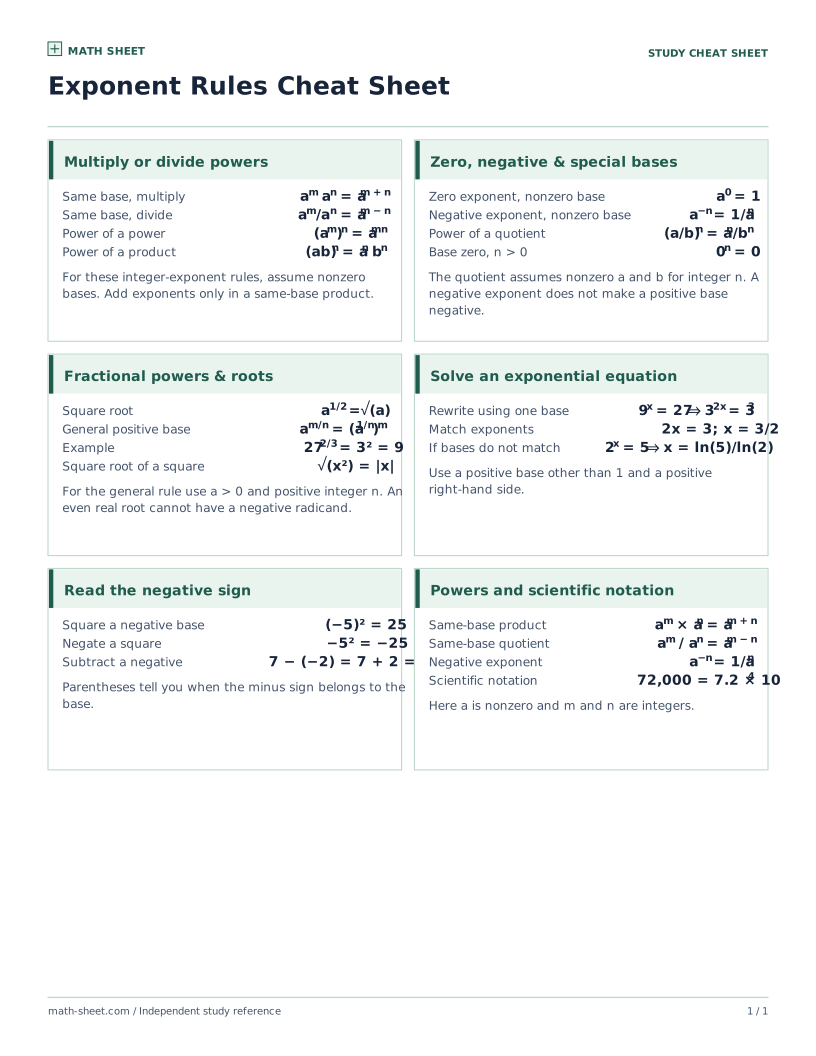
A one-page exponent rules reference with integer powers, fractional exponents, radicals and worked exponential equations.
Pre-algebra & Algebra I
Start by checking the bases and the operation. Use the examples to distinguish negative bases, negative powers and fractional powers.
On this page
Open a formula for its definition and a worked example.
Exponent Rules Cheat Sheet
What it does
For defined integer powers with a common base, multiplication adds exponents, division subtracts and nesting multiplies.
Worked example
Simplify 3²·3⁵, 3⁵/3² and (3²)⁵.
What it does
An integer exponent distributes over factors or over the numerator and denominator of a quotient. All expressions must exist, and a negative power needs nonzero bases.
Worked example
Simplify (2x)³ and (2x/3)³.
What it does
The first power leaves the base unchanged. The zero power of a nonzero base is one.
Worked example
Evaluate (−7)¹ and (−7)⁰.
What it does
A negative integer exponent means take the reciprocal of the positive power. For a nonzero fraction, this is equivalent to flipping it before raising it.
Worked example
Evaluate 4−3 and (2/5)−3.
What it does
For a positive base, the denominator of a rational exponent indicates a root and the numerator indicates a power. Odd roots can also take negative real inputs.
Worked example
Evaluate 641/2, 641/3 and 642/3.
What it does
A negative rational exponent combines an indexed root and a positive power with a reciprocal, for a positive real base.
Worked example
Evaluate 16−3/4.
What it does
Powers of ten scale numbers by place value. Scientific notation writes a nonzero number with a leading coefficient of magnitude at least 1 and below 10.
Worked example
Evaluate 10⁵ and write 0.00042 in scientific notation.
What it does
The natural exponential is the limit of increasingly frequent compounding. Its series is a sum of powers of the input divided by factorials.
Worked example
Use n = 2 and the first three series terms to approximate e² in two ways.
What it does
A positive exponential base other than one gives a one-to-one function. Equate exponents when the bases match, or use logs for any positive target.
Worked example
Solve 32x = 81 and 3y = 10.
What it does
Periodic compounding multiplies the balance by one plus the rate per period. Continuous compounding uses an exponential of the annual decimal rate times years.
Worked example
Invest $1,000 at 6% for two years. Compare annual and continuous compounding.
Download the compact sheet for a quick review, or print the complete formula list from this page.
1 page · US Letter / A4
A one-page exponent rules reference with integer powers, fractional exponents, radicals and worked exponential equations.
Math Sheet prepares original print materials. See how we check formulas and printouts.