Algebra I & II

Quadratic Formula Sheet

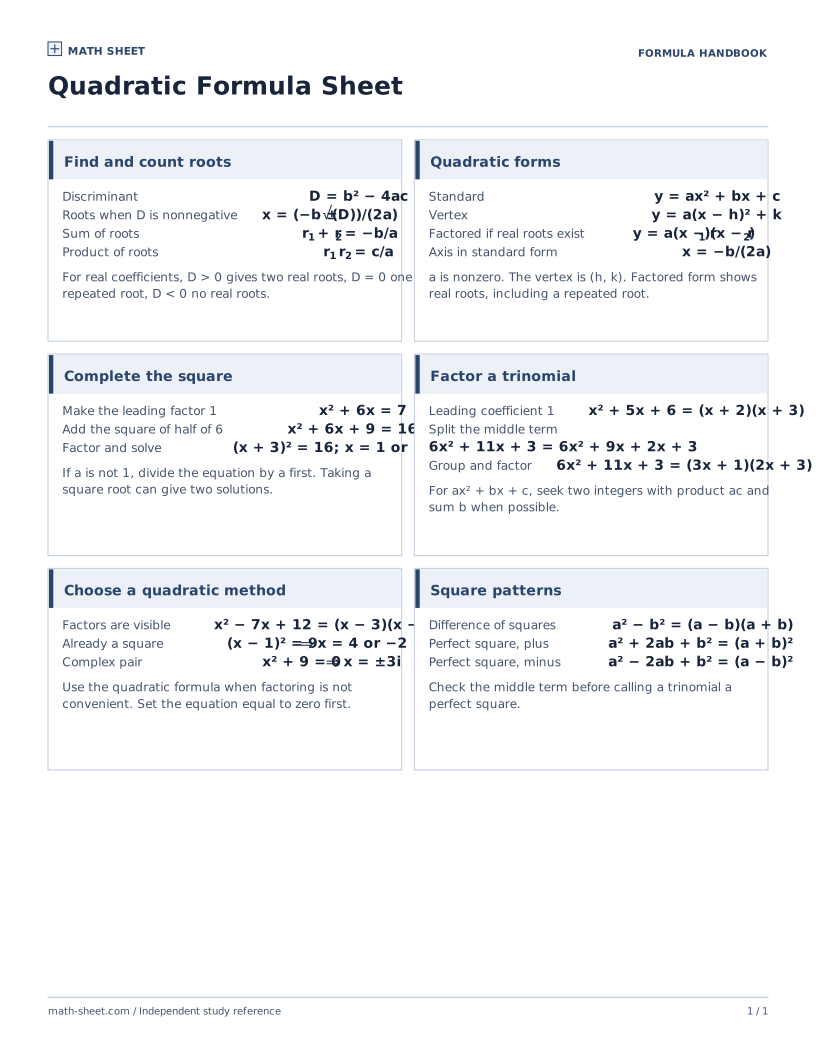
Read the form of the quadratic first. Match it to factoring, completing the square, or the quadratic formula and check how many roots to expect.

On this page

Find a formula

Open a formula for its definition and a worked example.

Solve a quadratic equation

  • Collect terms and set them equal to zeroax² + bx + c = 0A quadratic has a ≠ 0.

    What it does

    Standard form collects terms by degree on one side and leaves zero on the other. The squared term must have a nonzero coefficient.

    Worked example

    Rewrite 4x² + 2 = 5x − 1 in standard form.

    1. Subtract 5x and add 1 to both sides.
    2. Read the coefficients from 4x² − 5x + 3 = 0: a = 4, b = −5, c = 3.
    Link to this example
  • Use the discriminant to solveD = b² − 4ac; x = (−b ± √D)/(2a)

    What it does

    The quadratic formula solves ax² + bx + c = 0 for a ≠ 0. Its discriminant D is the expression inside the square root.

    Worked example

    Solve 2x² + x − 3 = 0.

    1. Calculate D = 1² − 4(2)(−3) = 25.
    2. Use x = (−1 ± 5)/4 to obtain x = 1 or x = −3/2.
    Link to this example

Predict the roots

  • Classify the roots from DD > 0: two real; D = 0: repeated real; D < 0: complex conjugatesThis classification assumes real coefficients.

    What it does

    The sign of the discriminant classifies the roots of a quadratic with real coefficients.

    Worked example

    Classify the roots of x² − 6x + 8, x² − 6x + 9, and x² − 6x + 10.

    1. Compute 36 − 4c for c = 8, 9, and 10. The results are 4, 0, and −4.
    2. The first has two distinct real roots, the second has a repeated real root, and the third has two nonreal conjugates.
    Link to this example
  • Recognize rational rootsFor integer a, b, c, real roots are rational iff D is a perfect square.Zero counts as a perfect square. For rational coefficients, clear denominators first.

    What it does

    With integer coefficients and a ≠ 0, real roots are rational exactly when D is an integer square. Clear denominators if the coefficients are rational.

    Worked example

    Are the roots of x² − 3x − 10 = 0 rational?

    1. D = 9 + 40 = 49 = 7².
    2. Then (3 ± 7)/2 gives the rational roots 5 and −2.
    Link to this example

Read the graph from its equation

  • Read the vertical intercepty = ax² + bx + c; (0, c)

    What it does

    The y-intercept occurs at x = 0, where all positive powers of x vanish and only the constant term remains.

    Worked example

    Find the y-intercept of y = −2x² + 6x − 5.

    1. Substitute 0 for x to get y = −5.
    2. The intercept is (0, −5).
    Link to this example
  • Locate the vertex and axisy = a(x − h)² + k; h = −b/(2a); k = c − b²/(4a)The vertex is (h, k), and the axis is x = h.

    What it does

    The vertex is the turning point of the parabola. Its x-coordinate also gives the vertical line of symmetry.

    Worked example

    Find the vertex and axis for y = 2x² − 8x + 5.

    1. Use h = 8/4 = 2 and evaluate y(2) = 8 − 16 + 5 = −3.
    2. The vertex is (2, −3), the axis is x = 2, and vertex form is y = 2(x − 2)² − 3.
    Link to this example
  • Locate the zeros in factored formy = a(x − r₁)(x − r₂)Each real root gives an x-intercept.

    What it does

    In factored form, the zero-product property finds each real input that makes the output zero.

    Worked example

    Find the intercepts on the x-axis for y = −3(x + 2)(x − 5).

    1. Set x + 2 or x − 5 equal to zero.
    2. The roots are −2 and 5, so the intercepts are (−2, 0) and (5, 0).
    Link to this example

Complete the square

  • Divide by the leading coefficientx² + (b/a)x = −c/a

    What it does

    Divide the entire equation by a ≠ 0 to make the coefficient of x² equal to one. Place the constant on the right.

    Worked example

    Prepare 3x² − 12x + 6 = 0 for completing the square.

    1. Divide every term by 3 to get x² − 4x + 2 = 0.
    2. Subtract 2 to get x² − 4x = −2.
    Link to this example
  • Add the same square to both sidesx² + (b/a)x + (b/(2a))² = −c/a + (b/(2a))²

    What it does

    Half the coefficient of x and square the result to supply the constant of a perfect-square trinomial.

    Worked example

    Complete the square on x² + 10x = 11.

    1. Half of 10 is 5, and 5² = 25. Add 25 to each side.
    2. The equation becomes x² + 10x + 25 = 36, or (x + 5)² = 36.
    Link to this example
  • Factor and take both square roots(x + b/(2a))² = D/(4a²); x = −b/(2a) ± √(D/(4a²))

    What it does

    Once one side is a square, take both real square roots of the other side when it is nonnegative.

    Worked example

    Finish solving x² − 8x + 16 = 9.

    1. Factor the left side as (x − 4)².
    2. Then x − 4 = ±3, so x = 7 or x = 1.
    Link to this example

Relate roots to coefficients

  • Vieta’s relationsr₁ + r₂ = −b/a; r₁r₂ = c/aCount a repeated root twice.

    What it does

    Vieta’s relations give the sum and product of the roots, counting multiplicity, directly from the coefficients.

    Worked example

    Find the sum and product of the roots of 3x² + 7x − 6 = 0.

    1. Divide −b by a to get a sum of −7/3.
    2. Divide c by a to get a product of −2.
    Link to this example
  • Build the monic equation from the rootsx² − (r₁ + r₂)x + r₁r₂ = 0

    What it does

    A monic quadratic has leading coefficient one. Its remaining coefficients follow from expanding the factors built from its roots.

    Worked example

    Build the monic quadratic with roots −4 and 7.

    1. The roots have sum 3 and product −28.
    2. The equation is x² − 3x − 28 = 0, equivalent to (x + 4)(x − 7) = 0.
    Link to this example
See Algebra Formula Sheet

Recognize factors at a glance

  • Two squares with a minus signu² − v² = (u − v)(u + v)

    What it does

    A difference of two squares factors as a difference times a sum because the cross terms cancel.

    Worked example

    Factor 25x² − 36.

    1. Write it as (5x)² − 6².
    2. The factors are (5x − 6)(5x + 6).
    Link to this example
  • Square of a binomialu² ± 2uv + v² = (u ± v)²

    What it does

    Squaring a binomial gives two square terms and a middle term equal to twice the signed product of its two parts.

    Worked example

    Factor 9x² − 24x + 16.

    1. The endpoints are (3x)² and 4², and −24x = −2(3x)(4).
    2. The trinomial is (3x − 4)².
    Link to this example
  • Sum or difference of cubesu³ ± v³ = (u ± v)(u² ∓ uv + v²)

    What it does

    Two cubes factor into a signed binomial times a trinomial whose middle sign reverses. The final term of the trinomial is positive.

    Worked example

    Factor 8x³ + 27 and 8x³ − 27.

    1. Recognize 8x³ = (2x)³ and 27 = 3³.
    2. The results are (2x + 3)(4x² − 6x + 9) and (2x − 3)(4x² + 6x + 9).
    Link to this example
See Factoring Rules Cheat Sheet

Apply the equation to height and motion

  • Height under constant gravityh(t) = h₀ + v₀t − gt²/2Use g > 0 and ignore air resistance. Here h₀ is the initial height and v₀ is the initial upward velocity.

    What it does

    In the constant-gravity model, initial height and velocity give the constant and linear terms, while downward acceleration gives the negative quadratic term.

    Worked example

    With g = 10 m/s², h₀ = 2 m, and v₀ = 15 m/s, find the height after 2 seconds.

    1. Substitute into h(2) = 2 + 15(2) − 10(2²)/2.
    2. The height is 12 m.
    Link to this example
  • Later ground-level timet = (v₀ + √(v₀² + 2gh₀))/gFor launch at or above ground, retain a nonnegative time.

    What it does

    Set height equal to zero and choose the later root that falls within the physical time interval.

    Worked example

    A ball starts at 15 m, moving upward at 10 m/s with g = 10 m/s². When does it hit the ground?

    1. Set 15 + 10t − 5t² = 0 and divide by −5 to get t² − 2t − 3 = 0.
    2. The factors give t = −1 or t = 3. The ball hits the ground 3 seconds after launch.
    Link to this example
  • Peak time and heightt = v₀/g; h = h₀ + v₀²/(2g)Use the vertex for a launch with v₀ ≥ 0. For v₀ < 0 the peak for t ≥ 0 is at launch.

    What it does

    For an upward launch the maximum height occurs at the vertex, where the vertical velocity is zero.

    Worked example

    With v₀ = 20 m/s, h₀ = 3 m, and g = 10 m/s², find the peak time and height.

    1. The peak occurs at t = 20/10 = 2 s.
    2. Substitute into h = 3 + 20²/(2 · 10) = 23 m.
    Link to this example
  • Solve without a linear termax² + c = 0 ⇒ x = ±√(−c/a)There are real solutions only when −c/a ≥ 0.

    What it does

    An equation with only a square term and a constant can be solved by isolating the square. Both signs are needed when the isolated value is positive.

    Worked example

    Solve 5x² − 45 = 0 over the reals.

    1. Divide 5x² = 45 by 5 to get x² = 9.
    2. Take both square roots: x = 3 or x = −3.
    Link to this example

Preview the printable

Download the compact sheet for a quick review, or print the complete formula list from this page.

Practice these skills

Related references

Sources and review

Math Sheet prepares original print materials. See how we check formulas and printouts.

Browse all formula sheets →