Pre-algebra through Algebra II

Inequality Rules Cheat Sheet

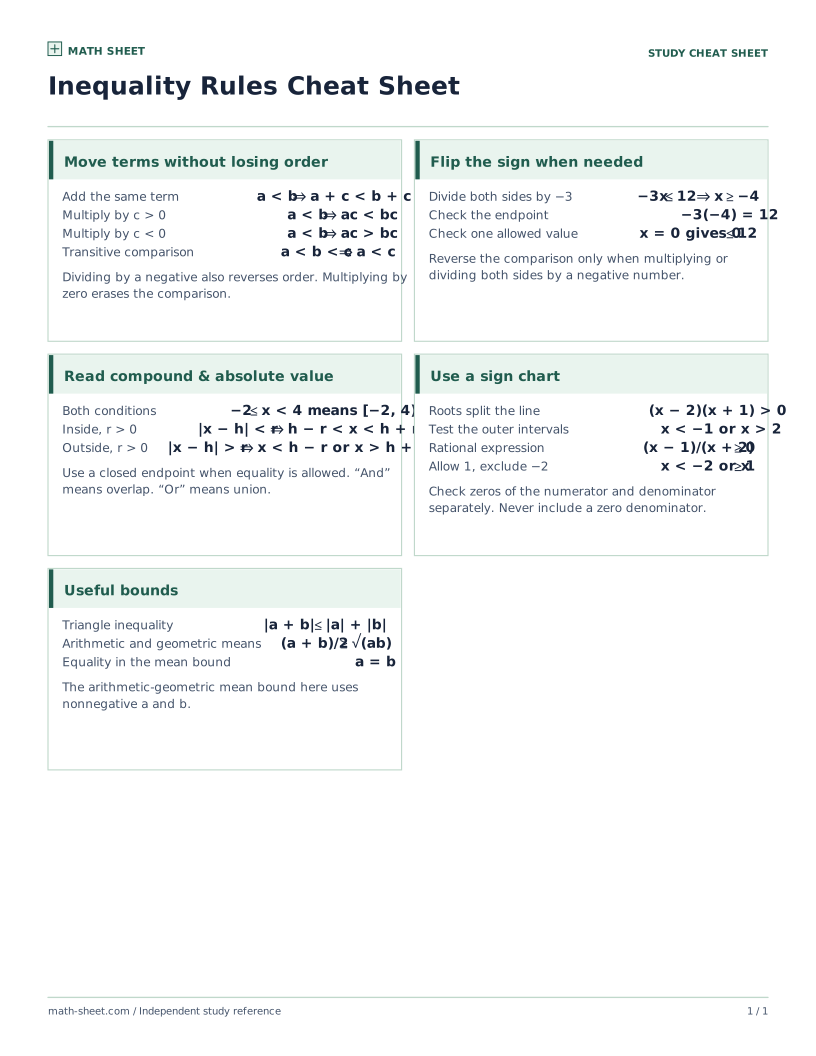
Track endpoints and the sign of any multiplier. Use a sign chart for quadratic and rational expressions, and test a value before you finish.

On this page

Find a formula

Open a formula for its definition and a worked example.

Read the comparison signs

  • Strict orderinga < b ⇔ b > aA strict boundary is excluded, so use an open dot on a number line.

    What it does

    A strict comparison places one real number to the left or right of another and excludes equality.

    Worked example

    Compare −5 and −2 using both strict signs.

    1. −5 is farther left on the number line, so −5 < −2.
    2. With the order of the numbers reversed, write −2 > −5.
    Link to this example
  • Ordering that allows equalitya ≤ b ⇔ b ≥ aUse a closed dot at a finite endpoint included in the solution.

    What it does

    A weak comparison permits equality as well as a strict order.

    Worked example

    Is x = 4 included in the solution x ≤ 4?

    1. Substituting x = 4 gives 4 ≤ 4, which is true.
    2. Include 4 and mark it with a closed dot.
    Link to this example
  • Different valuesa ≠ bEither a < b or a > b.

    What it does

    The not-equal sign excludes the case where the compared quantities have the same value.

    Worked example

    Solve 2x ≠ 6 over the reals.

    1. Equality would occur at x = 3.
    2. Every real number other than 3 is a solution.
    Link to this example
  • Endpoint markers< and > exclude equality, ≤ and ≥ include equality

    What it does

    Number-line endpoint markers show whether a boundary value satisfies an inequality.

    Worked example

    Draw the endpoints of −1 < x ≤ 3 on a number line.

    1. The comparison at −1 is strict, so put an open dot there.
    2. At 3 use a closed dot and shade the segment between.
    Link to this example

Operations on both sides

  • Add or subtract a shared amounta < b ⇒ a ± c < b ± cUse the same choice of sign on both sides.

    What it does

    Adding or subtracting the same real amount shifts both values together and keeps their order.

    Worked example

    Solve x − 5 < 2.

    1. Add 5 to both sides.
    2. The solution is x < 7.
    Link to this example
  • Scale by a positive numberc > 0: ac < bc and a/c < b/c whenever a < b

    What it does

    Multiplying or dividing both sides by a positive number preserves the comparison direction.

    Worked example

    Solve 3x ≥ 15.

    1. Divide both sides by positive 3.
    2. The result is x ≥ 5.
    Link to this example
  • Reverse order with a negative scalec < 0: ac > bc and a/c > b/c whenever a < b

    What it does

    Multiplying or dividing by a negative number reverses the order of the two sides.

    Worked example

    Solve −4x < 20.

    1. Divide by −4 and switch < to >.
    2. The result is x > −5.
    Link to this example

Consequences of order

  • Chain strict comparisonsa < b and b < c ⇒ a < c

    What it does

    Transitivity lets you connect two inequalities that share a middle value.

    Worked example

    Use −5 < −1 and −1 < 6 to compare −5 and 6.

    1. The shared value −1 is greater than −5 and smaller than 6.
    2. Thus −5 < 6.
    Link to this example
  • Compare two real numbersExactly one of a < b, a = b, a > b holds.

    What it does

    For any two real numbers, exactly one of less than, equal to or greater than is true.

    Worked example

    Compare 5/8 and 0.625.

    1. Dividing 5 by 8 gives 0.625.
    2. Equality holds, so both strict comparisons are false.
    Link to this example
  • Take reciprocals0 < a < b or a < b < 0 ⇒ 1/a > 1/b. If a < 0 < b, then 1/a < 0 < 1/b.Zero has no reciprocal.

    What it does

    Taking reciprocals reverses order on each side of zero separately. Reciprocals keep the sign of their inputs.

    Worked example

    Compare reciprocals for −4 < −2, then for −2 < 3.

    1. For the two negatives, −1/4 > −1/2, which reverses their order.
    2. Across zero the order stays −1/2 < 0 < 1/3.
    Link to this example
  • Square nonnegative values0 ≤ a < b ⇒ a² < b²

    What it does

    Squaring preserves strict order between nonnegative values because their squares grow with magnitude.

    Worked example

    Square 3 < 7. Then check whether the same operation keeps −7 < −3.

    1. The first gives 9 < 49.
    2. The negative inputs give 49 > 9, so the nonnegative condition matters.
    Link to this example

Distance from zero

  • Inside a distance bound|u| < a ⇔ −a < u < a. With ≤ use −a ≤ u ≤ a.u may itself be an expression such as f(x). Use a ≥ 0.

    What it does

    A less-than absolute value bound asks for values inside a distance from zero, with endpoints included for ≤.

    Worked example

    Solve |x − 2| ≤ 3.

    1. Write −3 ≤ x − 2 ≤ 3.
    2. Add 2 to all parts to obtain −1 ≤ x ≤ 5.
    Link to this example
  • Outside a distance bound|u| > a ⇔ u < −a or u > a. With ≥ use u ≤ −a or u ≥ a.Use a ≥ 0.

    What it does

    A greater-than absolute value bound asks for points in either tail outside a central interval.

    Worked example

    Solve |x + 1| > 4.

    1. Either x + 1 < −4 or x + 1 > 4.
    2. Subtract 1 to get x < −5 or x > 3.
    Link to this example
  • Zero as the bound|x| < 0 is impossible, and |x| ≥ 0 holds for every real x.

    What it does

    Absolute value is a nonnegative distance. Zero is possible exactly when the input is zero.

    Worked example

    Compare the solutions of |x − 7| < 0 and |x − 7| ≥ 0.

    1. The first has no solutions because distance cannot be negative.
    2. The second includes every real x, with equality at x = 7.
    Link to this example

Signs of quadratic expressions

  • Make a sign chart for q(x) = ax² + bx + cq(x) = 0 gives the real breakpoints. Test q(x) once in each open interval.Include a real root only when equality is allowed.

    What it does

    Quadratic zeros partition the number line into open intervals of constant sign.

    Worked example

    Solve x² + x − 6 ≤ 0.

    1. Factor as (x + 3)(x − 2), with zeros −3 and 2. At x = 0 the value is −6.
    2. Outside the two roots the product is positive. Include both roots to get [−3,2].
    Link to this example
  • Two roots r₁ < r₂ and a > 0q(x) < 0 for r₁ < x < r₂, q(x) > 0 for x < r₁ or x > r₂.The signs are reversed when a < 0.

    What it does

    An upward-opening quadratic with two distinct real roots is negative between the roots and positive outside them.

    Worked example

    Find where (x − 1)(x − 5) is positive.

    1. The roots are 1 and 5 and the leading coefficient is positive.
    2. The positive intervals are (−∞,1) and (5,∞).
    Link to this example
  • No real zerosb² − 4ac < 0 ⇒ q(x) has the sign of a for every real x.If the discriminant is zero, the repeated root touches zero and the sign does not change.

    What it does

    If a quadratic has no real zeros, it keeps the sign of its leading coefficient everywhere.

    Worked example

    Show that −x² + 2x − 3 is always negative.

    1. Its discriminant is 2² − 4(−1)(−3) = −8.
    2. There are no real zeros. The leading coefficient is negative, so all values are negative.
    Link to this example
See Quadratic Formula Sheet

Join or intersect solution sets

  • Both bounds must holda < x and x < b ⇔ a < x < b ⇔ x ∈ (a, b)For a ≤ x ≤ b, include both endpoints using brackets.

    What it does

    A conjunction uses the intersection, so a solution must satisfy both bounds at once.

    Worked example

    Find the values that satisfy x > −2 and x ≤ 4.

    1. Combine them as −2 < x ≤ 4.
    2. The interval is (−2,4].
    Link to this example
  • Either branch can holdx < a or x > b ⇔ x ∈ (−∞, a) ∪ (b, ∞)

    What it does

    A disjunction uses the union, so meeting either condition is enough.

    Worked example

    Write x < −1 or x > 4 in interval notation.

    1. The two strict bounds give (−∞,−1) and (4,∞).
    2. Join the intervals with ∪.
    Link to this example
  • Operate on a three-part inequalitya < x < b ⇒ a + c < x + c < b + cApply a shared operation to all three parts. Reverse both comparisons under negative scaling.

    What it does

    Operations on a compound chain must be applied to all three expressions. Multiplying or dividing by a negative reverses both comparisons.

    Worked example

    Solve −8 < −2x ≤ 4.

    1. Divide every part by −2 to get 4 > x ≥ −2.
    2. In increasing order, −2 ≤ x < 4.
    Link to this example

Signs of polynomial quotients

  • Find the candidate sign boundariesSolve P(x) = 0 and Q(x) = 0, then test P(x)/Q(x) in each interval.A boundary does not always flip the sign. Include a numerator zero only when equality is allowed and Q(x) ≠ 0.

    What it does

    Zeros of the numerator and denominator divide the domain into intervals where a rational expression has a constant sign.

    Worked example

    Solve (x − 2)/(x + 1) > 0.

    1. The boundaries are −1 and 2. Numerator and denominator have the same sign to the left of −1 and to the right of 2.
    2. The result is (−∞,−1) ∪ (2,∞).
    Link to this example
  • Preserve domain exclusionsQ(x) ≠ 0 even if a common factor cancels.

    What it does

    A denominator zero is excluded from the original expression, even when a common factor simplifies away.

    Worked example

    Solve (x² − 4)/(x − 2) ≥ 0.

    1. For x ≠ 2 the quotient simplifies to x + 2.
    2. The solution is [−2,2) ∪ (2,∞).
    Link to this example
  • Check before clearing a denominatorQ(x) > 0 preserves order. Q(x) < 0 reverses it.If the sign depends on x, split into sign cases or test intervals.

    What it does

    Clearing a denominator requires knowing its sign because a negative factor reverses the comparison.

    Worked example

    Solve 1/x > 1.

    1. For x > 0, multiply by x to get x < 1. For x < 0, multiplying reverses the sign and would require x > 1.
    2. Only the positive case works, giving 0 < x < 1.
    Link to this example

Useful upper and lower bounds

  • Direct and reverse triangle bounds|a + b| ≤ |a| + |b|, ||a| − |b|| ≤ |a − b|

    What it does

    The triangle bound limits the magnitude of a sum. Its reverse form bounds the difference in magnitudes by the magnitude of the difference.

    Worked example

    Check both bounds for a = −5 and b = 2.

    1. For the sum, |−5 + 2| = 3 ≤ 5 + 2.
    2. For the difference, |5 − 2| = 3 ≤ |−5 − 2| = 7.
    Link to this example
  • Arithmetic and geometric means(a + b)/2 ≥ √(ab) for a, b ≥ 0

    What it does

    For nonnegative inputs, the geometric mean never exceeds their arithmetic mean.

    Worked example

    Compare the arithmetic and geometric means of 4 and 9.

    1. The arithmetic mean is (4 + 9)/2 = 6.5.
    2. The geometric mean is √(4 × 9) = 6, so 6.5 ≥ 6.
    Link to this example
  • Cauchy–Schwarz inequality|u · v| ≤ ‖u‖‖v‖For the usual Euclidean norm and dot product.

    What it does

    Cauchy–Schwarz bounds the absolute dot product by the product of the vector lengths.

    Worked example

    Check the bound for u = (3,0) and v = (1,2).

    1. The absolute dot product is |3 × 1 + 0 × 2| = 3.
    2. The length product is 3√5, which is greater than 3.
    Link to this example
  • Bernoulli’s bound(1 + x)n ≥ 1 + nx for x ≥ −1 and integers n ≥ 1

    What it does

    Bernoulli’s inequality bounds (1 + x)n from below by its linear part when x ≥ −1 and n is a positive integer.

    Worked example

    Use the bound to estimate (1.02)5 from below.

    1. Take x = 0.02 and n = 5, so 1 + nx = 1.10.
    2. The exact power is about 1.1041, consistent with the lower bound.
    Link to this example
See Vector Formulas

Preview the printable

Download the compact sheet for a quick review, or print the complete formula list from this page.

Practice these skills

Related references

Sources and review

Math Sheet prepares original print materials. See how we check formulas and printouts.

Browse all formula sheets →