
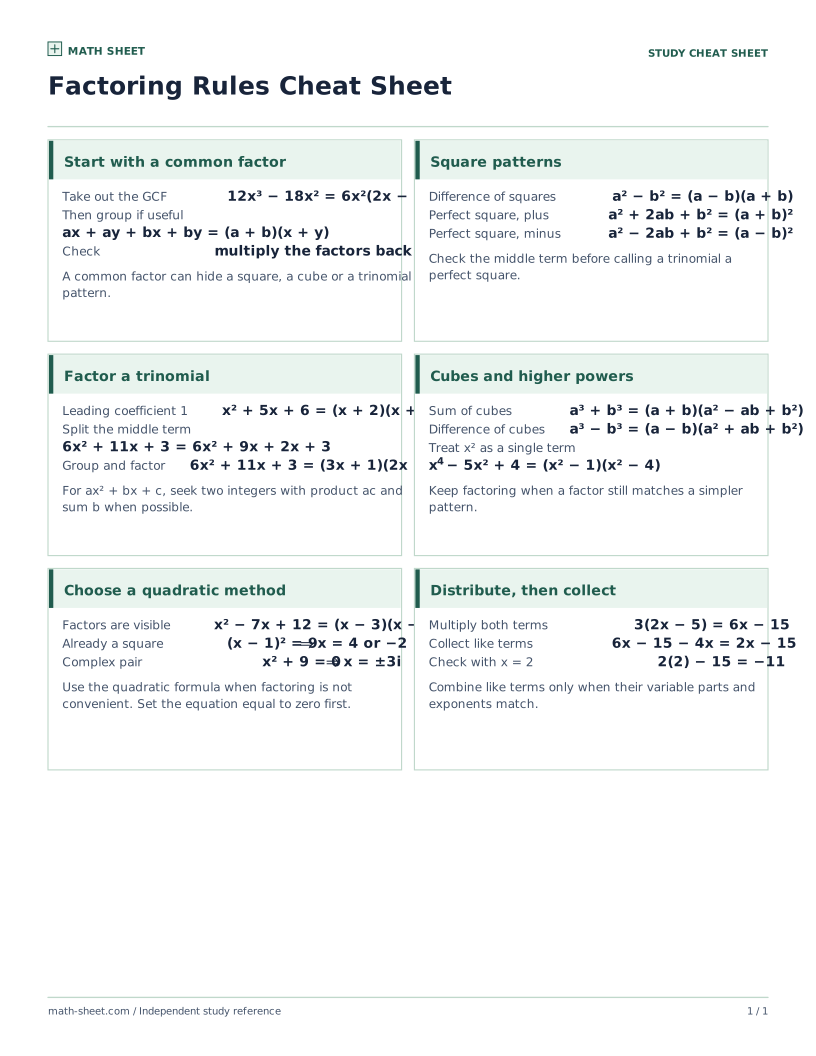
1 page · US Letter / A4
Factoring Rules Cheat Sheet
Recognize GCF, square and cube patterns, trinomials and grouping with a printable factoring cheat sheet.
Algebra I & II
Look for a common factor first. Use the number and shape of the remaining terms to choose a square, cube, trinomial or grouping pattern.
On this page
Open a formula for its definition and a worked example.
Factoring Rules Cheat Sheet
What it does
The greatest common factor is shared by every term. Pulling it out reverses distribution, and a negative common factor can make the remaining leading coefficient positive.
Worked example
Factor −18x² − 12x.
What it does
For a common monomial factor, use the greatest common divisor of coefficients and the lowest exponent of each variable shared by every term.
Worked example
Factor 15x⁴y³ + 20x²y⁵.
What it does
A difference of squares is the product of a sum and a difference because the cross terms cancel.
Worked example
Factor 25m² − 49n².
What it does
A sum of two squares in independent variables has no factorization into nonconstant real polynomials. With complex coefficients the imaginary unit supplies conjugate factors.
Worked example
Factor x² + 9 as far as possible over the reals and over the complex numbers.
What it does
A perfect-square trinomial has two squared outer terms and a middle term equal to twice their signed product. Its sign chooses plus or minus inside the square.
Worked example
Factor 4x² − 20x + 25 and the version with +20x.
What it does
A positive middle term can match the expansion of a binomial sum squared when it is exactly twice the product of the outer roots.
Worked example
Factor x² + 16x + 64.
What it does
For a monic quadratic, the constants of two linear factors multiply to the constant term and add to the coefficient of x.
Worked example
Factor x² − 11x + 24.
What it does
A positive constant term requires two factor constants with matching signs. A negative constant requires opposite signs.
Worked example
Factor x² + x − 12 and x² + 8x + 15.
What it does
For integer factoring of ax² + bx + c, split b into two numbers whose product is ac. Then factor the resulting groups.
Worked example
Factor 6x² + 11x + 3.
What it does
After factoring by splitting the middle term, expand the resulting binomials to verify all three coefficients.
Worked example
Factor 4x² + 12x + 5 and check the result.
What it does
Grouping works when two groups produce a common factor after each group’s local factor is removed.
Worked example
Factor 3ax − 6a + 5x − 10.
What it does
For some cubics, grouping pairs by degree exposes the same binomial in both groups.
Worked example
Factor x³ − 3x² + 2x − 6.
What it does
A cube pair factors into a binomial with the original sign and a quadratic with the opposite middle sign and a positive last term.
Worked example
Factor x³ − 125 and x³ + 125.
What it does
Numerical cubes can pair with a variable cube even when the numeric term appears first. Keep the order of the terms when factoring a difference.
Worked example
Factor 8 + z³ and 216 − z³.
What it does
A difference of fourth powers first factors as a difference of squared quantities. Its difference factor is itself another difference of squares.
Worked example
Factor x⁴ − 81 over the reals.
What it does
When a quartic has powers x⁴, x² and a constant, substituting a temporary variable for x² turns it into a quadratic.
Worked example
Factor x⁴ − 13x² + 36.
What it does
A positive integer power difference always contains the factor u − v. The remaining polynomial is the sum of all descending u powers with matching ascending v powers.
Worked example
Factor x⁵ − 32 using the difference-of-powers identity.
What it does
Removing a common factor first can expose a simpler expression. Counting the remaining terms helps choose its factorization pattern.
Worked example
Choose a method for 6x³ − 24x.
What it does
After taking out a shared factor, use term count as a clue. Two terms can hide square or cube patterns, three may form a quadratic, and four may permit grouping.
Worked example
Choose a method for y² − 49, y² + 9y + 20 and y³ + 2y² + 3y + 6.
What it does
A first split may leave factors that split again. Continue in the chosen coefficient field, then expand to check.
Worked example
Factor x⁴ − 16 completely over the reals and verify.
Download the compact sheet for a quick review, or print the complete formula list from this page.
1 page · US Letter / A4
Recognize GCF, square and cube patterns, trinomials and grouping with a printable factoring cheat sheet.
Math Sheet prepares original print materials. See how we check formulas and printouts.