Calculus I–II

Calculus Formula Sheet

Use this course review to connect limits, rates of change and accumulation. The first page follows core Calculus I ideas. The second gives integration techniques, applications and series checks for Calculus II.

On this page

Find a formula

Open a formula for its definition and a worked example.

Limits and instantaneous change

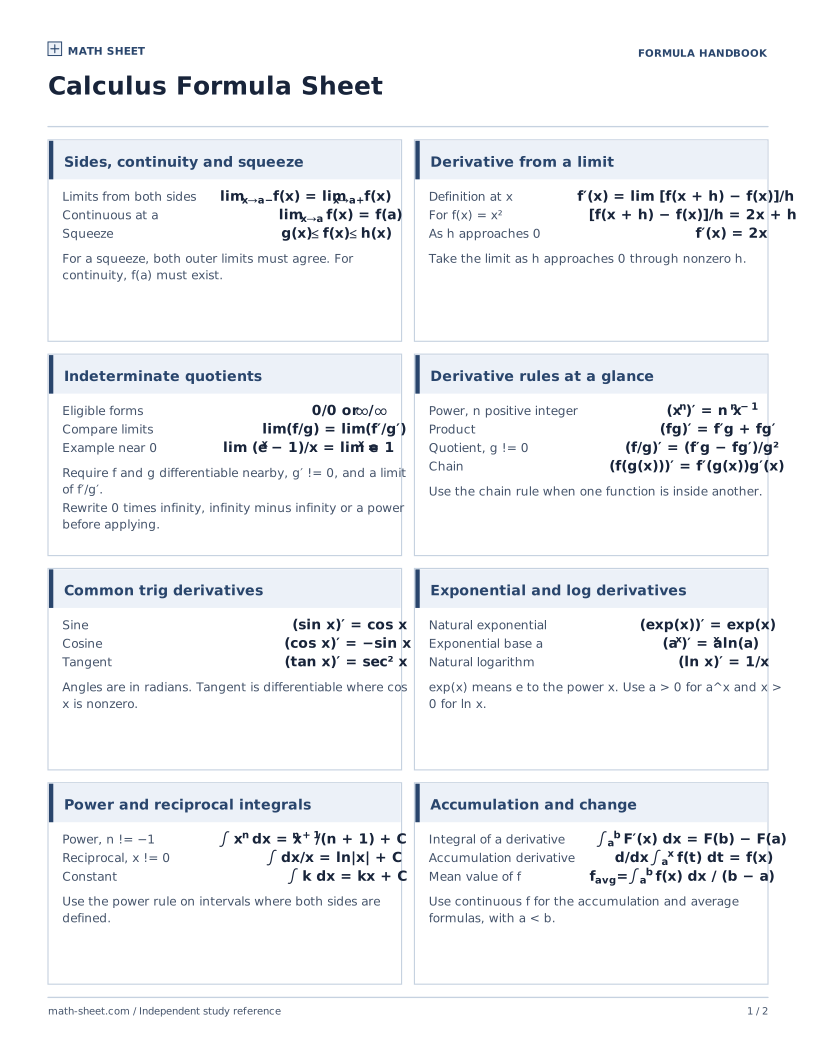
  • Turn a secant into a tangentf′(x) = lim h→0 [f(x + h) − f(x)]/h

    What it does

    The derivative is the limiting rate of change of the function between two inputs as their separation tends to zero.

    Worked example

    Find f′(3) directly for f(x) = x² − 2x.

    1. The numerator f(3 + h) − f(3) is 4h + h².
    2. Divide by h and let h tend to zero to get 4.
    Link to this example
  • Differentiate numerator and denominator separatelylim f/g = lim f′/g′L’Hôpital’s rule starts from 0/0 or ∞/∞. Use differentiable functions near the limit point, a nonzero g′ there, and an existing derivative-quotient limit, which can be infinite.

    What it does

    L’Hôpital’s rule can evaluate a qualifying 0/0 or ∞/∞ limit by differentiating numerator and denominator separately. The derivative quotient must have a limit.

    Worked example

    Evaluate lim x→∞ ln x / x.

    1. Both numerator and denominator grow without bound and the denominator derivative is 1.
    2. Their derivative quotient is 1/x, which approaches zero.
    Link to this example
  • Small-angle comparisonlim x→0 sin(x)/x = 1Use radians.

    What it does

    When an angle is in radians, sin u / u tends to one as u tends to zero.

    Worked example

    Evaluate lim x→0 sin(7x)/(2x).

    1. Rewrite the quotient as (7/2)·sin(7x)/(7x).
    2. The second factor tends to 1, so the limit is 7/2.
    Link to this example
See Limits Cheat Sheet

Differentiate expressions by structure

  • Bring down the power(xn)′ = nxn−1Stay where the function is differentiable. Differentiate the constant function 1 as a constant.

    What it does

    Differentiating a power multiplies by its exponent and lowers it by one wherever the function is differentiable.

    Worked example

    Differentiate x5/2 for x > 0.

    1. Bring down the factor 5/2 and subtract 1 from 5/2.
    2. The derivative is (5/2)x3/2.
    Link to this example
  • Handle a product, quotient or composition(fg)′ = f′g + fg′, (f/g)′ = (f′g − fg′)/g², (f ∘ g)′ = (f′ ∘ g)g′The quotient requires g ≠ 0.

    What it does

    The derivative of a product, quotient or composition follows a distinct structural rule. A quotient keeps the denominator squared and excludes its zeros.

    Worked example

    Differentiate (x² + 1)sin(2x)/x for x ≠ 0.

    1. By product and chain rules the numerator derivative is 2x sin(2x) + 2(x² + 1)cos(2x).
    2. The quotient rule gives [(x² − 1)sin(2x) + 2x(x² + 1)cos(2x)]/x².
    Link to this example
  • Differentiate e^x and its inverse(ex)′ = ex, (ln x)′ = 1/x for x > 0

    What it does

    The natural exponential is its own derivative. The derivative of its real inverse ln x is 1/x on x > 0.

    Worked example

    Find the slope of f(x) = ex + 2 ln x at x = 1.

    1. Differentiate termwise to get ex + 2/x.
    2. At 1 the slope is e + 2.
    Link to this example
See Derivatives cheat sheet

Rates of change of trig functions

  • Differentiate sine or cosine(sin x)′ = cos x, (cos x)′ = −sin x

    What it does

    In radians, the sine derivative is cosine and the cosine derivative is negative sine.

    Worked example

    Differentiate 4 sin x − 3 cos x.

    1. The sine term gives 4 cos x.
    2. The minus on the cosine term cancels the derivative’s minus to give 4 cos x + 3 sin x.
    Link to this example
  • Differentiate tangent or secant(tan x)′ = sec² x, (sec x)′ = sec x tan xUse radians and cos x ≠ 0.

    What it does

    Tangent and secant derivatives are defined where cosine is nonzero. Tangent differentiates to secant squared, and secant to secant times tangent.

    Worked example

    Find the derivative of tan x + sec x at x = π/4.

    1. At π/4, sec x = √2 and tan x = 1.
    2. The derivative is sec² x + sec x tan x = 2 + √2.
    Link to this example

Find antiderivatives by pattern

  • Integrate x to a power∫ xn dx = xn+1/(n+1) + C when n ≠ −1, ∫ x−1 dx = ln|x| + CUse an interval where the integrand is defined.

    What it does

    Most powers integrate by raising the exponent and dividing by the new one. The exponent −1 needs a logarithm on an interval away from zero.

    Worked example

    Find ∫ (4x³ − 3/x) dx for x < 0.

    1. The power term contributes 4x⁴/4 = x⁴.
    2. The reciprocal term gives −3 ln|x|, so the result is x⁴ − 3 ln|x| + C.
    Link to this example
  • Integrate the natural exponential∫ ex dx = ex + C

    What it does

    The natural exponential has the same antiderivative up to an additive constant.

    Worked example

    Find ∫ 7ex dx.

    1. Keep the constant 7 outside and integrate ex to ex.
    2. The family of antiderivatives is 7ex + C.
    Link to this example
  • Recognize trig antiderivatives∫ sin x dx = −cos x + C, ∫ cos x dx = sin x + C, ∫ sec² x dx = tan x + C

    What it does

    Sine, cosine and secant squared are reverse patterns for derivatives of negative cosine, sine and tangent on intervals where they are defined.

    Worked example

    Integrate 2 sin x + cos x + 3 sec² x on (−π/2, π/2).

    1. The first two antiderivatives are −2 cos x and sin x.
    2. Add 3 tan x and C to get −2 cos x + sin x + 3 tan x + C.
    Link to this example
See Integral Table and Integration Formulas

Connect derivatives with accumulation

  • Recover the integrand at the moving endpointd/dx ∫ax f(t) dt = f(x)Use continuity at the moving endpoint.

    What it does

    For an integral with fixed lower limit and variable upper limit, differentiation recovers the integrand at the moving endpoint when it is continuous there.

    Worked example

    Differentiate F(x) = ∫1x (t³ + 4) dt.

    1. The polynomial integrand is continuous, and the upper bound is x itself.
    2. The derivative is F′(x) = x³ + 4.
    Link to this example
  • Use an antiderivative at the bounds∫ab f(x) dx = F(b) − F(a)For continuous f, choose any F with F′ = f.

    What it does

    A definite integral of a continuous function equals an antiderivative evaluated at the upper bound minus its value at the lower bound.

    Worked example

    Evaluate ∫13 (2x + 1) dx.

    1. An antiderivative is x² + x.
    2. Subtract its value 2 at x = 1 from its value 12 at x = 3 to get 10.
    Link to this example

Choose an integration technique

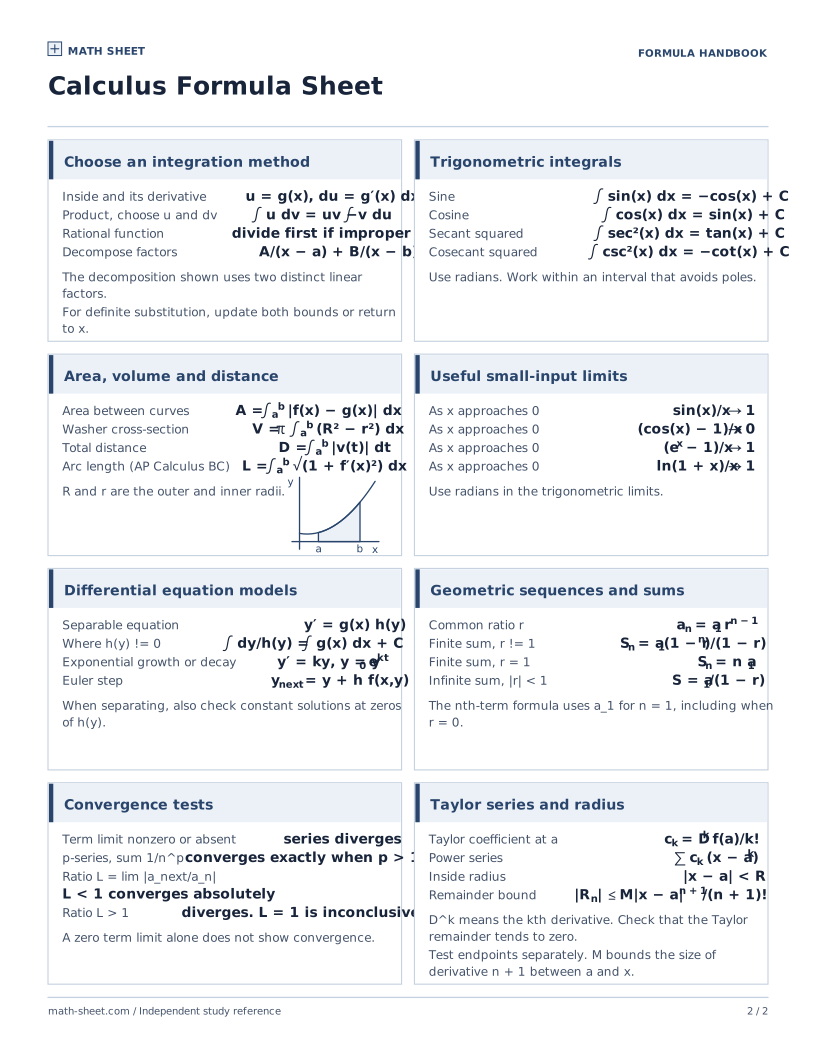
  • Replace an inner expression and its derivativeu = g(x), du = g′(x) dx, ∫ f(g(x))g′(x) dx = ∫ f(u) du

    What it does

    Substitution replaces an expression and its matching differential with a simpler variable to reverse the chain rule.

    Worked example

    Evaluate ∫ 2x cos(x² + 1) dx.

    1. Choose u = x² + 1 so du = 2x dx.
    2. Integrate cos u and substitute back to get sin(x² + 1) + C.
    Link to this example
  • Move a derivative to another factor∫ u dv = uv − ∫ v du

    What it does

    Integration by parts uses the product rule in reverse. Choose the factors so the remaining integral is simpler.

    Worked example

    Find ∫ xex dx.

    1. Let u = x and dv = ex dx, so du = dx and v = ex.
    2. Subtract ∫ ex dx from xex to get ex(x − 1) + C.
    Link to this example

Infinite series and their values

  • Use derivative data at a centerTaylor series at a = Σn=0∞ f(n)(a)(x − a)n/n!The sum equals f(x) where the Taylor remainder tends to zero.

    What it does

    Taylor expansion builds powers around a center from derivatives evaluated there. The equality to the original function depends on the remainder tending to zero.

    Worked example

    Find the degree-two Taylor polynomial of ln x at x = 1.

    1. At 1 the value is 0, first derivative 1 and second derivative −1.
    2. The degree-two Taylor polynomial is (x − 1) − (x − 1)²/2.
    Link to this example
  • Two series with simple convergence testsΣn=0∞ arn = a/(1 − r) for |r| < 1. Σn=1∞ 1/np converges if and only if p > 1.

    What it does

    A geometric series with ratio magnitude below one has a closed sum. A p-series from n = 1 converges exactly when p > 1.

    Worked example

    Sum 8 − 4 + 2 − 1 + … and classify Σn=1∞ 1/n.

    1. The geometric ratio is −1/2, so the sum is 8/(1 + 1/2) = 16/3.
    2. The harmonic series has p = 1 and diverges.
    Link to this example
See Sequences and Series Formula Sheet

Preview the printable

Download the compact sheet for a quick review, or print the complete formula list from this page.

Practice these skills

Related references

Sources and review

Math Sheet prepares original print materials. See how we check formulas and printouts.

Browse all formula sheets →