
1 page · US Letter / A4
Conic Sections Formula Sheet
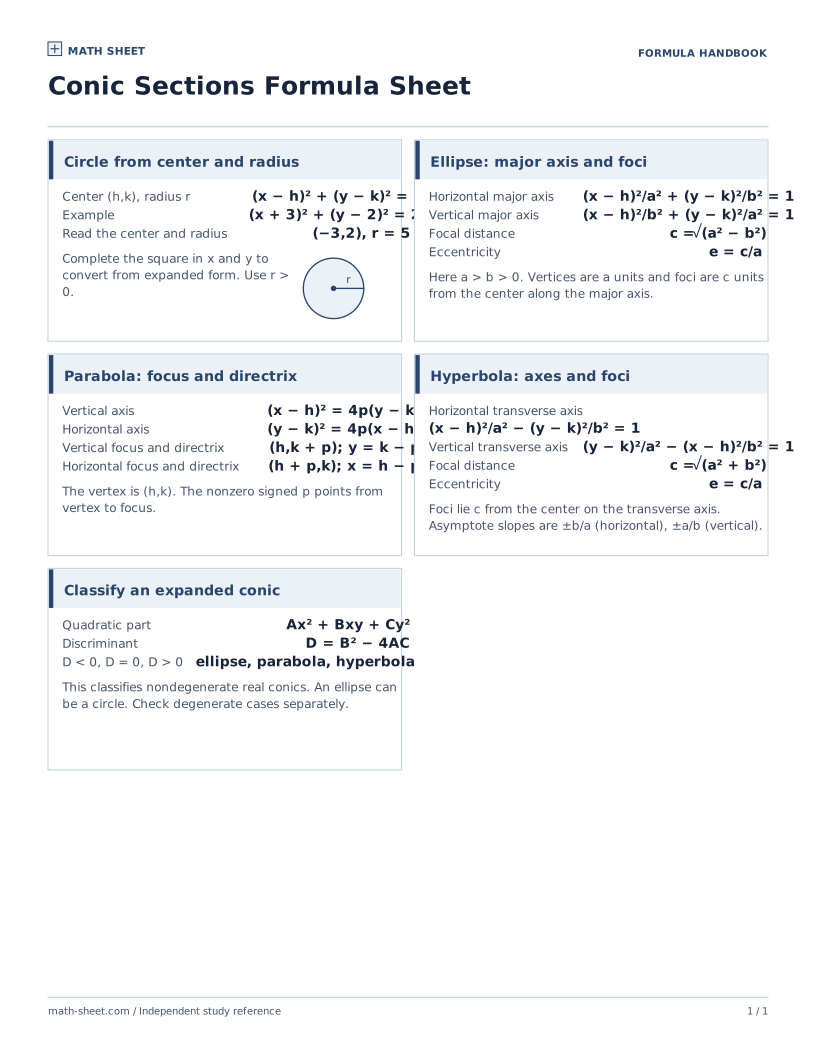
Compare circle, ellipse, parabola and hyperbola equations, with focus, directrix, eccentricity and discriminant cues.
Precalculus
Use the standard form to recognize the conic. Read the center or vertex first, then use the axis direction to place foci and asymptotes.
On this page
Open a formula for its definition and a worked example.
Conic Sections Formula Sheet
What it does
A circle is the set of all points at the same positive distance from a center. Translating the center shifts both squared coordinate terms.
Worked example
Write the circle of radius 4 centered at (2, −1), and then the one centered at the origin.
What it does
For a normalized circle equation with equal unit square coefficients and no xy term, complete the squares to find the center and positive radius.
Worked example
Find the center and radius of x² + y² − 6x + 4y − 12 = 0.
What it does
A circle’s circumference measures its boundary. Its area measures the disk bounded by it.
Worked example
Find both measures for x² + y² = 36.
What it does
A horizontal ellipse has its larger semiaxis along x. In centered form, the larger squared semiaxis is the x-term’s denominator.
Worked example
Write an ellipse with center (1, −2), horizontal semiaxis 5 and vertical semiaxis 3.
What it does
A horizontal ellipse reaches its long-axis endpoints by shifting the center along x by a. The short-axis endpoints shift vertically by b.
Worked example
Find the axis endpoints of (x − 2)²/36 + (y + 1)²/16 = 1.
What it does
An ellipse’s two foci are inside its major axis at distance c = √(a² − b²) from the center. Eccentricity is c/a.
Worked example
Find foci and eccentricity for an ellipse centered at (3, 1) with horizontal semiaxis 5 and vertical semiaxis 4.
What it does
An ellipse scales a unit disk along two perpendicular axes. Its area is π times the product of the semiaxis lengths.
Worked example
Find the area inside x²/49 + y²/16 = 1.
What it does
A vertical ellipse places the larger squared semiaxis beneath the y-term and the shorter one beneath the x-term.
Worked example
Write the ellipse with center (−1, 3), vertical semiaxis 6 and horizontal semiaxis 2.
What it does
For a vertical ellipse, vertices and foci lie above and below the center. Their distances from it are a and √(a² − b²) respectively.
Worked example
Find vertices and foci of (x + 2)²/9 + (y − 1)²/25 = 1.
What it does
In the focus form of a parabola, squaring x gives a vertical axis and squaring y gives a horizontal axis. The signed p determines the direction.
Worked example
Write a vertical parabola of vertex (1, 2) opening down with p = −3. Then write a horizontal version with the same vertex and p.
What it does
The focus is p units in the opening direction from the vertex, and the directrix is p units in the opposite direction. The axis passes through both vertex and focus.
Worked example
Find the focus, directrix and axis of (x − 2)² = 8(y + 1).
What it does
Eccentricity for a parabola is one because the distance to the focus equals the perpendicular distance to the directrix at every point.
Worked example
For y² = 8x, verify the distance ratio at (2, 4).
What it does
A horizontal hyperbola has a positive x-square term. Its vertices sit a units to the left and right of the center.
Worked example
Find the vertices of (x − 1)²/16 − (y + 2)²/9 = 1.
What it does
For a hyperbola, the focal distance c is the hypotenuse of a right triangle with legs a and b. Dividing c by a gives eccentricity above one.
Worked example
Find the foci and eccentricity of a horizontal hyperbola centered at (2, 0) with a = 3 and b = 4.
What it does
The two asymptotes for a horizontal hyperbola pass through its center and have slopes ±b/a.
Worked example
Find the asymptotes of (x − 3)²/25 − (y − 1)²/4 = 1.
What it does
A vertical hyperbola has a positive y-square term. Its vertices shift the center by ±a in the y-coordinate.
Worked example
Find the vertices of (y − 4)²/9 − (x + 2)²/16 = 1.
What it does
For a vertical hyperbola, the foci are displaced vertically by c = √(a² + b²). Its asymptotes pass through the center with slopes ±a/b.
Worked example
Find foci and asymptotes of (y − 1)²/16 − (x + 3)²/9 = 1.
What it does
In a quadratic curve equation, B² − 4AC uses only the coefficients of x², xy and y². Linear terms and the constant affect the location or degeneracy.
Worked example
Compute the conic discriminant for 2x² + 3xy − y² − 4x + 5 = 0.
What it does
For nondegenerate real conics, negative, zero and positive discriminants identify the ellipse, parabola and hyperbola families. Degeneracy requires a separate check.
Worked example
Classify x² + 4y² = 4, y² = 4x and x² − y² = 1.
Download the compact sheet for a quick review, or print the complete formula list from this page.
1 page · US Letter / A4
Compare circle, ellipse, parabola and hyperbola equations, with focus, directrix, eccentricity and discriminant cues.
Math Sheet prepares original print materials. See how we check formulas and printouts.