
1 page · US Letter / A4
Perimeter Formula Sheet
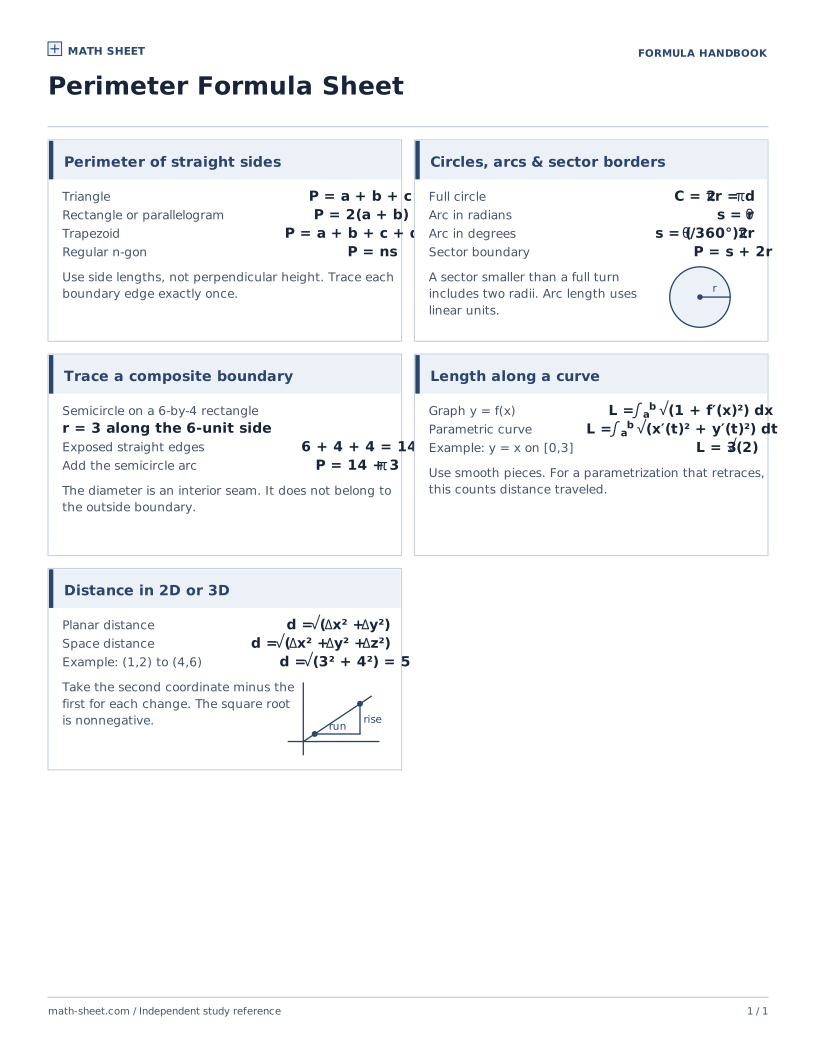
Find perimeter, circumference and arc length for straight, curved and composite boundaries with a worked example.
Geometry through calculus
Trace the outside of the shape before you add lengths. For a circle or sector, check whether the angle is given in degrees or radians.
On this page
Open a formula for its definition and a worked example.
Perimeter Formula Sheet
What it does
A triangle’s perimeter is the total distance along its three edges.
Worked example
Find the perimeter of a triangle with sides 6, 9 and 11 cm.
What it does
An equilateral triangle uses one repeated length three times. An isosceles triangle uses its matching side length twice and then adds the third side.
Worked example
Compare a triangle with all sides 7 cm and one with sides 7, 7 and 10 cm.
What it does
If only the legs of a right triangle are given, use the Pythagorean theorem to find the missing edge before adding.
Worked example
Find the perimeter of a right triangle with legs 5 and 12 cm.
What it does
Both a square and a rhombus have four sides of equal length, so their perimeter is four times any side.
Worked example
A rhombus has sides of 7 m. What is its perimeter?
What it does
A rectangle, parallelogram or kite uses two occurrences of each representative side length.
Worked example
A kite has two sides of length 4 cm and two of length 9 cm. Find its perimeter.
What it does
A trapezoid’s perimeter adds both parallel bases and both other sides. Height is used for area.
Worked example
Find the perimeter of a trapezoid with bases 8 and 14 cm and legs 5 and 5 cm.
What it does
A regular polygon’s side lengths all match, so multiplying the length by the number of sides sums the boundary.
Worked example
A regular octagon has 4 cm sides. Find the perimeter.
What it does
Circumference is the total circle boundary, found by multiplying diameter by π or radius by 2π.
Worked example
Find the circumference of a circle with radius 9 mm.
What it does
An arc covers the same fraction of the circumference as its central angle does of a full turn.
Worked example
Find the arc length for a 120° sector of radius 9 cm using degrees and radians.
What it does
Graph length adds infinitesimal straight-line distances from horizontal and vertical changes, assuming a smooth graph on the interval.
Worked example
Find the length of y = 3x over 0 ≤ x ≤ 2.
What it does
Parametric arc length integrates the speed, the magnitude of the velocity from the two coordinate derivatives.
Worked example
Find the length traced by x(t) = 3 cos t, y(t) = 3 sin t on 0 ≤ t ≤ π.
What it does
Polar arc length uses contributions from changing radius and changing angle. Angles are in radians.
Worked example
Find the length traced by r(θ) = 4 for 0 ≤ θ ≤ π/3.
Download the compact sheet for a quick review, or print the complete formula list from this page.
1 page · US Letter / A4
Find perimeter, circumference and arc length for straight, curved and composite boundaries with a worked example.
Math Sheet prepares original print materials. See how we check formulas and printouts.