
1 page · US Letter / A4
Volume Formula Sheet
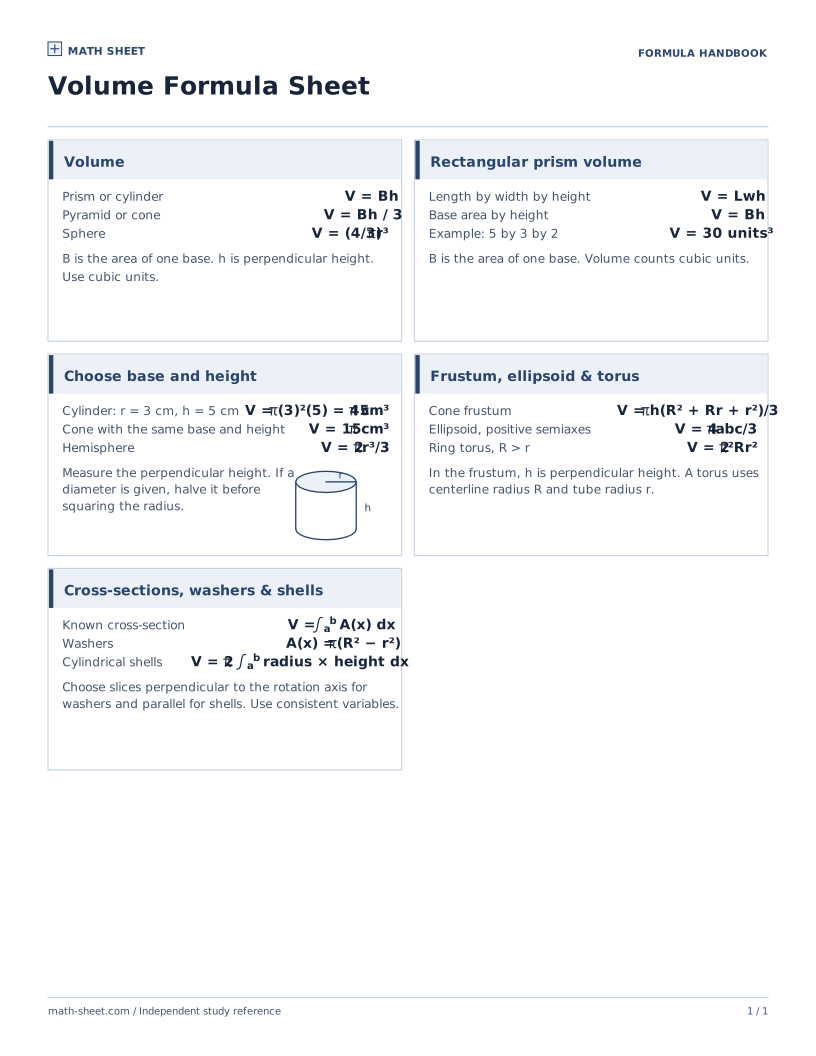
Print volume formulas for prisms, pyramids, cylinders, cones, spheres, frustums, ellipsoids, tori and integration.
Geometry through calculus
Find the shape and its perpendicular height. Use the cross-section or shell formula when a solid is formed by rotation.
On this page
Open a formula for its definition and a worked example.
Volume Formula Sheet
What it does
Every slice parallel to a prism’s bases has the same area. Volume is base area times the perpendicular separation of the bases, even if the prism leans.
Worked example
An oblique prism has base area 16 and perpendicular height 7. A slanted edge measures 9. Find its volume.
What it does
A box’s volume multiplies its three perpendicular dimensions. A cube uses the same edge length for all three.
Worked example
Find the volumes of a cube of edge 5 and a box of dimensions 5, 3, and 2.
What it does
The prism rule uses the area of its base polygon. A triangle uses half base times altitude, while a regular hexagon splits into six equilateral triangles.
Worked example
Compare height-4 prisms whose bases are a triangle of base 6 and altitude 3 and a regular hexagon of side 2.
What it does
Parallel slices in a pyramid shrink toward the apex. Its volume is one third of the base area times perpendicular height.
Worked example
Find the volumes of a square pyramid with base side 4 and a rectangular pyramid with base 3 by 5. Both heights are 9.
What it does
A regular tetrahedron is a triangular pyramid with equal edges. The regularity fixes both base area and perpendicular height in terms of the edge.
Worked example
Find the volume of a regular tetrahedron of edge 6.
What it does
A parallel cut through a pyramid leaves a frustum with similar bases. Its volume depends on both base areas, their geometric mean, and the perpendicular separation.
Worked example
A pyramidal frustum has base areas 36 and 9 and height 4. Find its volume.
What it does
A cylinder with circular bases has the same area πr² in every slice parallel to the bases. Use perpendicular height for a right or oblique cylinder.
Worked example
An oblique cylinder has base radius 3 and a perpendicular base separation of 5. Find its volume.
What it does
For a concentric hollow cylinder, subtract the volume of the empty inner cylinder from the outer one. The resulting base area is an annulus.
Worked example
A tube has outer radius 5, inner radius 3, and length 4. Find its material volume.
What it does
A cone has one third the volume of its matching cylinder. A frustum keeps two parallel circular ends after the tip is removed.
Worked example
Find the volumes of a cone of radius 4 and height 6 and a frustum of radii 4 and 2 and height 6.
What it does
Sphere volume grows with the cube of its radius. A cut through the center splits it into two equal-volume hemispheres.
Worked example
Find the sphere and hemisphere volumes for radius 3.
What it does
A spherical cap is a portion cut from a sphere by a plane. Its height measures the axial distance from that plane to the cap’s tip.
Worked example
A sphere of radius 4 has a cap of height 2. Find the cap volume.
What it does
An ellipsoid is a scaled sphere. Scaling the three coordinate directions multiplies volume by the product of the semiaxes.
Worked example
Find the volume of an ellipsoid with semiaxes 2, 3, and 5.
What it does
A ring torus revolves a disk of radius r around an external coplanar axis R units away. Volume is disk area times the circular path length of its center.
Worked example
A ring torus has R = 7 and r = 2. Find its volume.
What it does
Disks and washers slice perpendicular to the rotation axis. A disk has area πR², while a washer subtracts the area of its inner hole.
Worked example
Rotate the region 0 ≤ x ≤ 1 and 1 ≤ y ≤ 3 about the x-axis. Find the volume, then compare with the region that starts at y = 0.
What it does
A cylindrical shell has volume equal to circumference times height times its small radial thickness. Integrate the product over the radii.
Worked example
Rotate the region 0 ≤ x ≤ 2 and 0 ≤ y ≤ x about the y-axis. Find its volume using shells.
What it does
Integration sums volumes of thin slices. The cross-sectional area may come from any given shape if it is expressed as a function of the slice position.
Worked example
A solid has square slices perpendicular to the x-axis, with side length 2x for 0 ≤ x ≤ 3. Find its volume.
Download the compact sheet for a quick review, or print the complete formula list from this page.
1 page · US Letter / A4
Print volume formulas for prisms, pyramids, cylinders, cones, spheres, frustums, ellipsoids, tori and integration.
Math Sheet prepares original print materials. See how we check formulas and printouts.