Geometry through calculus

Area Formula Sheet

Match the formula to the measurements given. Label the perpendicular height, check the angle units and report square units.

On this page

Find a formula

Open a formula for its definition and a worked example.

Triangles from lengths, angles or coordinates

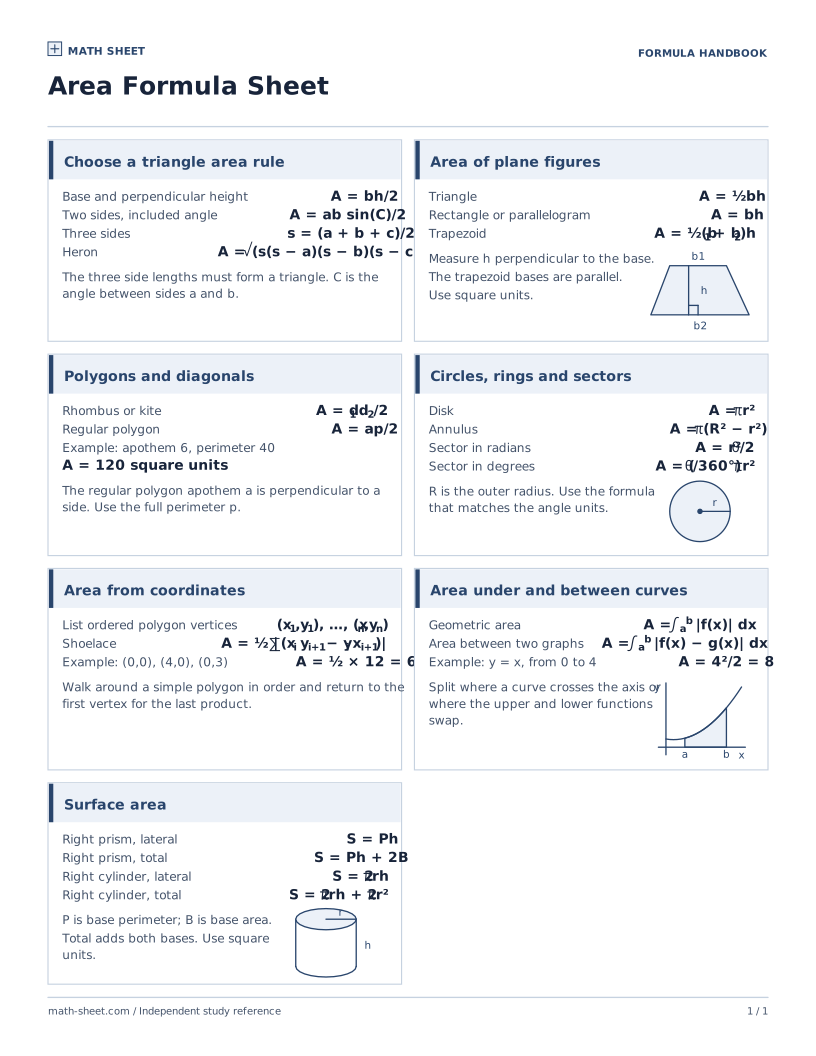
  • Use a height or an included angleA = bh/2 or A = ab sin C/2The height is perpendicular to the base. C is the angle between sides a and b.

    What it does

    Triangle area is half a base times its perpendicular height. When two side lengths and their included angle are given, the sine supplies the height.

    Worked example

    Find the area when adjacent sides are 8 and 5 with included angle 30°.

    1. With base 8 the height is 5 sin 30° = 5/2.
    2. Use 8·(5/2)/2 = 10, also equal to 8·5·sin 30°/2.
    Link to this example
  • Use only side lengthss = (a + b + c)/2, A = √(s(s − a)(s − b)(s − c)). For equal sides of length u, A = √3 u²/4.

    What it does

    Heron’s formula uses the semiperimeter and three side lengths. Equal side lengths reduce it to the equilateral shortcut.

    Worked example

    Find areas for a 5–5–6 triangle and an equilateral triangle with side 6.

    1. For sides 5, 5, 6 the semiperimeter is 8 and the area is √(8·3·3·2) = 12.
    2. For equal sides 6, use √3·36/4 = 9√3.
    Link to this example
  • Use three points in order2A = |x₁(y₂ − y₃) + x₂(y₃ − y₁) + x₃(y₁ − y₂)|Reversing the vertex order changes the sign inside the absolute value.

    What it does

    The coordinate determinant computes twice the signed area of a triangle. Take the magnitude to make it independent of vertex order.

    Worked example

    Find the area with vertices (1, 1), (5, 2) and (3, 6).

    1. Substitute into the determinant to get 1(2 − 6) + 5(6 − 1) + 3(1 − 2) = 18.
    2. The area is |18|/2 = 9 square units.
    Link to this example

Areas of four-sided figures

  • Multiply a base and perpendicular heightRectangle lw, square s², parallelogram bh

    What it does

    The area of a parallelogram is base times perpendicular height. Rectangles and squares use their perpendicular side lengths directly.

    Worked example

    Find areas of a 7-by-3 rectangle, a square with side 3 and a parallelogram with base 7 and height 4.

    1. Multiply 7·3 for the rectangle and square 3 for the square.
    2. Multiply 7·4 for the parallelogram. The areas are 21, 9 and 28.
    Link to this example
  • Average the parallel sides firstTrapezoid A = ((b₁ + b₂)/2)h

    What it does

    A trapezoid uses the average of its two parallel base lengths times their perpendicular separation.

    Worked example

    The parallel sides are 5 and 11, and the height is 4. Find the area.

    1. The average base length is (5 + 11)/2 = 8.
    2. Multiply by 4 to get 32 square units.
    Link to this example
  • Use perpendicular diagonalsKite or rhombus A = d₁d₂/2

    What it does

    In a kite or rhombus, the diagonals are perpendicular. The area is half their product.

    Worked example

    A kite’s diagonals are 7 cm and 12 cm. Find its area.

    1. Multiply the two full diagonals to get 84 cm².
    2. Take half to get 42 cm².
    Link to this example

Circles, ellipses and pieces of disks

  • Area inside a circle or ellipseCircle πr², ellipse πabFor the ellipse, use the two semiaxis lengths.

    What it does

    A circle’s interior uses its squared radius. An ellipse uses π times the product of its major and minor semiaxis lengths.

    Worked example

    Find the areas of a circle of radius 4 and an ellipse with semiaxes 4 and 3.

    1. The circle gives π·4² = 16π.
    2. The ellipse gives π·4·3 = 12π square units.
    Link to this example
  • Take a fraction of the diskSector A = θr²/2 in radians, or A = (θ/360°)πr² in degrees

    What it does

    A sector occupies the same fraction of the disk as its central angle occupies of a full turn. Use the form that matches the angle units.

    Worked example

    Find the area of a 60° sector of radius 6 using degrees and radians.

    1. Using degrees, (60/360)π·6² = 6π.
    2. Convert 60° to π/3 radians and check (1/2)·6²·(π/3) = 6π.
    Link to this example
  • Subtract a smaller concentric diskRing area A = π(R² − r²)Use outer radius R and inner radius r.

    What it does

    An annulus lies between concentric circles. Subtract the inner disk area from the outer disk area.

    Worked example

    A ring has outer radius 7 and inner radius 5. Find its area.

    1. Subtract the squared radii, 49 − 25 = 24.
    2. Multiply by π to get 24π square units.
    Link to this example
  • Subtract the signed triangular area from the sectorCircular segment A = r²(θ − sin θ)/2Use the arc’s central angle in radians, 0 ≤ θ ≤ 2π.

    What it does

    A chord and circular arc enclose a segment. Subtract the signed center triangle area from the sector area, using the central angle in radians.

    Worked example

    Find the minor segment of a radius-4 circle with central angle π/2.

    1. The sector is 16(π/2)/2 = 4π and the triangle is 16 sin(π/2)/2 = 8.
    2. The segment area is 4π − 8.
    Link to this example

Regular polygons from a side or apothem

  • Decompose into congruent trianglesA = ap/2 = ns²/[4 tan(π/n)]Use n ≥ 3, side s, perimeter p = ns and apothem a perpendicular to a side.

    What it does

    A regular polygon can be divided into equal triangles. Their common height is the apothem, which can be found from one half-side and half the central angle.

    Worked example

    Find the area of a regular hexagon with side 4.

    1. Its perimeter is 24. Its apothem is 2/tan(π/6) = 2√3.
    2. Compute 24·2√3/2 = 24√3.
    Link to this example
  • Evaluate the constant for a specific side countFor n = 3, 5, 6, 8 respectively, multiply s² by √3/4, √(5(5 + 2√5))/4, 3√3/2, 2(1 + √2).

    What it does

    For regular polygons with a fixed number of sides, the area is a side-count constant times the square of the side length.

    Worked example

    Find the areas of a regular triangle, pentagon, hexagon and octagon with side 2.

    1. Multiply each shape’s constant by 2² = 4. The triangle and pentagon give √3 and √(5(5 + 2√5)).
    2. The hexagon and octagon give 6√3 and 8(1 + √2).
    Link to this example

Integrate over a region

  • Slice verticallyA = ∫ab |f(x)| dx or A = ∫ab |f(x) − g(x)| dxFor a region above the axis use f directly. For a region between two curves integrate upper minus lower, splitting where their order changes.

    What it does

    A vertical slice has height equal to the absolute difference of its two bounding y-values. Between a curve and the axis, the second value is zero.

    Worked example

    On [0, 2], find the area between y = x − 1 and the axis, and between y = x − 1 and y = 2.

    1. The axis problem consists of two right triangles of base and height 1, with total area 1.
    2. The second problem integrates 2 − (x − 1) = 3 − x, giving [3x − x²/2]02 = 4.
    Link to this example
  • Change variables for a parametric graph∫ab y(t)x′(t) dtThis is signed. For area below a nonnegative graph, choose a traversal with x increasing once across the interval.

    What it does

    For a parametric graph, replace dx with x′(t) dt. The resulting integral is signed and gives area under a nonnegative graph traversed once with increasing x.

    Worked example

    Find the area under x(t) = 2t, y(t) = t² for 0 ≤ t ≤ 2.

    1. Here x′(t) = 2, so the area is ∫02 2t² dt.
    2. Evaluate (2/3)t³ at the endpoints to get 16/3.
    Link to this example
  • Sweep radial slicesA = (1/2) ∫αβ [R(θ)² − r(θ)²] dθUse 0 ≤ r ≤ R, radians, and a sweep that covers the region once. Set r = 0 when measuring from the origin.

    What it does

    Polar area uses radial sector slices in radians. Squared outer and inner radii are subtracted and the angular sweep should trace the region once.

    Worked example

    Find the area between r = 3 and r = 1 for 0 ≤ θ ≤ π/4, and the area from the origin to the outer curve.

    1. The ring sector integrates the constant (9 − 1)/2 = 4 across π/4, giving π.
    2. Set the inner radius to zero for the full sector to get 9π/8.
    Link to this example
See Integral Table and Integration Formulas

Area on the outside of a solid

  • Count the faces of a boxCube 6s², rectangular prism 2(lw + lh + wh)

    What it does

    Surface area adds the exterior face areas. A rectangular box has two faces of each of its three side pairs, and a cube has six identical faces.

    Worked example

    Find surface areas of a side-4 cube and a 2-by-3-by-4 box.

    1. The cube has 6·4² = 96 square units.
    2. The box has 2(2·3 + 2·4 + 3·4) = 52 square units.
    Link to this example
  • Area of a spherical shellSA = 4πr²

    What it does

    The area of a sphere’s exterior is four times the disk area for the same radius.

    Worked example

    Find the surface area of a sphere with diameter 10 cm.

    1. Halve the diameter to get radius 5 cm.
    2. Compute 4π·5² = 100π cm².
    Link to this example
  • Include the circular basesClosed cylinder 2πr² + 2πrh, closed right cone πr² + πrℓHere h is cylinder height and ℓ is cone slant height.

    What it does

    Closed cylinder and cone areas include the lateral surface plus the circular base areas. Use vertical height for the cylinder and slant height for the right cone.

    Worked example

    Find surface areas for a cylinder of radius 3 and height 4 and a right cone with the same radius and height.

    1. The cylinder has 2π·3² + 2π·3·4 = 42π.
    2. The cone has slant height 5, so its area is π·3² + π·3·5 = 24π.
    Link to this example
See Surface Area Formula Sheet

Preview the printable

Download the compact sheet for a quick review, or print the complete formula list from this page.

Practice these skills

Related references

Sources and review

Math Sheet prepares original print materials. See how we check formulas and printouts.

Browse all formula sheets →