Geometry through calculus

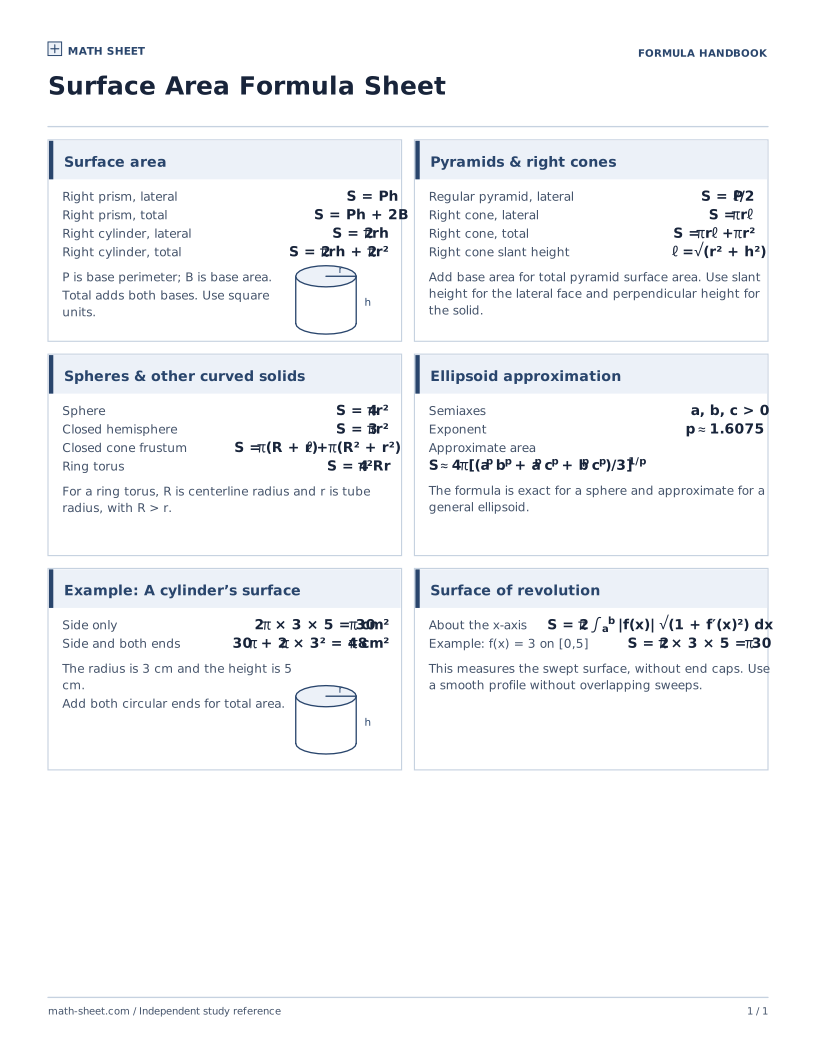
Surface Area Formula Sheet

Decide whether the ends are included. Find the correct slant or perpendicular height before substituting, then report square units.

On this page

Find a formula

Open a formula for its definition and a worked example.

Count the faces of a right prism

  • Cube and rectangular boxCube: S = 6s²; box: S = 2(ℓw + ℓh + wh)

    What it does

    A cube has six equal square faces. A rectangular box has three pairs of faces with areas ℓw, ℓh, and wh.

    Worked example

    Find surface areas for a cube of edge 3 and a box of dimensions 3, 4, and 5.

    1. For the cube, multiply one face area by six: 6(3²) = 54.
    2. For the box, sum the three pair areas: 2(12 + 15 + 20) = 94 square units.
    Link to this example
  • Triangular bases plus lateral rectanglesS = b ht + PℓUse b and h_t for one triangular base and ℓ for the perpendicular distance between the bases.

    What it does

    A right triangular prism has two congruent triangular bases and three lateral rectangles. Its lateral area is base perimeter times prism length.

    Worked example

    A right prism has a 3–4–5 triangle as its base and length 6. Find its surface area.

    1. Base perimeter is 12, and one base area is 3(4)/2 = 6.
    2. Add the two bases and the lateral rectangles: 2(6) + 12(6) = 84 square units.
    Link to this example
  • Use the perimeter and area of one baseLateral area = Ph; total area = Ph + 2BIn a right prism, the side rectangles have height h.

    What it does

    For any right prism, each lateral rectangle uses one base edge and the perpendicular height. Total area adds the two bases.

    Worked example

    A right prism has base perimeter 18, base area 20, and height 7. Find lateral and total area.

    1. Lateral area = 18(7) = 126.
    2. Total area = 126 + 2(20) = 166 square units.
    Link to this example

Wrap a right cylinder or tube

  • Curved side and both circular endsLateral area = 2πrh; total area = 2πrh + 2πr²

    What it does

    Unrolling a right cylinder’s side produces a rectangle with width equal to the circumference. Closing both ends adds two disks.

    Worked example

    Find lateral and total area of a closed cylinder of radius 2 and height 5.

    1. The side area is 2π(2)(5) = 20π.
    2. The disks add 2π(2²) = 8π, so the total is 28π square units.
    Link to this example
  • Hollow cylinder with annular endsS = 2π(R + r)h + 2π(R² − r²)Count the inner wall, outer wall and two ring-shaped ends with outer radius R > r.

    What it does

    A hollow cylinder has inner and outer curved walls and two annular ends. Each annulus subtracts the inner disk from the outer one.

    Worked example

    A tube has R = 4, r = 2, and length 3. Find total surface area.

    1. The two walls give 2π(4 + 2)(3) = 36π.
    2. The ends give 2π(16 − 4) = 24π, so the total is 60π square units.
    Link to this example

Use slant height on pyramids and cones

  • Regular pyramid faces and baseLateral area = Pℓ/2; total area = B + Pℓ/2; square base: S = s² + 2sℓℓ is the slant height of a lateral face.

    What it does

    The lateral triangles of a regular pyramid share the same slant height. Add their areas and then the base for total area.

    Worked example

    Find lateral and total area of a square pyramid with base side 6 and slant height 5.

    1. Its base perimeter is 24, so lateral area is 24(5)/2 = 60.
    2. Add base area 36 to get 96 square units.
    Link to this example
  • Right circular coneLateral area = πrℓ; total area = πrℓ + πr²

    What it does

    The side of a right cone opens into a sector whose radius is its slant height. Total area adds the circular base.

    Worked example

    Find lateral and total area for a cone with radius 3 and perpendicular height 4.

    1. Find slant height √(3² + 4²) = 5, so the side area is 15π.
    2. Add base area 9π to get 24π square units.
    Link to this example
  • Curved side of a right conical frustumLateral area = π(R + r)ℓUse the slant length between the parallel circular ends.

    What it does

    A right conical frustum’s curved surface equals the average circumference of its parallel rims times the slant length.

    Worked example

    Find the lateral area of a frustum with radii 5 and 2 and slant length 4.

    1. The average circumference is (10π + 4π)/2 = 7π.
    2. Multiply by 4 to get 28π square units.
    Link to this example

Measure round surfaces

  • Sphere and hemisphereSphere: S = 4πr²; hemisphere curved: 2πr²; hemisphere with base: 3πr²

    What it does

    A sphere’s surface splits into two equal curved halves. A closed hemisphere also has a flat circular base.

    Worked example

    Find a sphere’s area and both hemisphere area conventions for r = 3.

    1. The sphere has area 4π(3²) = 36π, so one curved half has area 18π.
    2. Adding the flat base 9π gives a closed hemisphere area of 27π.
    Link to this example
  • Curved area of a spherical capS = 2πrhMeasure the cap height h along the sphere’s axis, with 0 ≤ h ≤ 2r.

    What it does

    A spherical cap is the curved portion above a plane cut. Its curved area depends on sphere radius and the axial distance from the plane to the cap tip.

    Worked example

    A sphere of radius 5 has a cap of height 2. Find the curved area.

    1. Substitute r = 5 and h = 2 into 2πrh.
    2. The curved area is 20π square units.
    Link to this example
  • Surface of a ring torusS = 4π²RrR is the centerline radius and r is the tube radius, with R > r.

    What it does

    A ring torus forms when a circle of radius r revolves around a coplanar axis R units from its center. For R > r its surface equals the circle circumference times the center’s travel distance.

    Worked example

    Find the surface area of a ring torus with R = 6 and r = 2.

    1. The tube circumference is 4π and its center travels 12π.
    2. Multiply to obtain 48π² square units.
    Link to this example
  • Approximate an ellipsoid’s surfaceS ≈ 4π[((ab)p + (ac)p + (bc)p)/3]1/pUse positive semiaxes a, b, c and p = 1.6075.

    What it does

    The ellipsoid approximation combines the pairwise products of the three positive semiaxes with a power mean. Equal semiaxes reduce to the exact sphere formula.

    Worked example

    Approximate the surface area of an ellipsoid with semiaxes 3, 2, and 2.

    1. The pair products are 6, 6, and 4. With p = 1.6075, compute [(2 · 6p + 4p)/3]1/p ≈ 5.385.
    2. Multiply by 4π to get approximately 67.7 square units.
    Link to this example

Integrate around a rotation axis

  • Rotate a graph about a coordinate axisAbout x-axis: S = 2π∫ |y|√(1 + (dy/dx)²) dx; about y-axis: S = 2π∫ |x|√(1 + (dx/dy)²) dyIntegrate over the relevant x- or y-interval. The absolute value is distance to the rotation axis.

    What it does

    Surface area of revolution integrates circumference at each point against arc length. The radius is the absolute distance from the rotation axis.

    Worked example

    Rotate y = −2 for 0 ≤ x ≤ 3 about the x-axis. Find the curved surface area.

    1. The radius is |−2| = 2 and the arc-length factor is √(1 + 0²) = 1.
    2. Integrate the constant 4π over length 3 to obtain 12π square units.
    Link to this example
  • Rotate a parametric curve about the x-axisS = 2π∫ |y(t)|√(x′(t)² + y′(t)²) dtUse an interval where the parametrization sweeps the surface once.

    What it does

    For a parametric curve, the arc-length factor is its speed. The distance to the x-axis is |y(t)|.

    Worked example

    Rotate x(t) = 2t, y(t) = 3 for 0 ≤ t ≤ 2 about the x-axis.

    1. The speed is √(2² + 0²) = 2 and the radius is 3.
    2. Integrate 2π(3)(2) over t from 0 to 2 to obtain 24π square units.
    Link to this example
See Integral Table and Integration Formulas

Preview the printable

Download the compact sheet for a quick review, or print the complete formula list from this page.

Practice these skills

Related references

Sources and review

Math Sheet prepares original print materials. See how we check formulas and printouts.

Browse all formula sheets →