
1 page · US Letter / A4
Distance and Midpoint Formula Sheet
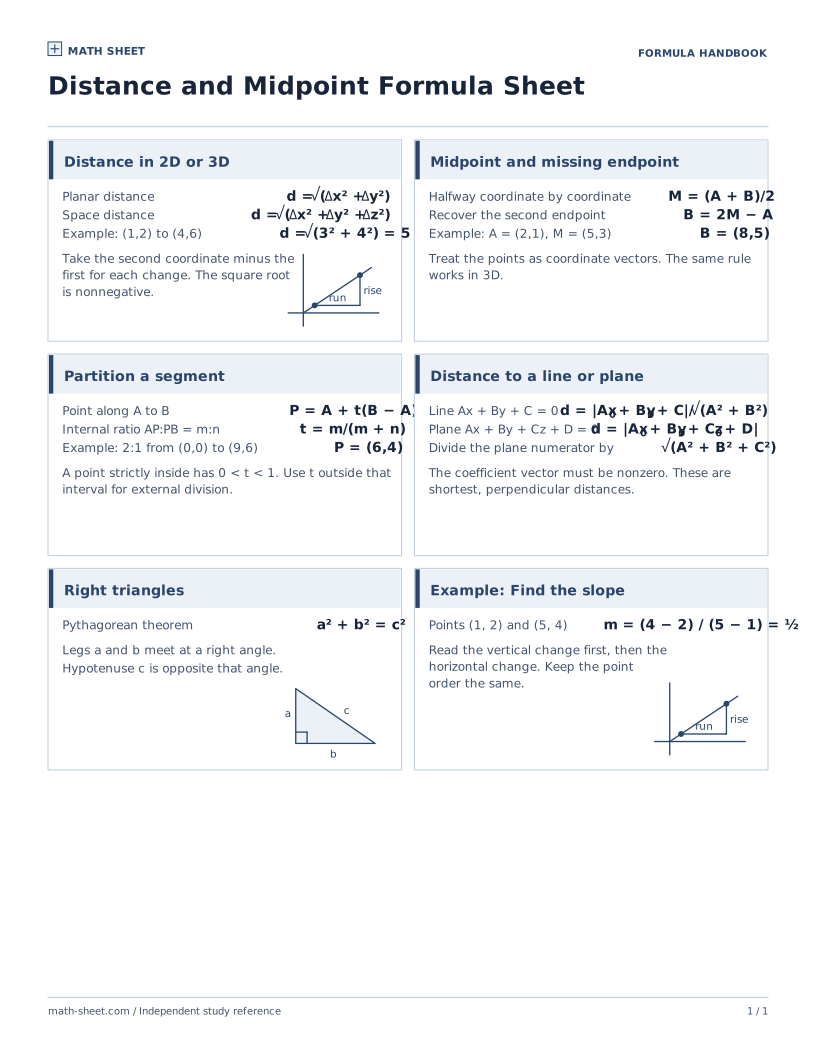
Print 2D and 3D distance, midpoint, missing endpoint, segment partition and point-to-line distance formulas.
Coordinate geometry
Decide whether you are finding a length, a point halfway along a segment, or a point that divides it in a given ratio.
On this page
Open a formula for its definition and a worked example.
Distance and Midpoint Formula Sheet
What it does
Euclidean distance is the length of the coordinate difference vector. One dimension uses an absolute value and higher dimensions combine squared perpendicular changes.
Worked example
Use A = (−1, 2, 1) and B = (2, 6, 13). Find the distance in space and after projecting onto the xy-plane and x-axis.
What it does
From the origin, coordinate differences equal the coordinates of the destination itself. Square, add and take a square root.
Worked example
Find distances from the origin to (6, 8) and (6, 8, 24).
What it does
The midpoint divides a segment into two equal lengths. Its coordinates are the averages of the corresponding endpoint coordinates.
Worked example
Find the midpoint of A = (−2, 5, 6) and B = (4, −1, 2), including its xy and x projections.
What it does
A partition point weights the endpoints to achieve AP:PB = m:n. The internal point uses positive weights, while an external point extrapolates and requires m ≠ n.
Worked example
Let A = (0, 0) and B = (6, 3). Divide the line internally and externally in the ratio AP:PB = 2:1.
What it does
The centroid is the intersection of a triangle’s medians. Each coordinate equals the mean of the three vertex coordinates.
Worked example
Find the centroid of (0, 0), (9, 0) and (0, 6).
What it does
Point-to-line distance is the perpendicular separation. Divide the absolute value of the line equation at the point by the length of the line’s normal vector.
Worked example
Find the distance from (2, 1) to 3x − 4y + 8 = 0.
What it does
Parallel lines can share the same normal coefficients A and B. Their distance is the absolute difference of the constants divided by the normal length.
Worked example
Find the distance between 3x + 4y − 10 = 0 and 6x + 8y + 10 = 0.
What it does
Pythagoras combines perpendicular component lengths into a hypotenuse. In three dimensions apply it again with the third component.
Worked example
Find the magnitudes of vectors ⟨8, 15⟩ and ⟨8, 15, 0⟩, then of ⟨8, 15, 12⟩.
What it does
The circumradius is the distance from a triangle’s circumcenter to any vertex. Given a positive area, divide the product of its sides by four times that area.
Worked example
Find the circumradius of a right triangle with sides 6, 8 and 10.
What it does
Use a distance formula on the appropriate segment. Opposite circle points form a diameter, adjacent square vertices form a side, and a triangle’s three side lengths sum to its perimeter.
Worked example
Use A = (0, 0), B = (3, 0) and C = (0, 4). Find the triangle perimeter, the length of AB as a square side, and BC as the diameter of the circle centered at its midpoint.
What it does
The center of a circle is equidistant from each chord’s endpoints, so it lies on the chord’s perpendicular bisector. Two nonparallel chords determine the center.
Worked example
Find the circle center through (0, 0), (6, 0) and (0, 4).
Download the compact sheet for a quick review, or print the complete formula list from this page.
1 page · US Letter / A4
Print 2D and 3D distance, midpoint, missing endpoint, segment partition and point-to-line distance formulas.
Math Sheet prepares original print materials. See how we check formulas and printouts.