
Preview page 2
2 pages · US Letter / A4
Geometry Formula Sheet: Expanded
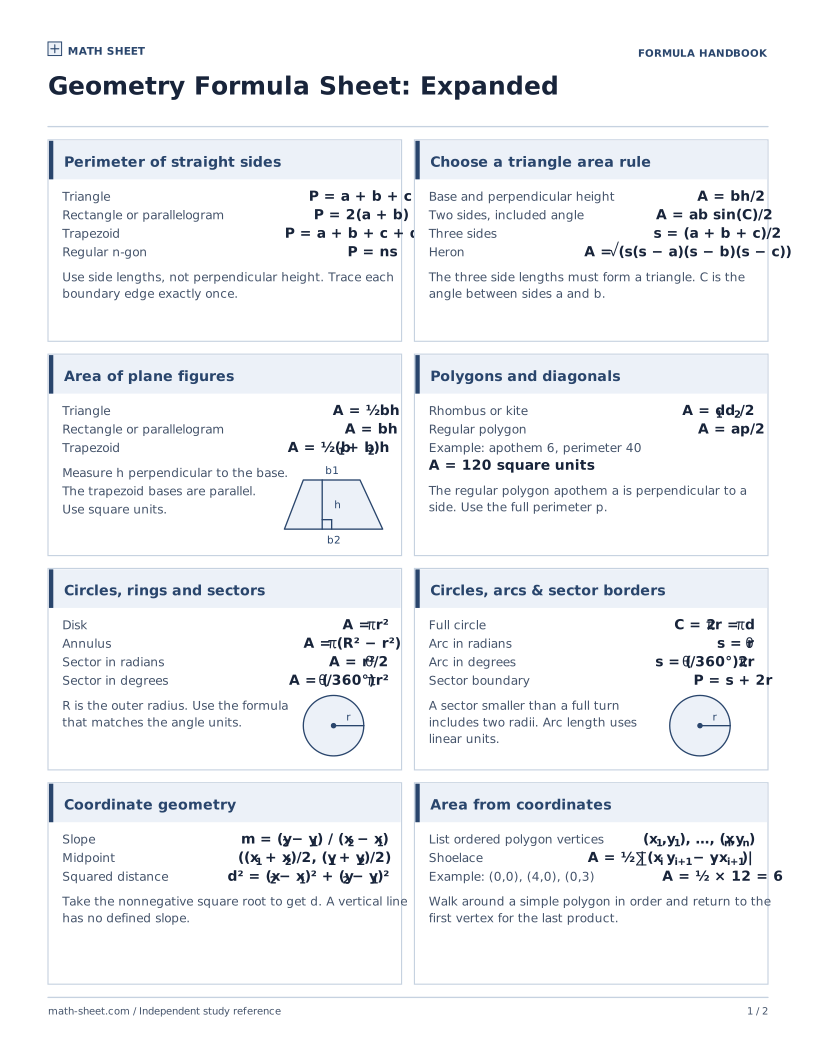
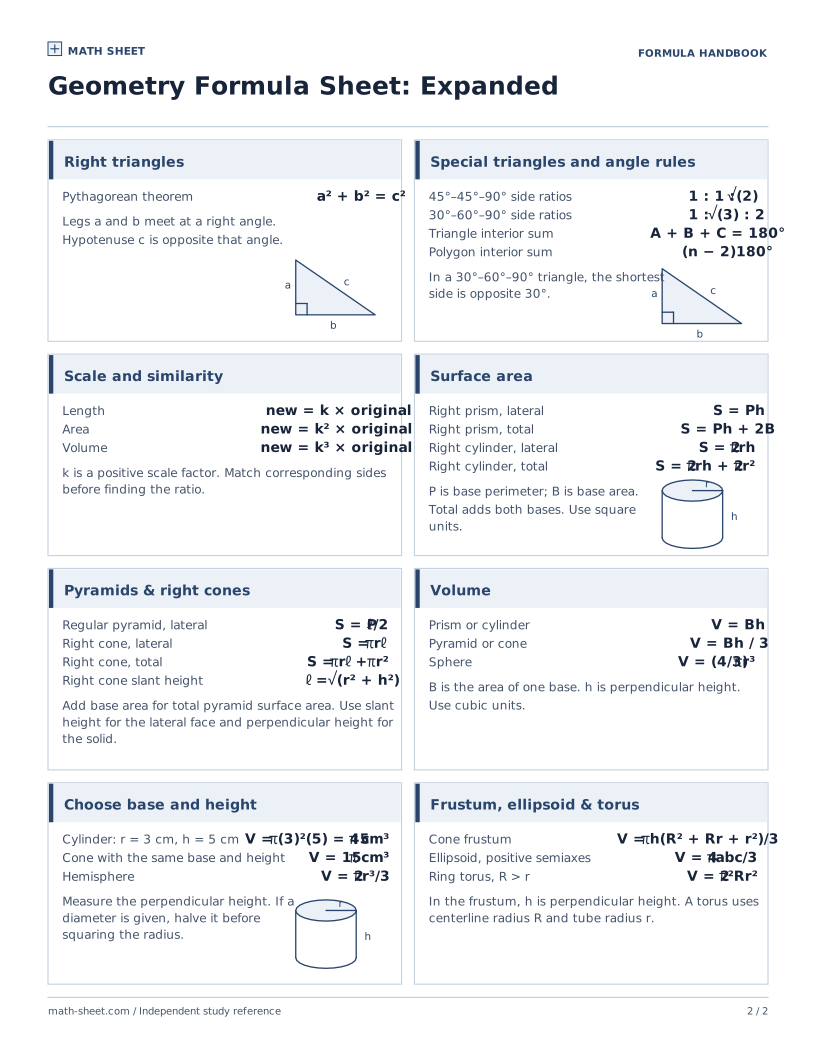
A two-page geometry reference with plane and solid measurement, coordinate geometry, circle arcs, special triangles and similarity.
Geometry reference
Choose the formula by what you need to measure. This reference keeps area, surface area and volume separate, with labelled figures and reminders about perpendicular height and units.
On this page
Open a formula for its definition and a worked example.
Geometry Formula Sheet
What it does
A triangle has half the area of a parallelogram with the same base and perpendicular height.
Worked example
A triangle has base 10 cm and height 7 cm. Find its area.
What it does
The Pythagorean theorem relates the two legs of a right triangle to its hypotenuse.
Worked example
The legs of a right triangle measure 9 and 12. Find the hypotenuse.
What it does
Heron’s formula finds a triangle’s area from its three side lengths through the semiperimeter.
Worked example
A triangle has side lengths 5, 5 and 6. Find its area without using a height.
What it does
In plane geometry, the three interior angles of a triangle total 180°.
Worked example
Two angles are 47° and 68°. Find the third.
What it does
The sine rule relates each side of a triangle to the sine of its opposite angle.
Worked example
In a triangle, A = 30°, B = 45° and side a = 6. Find b.
What it does
The cosine rule finds the side across from the known included angle when both adjacent sides are known.
Worked example
Two sides each measure 6 and enclose a 60° angle. Find the opposite side.
What it does
A rectangle or parallelogram covers its base length times the perpendicular distance to the opposite side.
Worked example
A parallelogram has base 9 m, perpendicular height 4 m and slanted side 5 m. Find its area.
What it does
A trapezoid’s area is the average length of its parallel sides times the perpendicular height.
Worked example
The parallel sides are 7 and 13 cm, and the height is 6 cm. Find the area.
What it does
The interior angle sum of a simple polygon with n sides equals the sum for n − 2 triangles. For a regular polygon, its angles share the total equally.
Worked example
Find the sum and each angle of a regular hexagon.
What it does
Circumference measures the distance around the circle. The diameter is twice the radius.
Worked example
A wheel has diameter 18 cm. Find its circumference in terms of π.
What it does
Circle area measures the region inside the boundary and is proportional to the square of the radius.
Worked example
A circle has radius 7 m. Find the exact area.
What it does
Arc length and sector area represent the same fraction of the circle’s boundary and area. Use radians in rθ and r²θ/2.
Worked example
Find the arc length and sector area for radius 6 cm and central angle π/3 radians.
What it does
A circle contains the points at a fixed distance r from the center (h,k). Squared coordinate differences give that distance squared.
Worked example
Write the equation of the circle centered at (−2,3) with radius 4.
What it does
A box’s volume equals the area of a rectangular base times its perpendicular height.
Worked example
A box measures 3 by 5 by 8 cm. Find its volume.
What it does
A circular cylinder of constant cross-section has volume equal to its disk area times perpendicular height.
Worked example
A cylinder has diameter 8 cm and height 9 cm. Find its volume.
What it does
A pyramid or cone takes one third the volume of a prism or cylinder with the same base area and perpendicular height.
Worked example
Compare a pyramid with base area 24 cm² and a cone with radius 3 cm, both 6 cm high.
What it does
A sphere’s volume is four thirds of π times the radius cubed.
Worked example
A sphere has diameter 6 cm. Find the exact volume.
What it does
A rectangular box has two faces of each of its three face dimensions.
Worked example
A box measures 2, 3 and 5 cm on adjacent edges. Find total surface area.
What it does
A closed right cylinder has two circular bases and a side that unrolls to a rectangle.
Worked example
A cylinder has radius 3 m and height 4 m. Find total surface area.
What it does
The surface area of a sphere equals four times the area of a disk with the same radius.
Worked example
A sphere has radius 5 cm. Find the area of its surface.
What it does
A closed right circular cone’s area adds its base disk to the curved side, using the slant height.
Worked example
A cone has base radius 5 cm and slant height 13 cm. Find total area.
What it does
The distance formula uses the horizontal and vertical differences as the legs of a right triangle.
Worked example
Find the distance between (−1,2) and (5,10).
What it does
The point halfway along a segment averages the two x-coordinates and the two y-coordinates separately.
Worked example
Find the midpoint of (−3,4) and (7,−2).
What it does
Slope measures vertical change per unit of horizontal change. Use the same endpoint order in both differences.
Worked example
Find the slope through (−1,7) and (3,−1).
Download the compact sheet for a quick review, or print the complete formula list from this page.
2 pages · US Letter / A4
A two-page geometry reference with plane and solid measurement, coordinate geometry, circle arcs, special triangles and similarity.
1 page · US Letter / A4
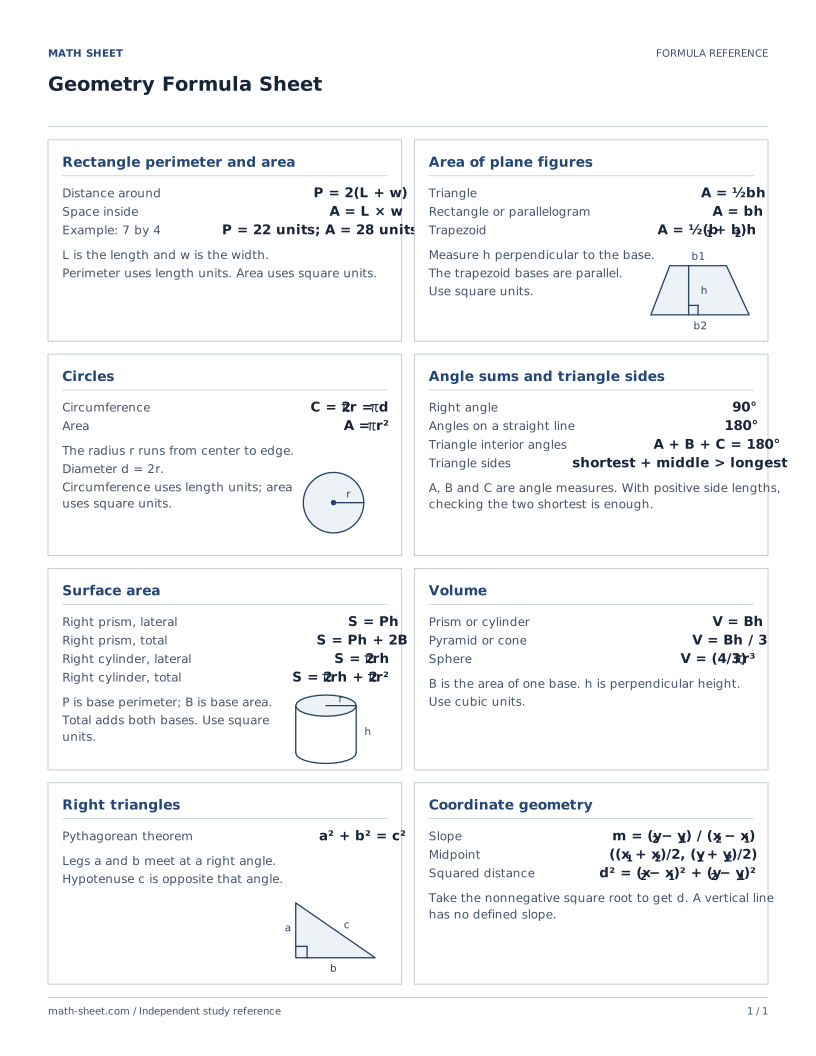
A compact guide to perimeter, area, circles, angle and side rules, solid measurement and coordinate geometry, with labeled diagrams.
Customize in the Cheat Sheet Maker →
L is the length and w is the width.
Perimeter uses length units. Area uses square units.
Measure h perpendicular to the base.
The trapezoid bases are parallel.
Use square units.
The radius r runs from center to edge.
Diameter d = 2r.
Circumference uses length units; area uses square units.
A, B and C are angle measures. With positive side lengths, checking the two shortest is enough.
P is base perimeter; B is base area.
Total adds both bases. Use square units.
B is the area of one base. h is perpendicular height.
Use cubic units.
Legs a and b meet at a right angle.
Hypotenuse c is opposite that angle.
Take the nonnegative square root to get d. A vertical line has no defined slope.
Math Sheet prepares original print materials. See how we check formulas and printouts.