
1 page · US Letter / A4
Unit Circle Chart
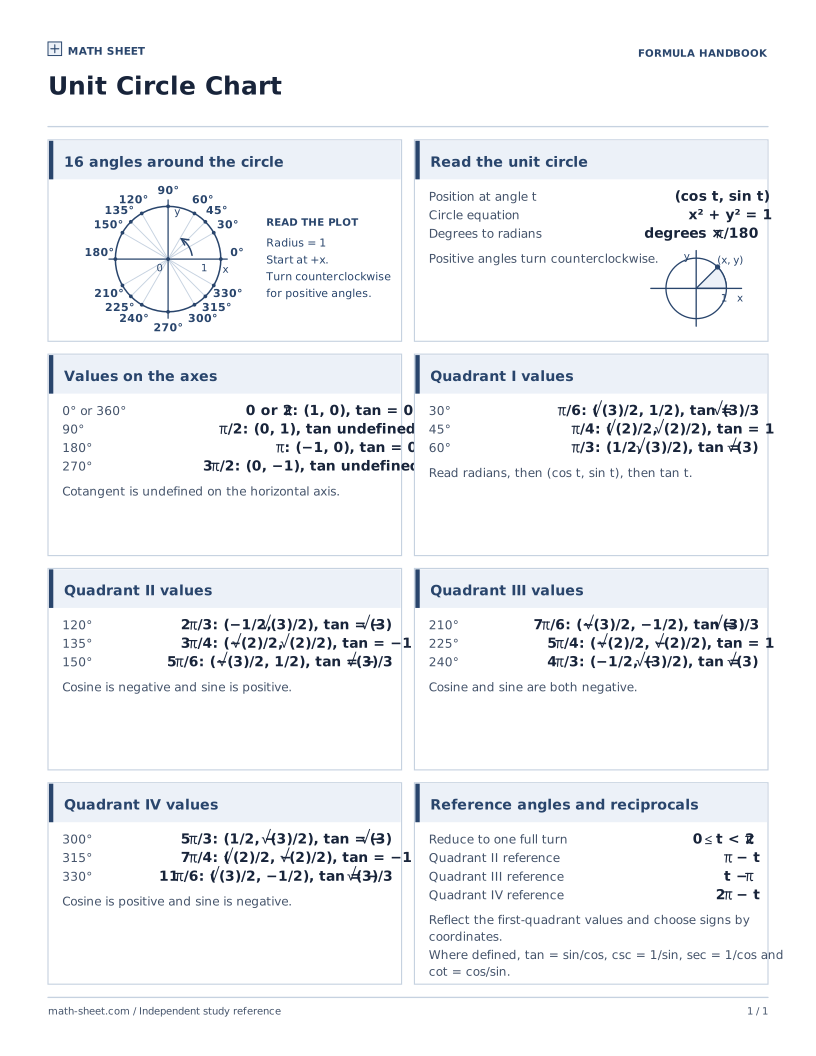
One-page unit circle chart with every standard angle in degrees and radians, exact sine, cosine and tangent values, and quadrant signs.
Trigonometry and precalculus
Read cosine as the x-coordinate and sine as the y-coordinate. Print exact values for the axes and all four quadrants, with a quick way to recover a missing value from a reference angle.
On this page
Open a formula for its definition and a worked example.
Unit Circle Chart
What it does
The unit circle consists of all points one unit from the origin. An angle measured counterclockwise from the positive x-axis has point (cos θ, sin θ).
Worked example
Find the point for θ = π/4 and check that it is on the circle.
What it does
Tangent is the vertical coordinate divided by the horizontal coordinate. On the circle, a zero horizontal coordinate leaves tangent undefined.
Worked example
Find the tangent at the unit-circle point (−√3/2, 1/2).
What it does
A half turn equals both 180° and π radians. Ratios formed from this equivalence convert between the two units.
Worked example
Convert 150° to radians and 7π/6 radians to degrees.
What it does
A full turn is 2π radians. Half and quarter turns divide that angle by two and four respectively.
Worked example
How many radians and degrees are in three quarter turns?
What it does
On the unit circle, sine is the height. The horizontal axis has height zero, while the top and bottom points have heights 1 and −1.
Worked example
Find sin 270° and sin 180° by locating their axis points.
What it does
The first-quadrant sine values are the heights of the unit-hypotenuse special triangles for 30°, 45°, and 60°.
Worked example
Find sin(π/6), sin(π/4), and sin(π/3).
What it does
Cosine records horizontal position. It is zero on the vertical axis and equals 1 or −1 on the positive or negative horizontal axis.
Worked example
Compare cos 90° and cos 180°.
What it does
The first-quadrant cosine values are adjacent legs of special right triangles with hypotenuse one. Complementary angles swap sine and cosine.
Worked example
Find cos 30°, cos 45°, and cos 60°.
What it does
At angles on the horizontal axis, the vertical coordinate is zero and the horizontal coordinate is nonzero. Their quotient is zero.
Worked example
Find tan 0° and tan 180°.
What it does
The three familiar first-quadrant tangents are height divided by horizontal position at the corresponding unit-circle point.
Worked example
Compute tan(π/6), tan(π/4), and tan(π/3).
What it does
At a vertical-axis angle, cosine is zero. The tangent quotient is undefined there.
Worked example
Find tan(3π/2).
What it does
The signs of cosine and sine follow the horizontal and vertical coordinates. Tangent is positive when their signs agree and negative when they differ.
Worked example
Give the signs of sin, cos, and tan at 210° and 330°.
What it does
Reciprocal functions invert the appropriate nonzero ratio. In particular, cotangent is x/y on the unit circle, so it can be zero when x is zero and y is nonzero.
Worked example
Evaluate csc, sec, and cot at θ = π/3.
Download the compact sheet for a quick review, or print the complete formula list from this page.
1 page · US Letter / A4
One-page unit circle chart with every standard angle in degrees and radians, exact sine, cosine and tangent values, and quadrant signs.
Math Sheet prepares original print materials. See how we check formulas and printouts.