Digital SAT preparation

SAT Math Formula Sheet

Review the math you will use across the four Digital SAT Math domains. The printable puts common formulas next to cues for choosing them and short examples.

This is an independent study aid for preparation. College Board provides its own reference in Bluebook. Use the link in the sources to see the official testing tools.

On this page

Find a formula

Open a formula for its definition and a worked example.

Geometry on the SAT test reference

  • Area and perimeter of a circleA = πr²; C = 2πr

    What it does

    Circle area measures the region inside the boundary. Circumference measures distance around it. Both formulas appear on the SAT test reference.

    Worked example

    Find the area and circumference of a circle with diameter 14 cm.

    1. Halve the diameter to obtain r = 7 cm.
    2. Area = 49π cm² and circumference = 14π cm.
    Link to this example
  • Area from a base and heightRectangle: A = ℓw; triangle: A = bh/2The triangle height is perpendicular to its base.

    What it does

    Rectangle area is the product of perpendicular dimensions. A triangle with the same base and height has half that area.

    Worked example

    Compare a 10-by-6 rectangle and a triangle with base 10 and perpendicular height 6.

    1. Multiply 10 · 6 to get rectangle area 60 square units.
    2. Halve 60 to get triangle area 30 square units.
    Link to this example
  • Relate the sides of a right trianglec² = a² + b²Use c for the hypotenuse.

    What it does

    The Pythagorean relation connects the two legs of a right triangle to its hypotenuse.

    Worked example

    A right triangle has hypotenuse 13 and one leg 5. Find the other leg.

    1. Subtract the known leg square: b² = 13² − 5² = 144.
    2. Take the positive root to get b = 12.
    Link to this example
  • Volumes with matching parallel basesBox: V = ℓwh; cylinder: V = πr²h

    What it does

    A box and a cylinder both have constant cross-sectional area parallel to their bases. Volume multiplies that area by perpendicular height.

    Worked example

    Find volumes for a 3-by-5-by-4 box and a cylinder of radius 3 and height 4.

    1. The box has base area 3 · 5 = 15 and the cylinder has base area 9π.
    2. Multiplying by height 4 gives volumes 60 and 36π cubic units.
    Link to this example
  • Volumes that taper to a pointCone: V = πr²h/3; rectangular pyramid: V = ℓwh/3

    What it does

    A cone or pyramid has one third the volume of the matching constant-cross-section solid with the same base and height.

    Worked example

    Compare a cone of radius 3 and height 8 with a rectangular pyramid of base dimensions 3 and 5 and height 8.

    1. Their base areas are 9π and 15.
    2. Multiply each by 8/3 to obtain 24π and 40 cubic units.
    Link to this example
  • Volume of a sphereV = 4πr³/3

    What it does

    Sphere volume measures the space enclosed by all points at a fixed distance r from the center.

    Worked example

    Find the volume of a sphere of diameter 6.

    1. The radius is 3, so r³ = 27.
    2. Compute 4π(27)/3 = 36π cubic units.
    Link to this example
  • Special right triangle side ratios45°–45°–90°: 1 : 1 : √2; 30°–60°–90°: 1 : √3 : 2Ratios list sides opposite the angles in the order shown.

    What it does

    The ratios pair each angle with its opposite side. Multiplying every side by a common factor preserves the angles.

    Worked example

    Find the hypotenuse if a 45° right triangle has leg 5. Then find the longer leg of a 30° right triangle with hypotenuse 10.

    1. For 45°–45°–90°, a leg of 5 scales the hypotenuse to 5√2.
    2. For 30°–60°–90°, the hypotenuse is twice the short leg, so the longer leg is 5√3.
    Link to this example

Lines and their slopes

  • Rise divided by runm = (y₂ − y₁)/(x₂ − x₁)A vertical line has undefined slope.

    What it does

    Slope is the vertical change per unit horizontal change. It is undefined when the two x-coordinates coincide.

    Worked example

    Find the slope through (−2, 4) and (4, 1).

    1. The rise is 1 − 4 = −3 and the run is 4 − (−2) = 6.
    2. Divide to get m = −1/2.
    Link to this example
  • Choose a convenient equation formy = mx + b; y − y₁ = m(x − x₁); Ax + By = CThe first two forms require a finite slope.

    What it does

    Point-slope form uses a known point and finite slope. Slope-intercept form exposes the y-intercept. Standard form can also describe vertical lines.

    Worked example

    Write the line through (2, −1) with slope 3 in all three forms.

    1. Point-slope form is y + 1 = 3(x − 2). Expanding gives y = 3x − 7.
    2. Rearrange to get 3x − y = 7.
    Link to this example
  • Compare the directions of two linesParallel: m₁ = m₂; perpendicular: m₁m₂ = −1For finite slopes, equal slopes on distinct lines give parallel lines. A vertical and a horizontal line are perpendicular.

    What it does

    Two distinct lines with the same finite slope are parallel. Perpendicular finite slopes are negative reciprocals. A vertical and a horizontal line are perpendicular.

    Worked example

    For y = 2x + 1, write a parallel and a perpendicular line through (0, 4).

    1. Use y-intercept 4 for both equations. The parallel slope stays 2.
    2. The perpendicular slope is −1/2 since 2(−1/2) = −1. The lines are y = 2x + 4 and y = −x/2 + 4.
    Link to this example

Quadratic tools and factoring shortcuts

  • Roots from coefficientsD = b² − 4ac; x = (−b ± √D)/(2a)For real roots, require D ≥ 0 and a ≠ 0.

    What it does

    The discriminant tells whether real roots are available. For a ≠ 0 and D ≥ 0, the quadratic formula produces them.

    Worked example

    Find the roots of x² − 4x − 5 = 0.

    1. D = (−4)² − 4(1)(−5) = 36.
    2. Use (4 ± 6)/2 to obtain x = 5 or x = −1.
    Link to this example
  • Find the horizontal coordinate of the vertexx = −b/(2a)Evaluate y at this x to find the vertical coordinate.

    What it does

    For a parabola written y = ax² + bx + c, the symmetry line goes through x = −b/(2a).

    Worked example

    Find the vertex of y = −x² + 6x + 1.

    1. Compute x = −6/(−2) = 3.
    2. Substitute y = −9 + 18 + 1 = 10. The vertex is (3, 10).
    Link to this example
  • Spot a product hidden in a polynomialu² − v² = (u − v)(u + v); (u + v)² = u² + 2uv + v²

    What it does

    A difference of squares factors into conjugate binomials. A perfect-square trinomial has a middle term equal to twice the product of its square roots, with the appropriate sign.

    Worked example

    Factor 16x² − 9 and x² + 10x + 25.

    1. Recognize (4x)² − 3² and use (4x − 3)(4x + 3).
    2. Recognize 10x = 2(x)(5) and use (x + 5)².
    Link to this example
See Quadratic Formula Sheet

Rewrite powers and roots

  • Same-base product and nested powersam an = am+n; (am)n = amnThese rules hold for positive a and real m and n.

    What it does

    When multiplying powers with the same base, add exponents. When raising a power to a power, multiply exponents.

    Worked example

    Simplify (2³ · 2⁴)².

    1. Add the inner exponents to obtain (2⁷)².
    2. Multiply by the outer exponent to get 2¹⁴ = 16,384.
    Link to this example
  • Negative and zero exponentsa−n = 1/an; a⁰ = 1For integer n, require a ≠ 0.

    What it does

    A negative exponent gives a reciprocal. A nonzero base raised to zero gives one.

    Worked example

    Evaluate 5−2 + 7⁰.

    1. Replace 5−2 by 1/25 and 7⁰ by 1.
    2. The result is 26/25.
    Link to this example
  • Fractional power as a rootam/n = ⁿ√(am)Use a > 0 and integers m, n with n > 0.

    What it does

    For a positive base and positive denominator, the denominator of a fractional exponent names the root and the numerator names the power.

    Worked example

    Evaluate 813/4.

    1. The positive fourth root of 81 is 3.
    2. Cube 3 to get 27.
    Link to this example
See Exponent Rules Cheat Sheet

Measure on the coordinate plane

  • Length between two pointsd = √((x₂ − x₁)² + (y₂ − y₁)²)

    What it does

    The coordinate differences are the legs of a right triangle whose hypotenuse gives the straight-line distance.

    Worked example

    Find the distance from (−3, 2) to (1, 5).

    1. The horizontal and vertical changes are 4 and 3.
    2. The distance is √(4² + 3²) = 5.
    Link to this example
  • Average the endpointsM = ((x₁ + x₂)/2, (y₁ + y₂)/2)

    What it does

    A midpoint lies halfway along the segment, so each of its coordinates averages the corresponding endpoint coordinates.

    Worked example

    Find the midpoint of the segment from (−4, 7) to (6, −1).

    1. Average the x-values: (−4 + 6)/2 = 1.
    2. Average the y-values: (7 − 1)/2 = 3. The midpoint is (1, 3).
    Link to this example
  • Circle of radius r about (h, k)(x − h)² + (y − k)² = r²

    What it does

    The equation states that each point on the circle is at distance r from the center (h, k).

    Worked example

    Write the circle centered at (−2, 3) through (2, 6).

    1. The squared radius is (2 + 2)² + (6 − 3)² = 25.
    2. The equation is (x + 2)² + (y − 3)² = 25.
    Link to this example

Angles, sectors and right-triangle ratios

  • Angle totalsTriangle: 180°; simple n-gon: (n − 2) × 180°; convex exterior total: 360°Count one exterior angle at each vertex.

    What it does

    A simple n-sided polygon can be divided into n − 2 triangles. On a convex polygon, the exterior turns make one full revolution.

    Worked example

    Find the interior angle sum and each exterior angle of a regular octagon.

    1. Use (8 − 2) · 180° = 1,080° for the interior sum.
    2. Eight equal exterior angles share 360°, so each is 45°.
    Link to this example
  • Use the chosen acute anglesin θ = opposite/hypotenuse; cos θ = adjacent/hypotenuse; tan θ = opposite/adjacent

    What it does

    Sine, cosine and tangent compare sides relative to the chosen acute angle in a right triangle.

    Worked example

    For θ with opposite side 8 and adjacent side 15, find all three ratios.

    1. The hypotenuse is √(8² + 15²) = 17.
    2. Then sin θ = 8/17, cos θ = 15/17, and tan θ = 8/15.
    Link to this example
  • Turn a central angle into a length or areaArc length: s = rθ; sector area: A = r²θ/2Use radians.

    What it does

    A central angle θ in radians occupies the fraction θ/(2π) of the circle, so it scales both circumference and area by that fraction.

    Worked example

    Find arc length and sector area for r = 6 and θ = π/3.

    1. The arc length is 6(π/3) = 2π.
    2. The area is 6²(π/3)/2 = 6π.
    Link to this example
See Trigonometry Formula Sheet

Summarize data and compare quantities

  • Center and spreadMean = sum/count; median = middle; range = maximum − minimumSort before finding the median. Average the two central values when the count is even.

    What it does

    Mean averages all values, median locates the center after sorting, and range measures the distance between the extremes.

    Worked example

    Find the mean, median and range of 7, 1, 4, 12.

    1. Sort to get 1, 4, 7, 12. The mean is 24/4 = 6.
    2. The median is (4 + 7)/2 = 5.5 and the range is 12 − 1 = 11.
    Link to this example
  • Change relative to the original valuePercent change = 100% × (new − original)/originalThe original value must be nonzero.

    What it does

    Percent change compares the signed difference to the nonzero original value.

    Worked example

    A price falls from 80 dollars to 68 dollars. Find the percent change.

    1. Compute (68 − 80)/80 = −12/80 = −0.15.
    2. The price decreased by 15%.
    Link to this example
  • Probability by countingP(A) = count of outcomes in A / count of all outcomesThis ratio assumes equally likely outcomes.

    What it does

    For equally likely elementary outcomes, probability is the fraction of outcomes that satisfy the event.

    Worked example

    A bag contains four green and six blue identical-size counters. What is the probability of drawing green uniformly?

    1. There are 4 favorable outcomes among 10 total outcomes.
    2. The probability is 4/10 = 2/5.
    Link to this example
See Statistics Formula Sheet

Optional algebra extension: complex numbers

  • Cycle of powers of ii = √(−1); i² = −1; i³ = −i; i⁴ = 1; i⁵ = iPowers repeat in blocks of four.

    What it does

    The imaginary unit satisfies i² = −1. Since i⁴ = 1, its positive integer powers repeat every four. This is an algebra extension.

    Worked example

    Evaluate i¹⁹.

    1. Divide 19 by 4 and keep the remainder 3.
    2. i¹⁹ = (i⁴)⁴i³ = −i.
    Link to this example
  • Conjugate a complex numberConjugate of a + bi = a − biThis section extends the algebra reference beyond the published digital SAT content domains.

    What it does

    Complex conjugation preserves the real part and reverses the imaginary part. A number times its conjugate gives the squared modulus.

    Worked example

    Find the conjugate of 5 − 2i and multiply the pair.

    1. Reverse the sign of −2i to obtain 5 + 2i.
    2. Then (5 − 2i)(5 + 2i) = 25 − 4i² = 29.
    Link to this example

Preview the printable

Download the compact sheet for a quick review, or print the complete formula list from this page.

SAT Math Formula Sheet, page 1

1 page · US Letter / A4

SAT Math Formula Sheet

An independent digital SAT study sheet with selected algebra, advanced math, problem-solving and data analysis, and geometry and trigonometry rules.

Customize in the Cheat Sheet Maker →

Read the reference on this page

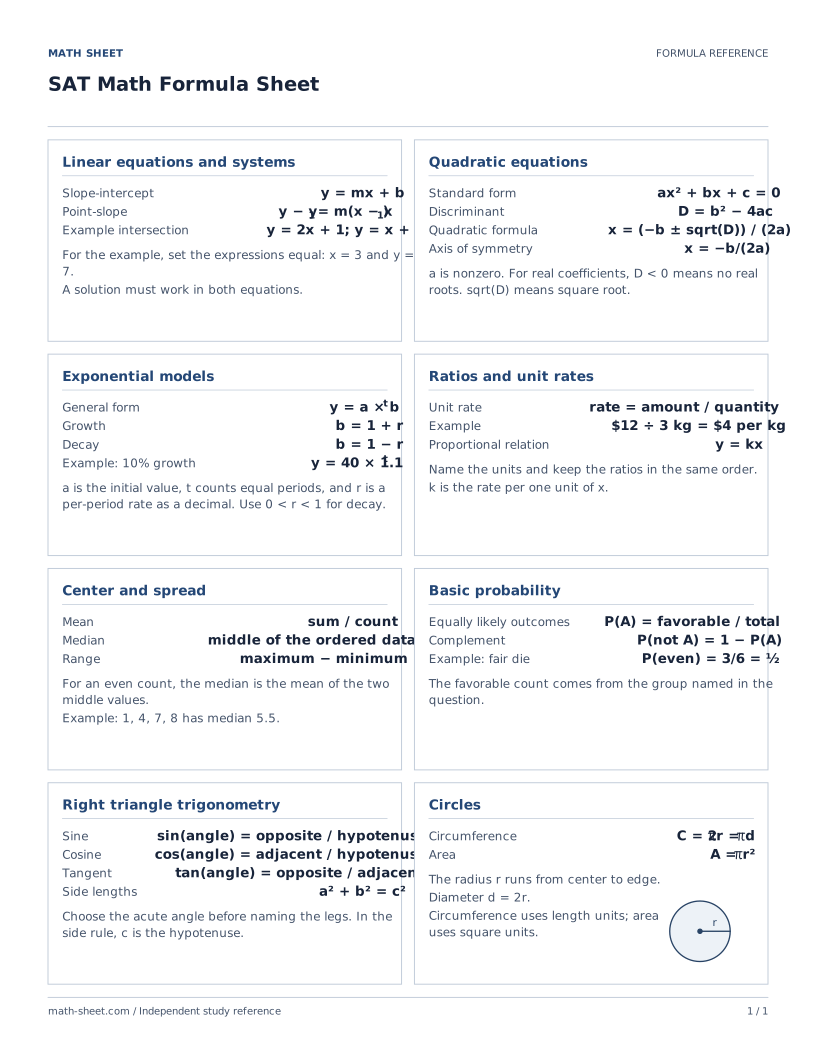
Linear equations and systems

Slope-intercept
y = mx + b
Point-slope
y − y1 = m(x − x1)
Example intersection
y = 2x + 1; y = x + 4

For the example, set the expressions equal: x = 3 and y = 7.

A solution must work in both equations.

Quadratic equations

Standard form
ax² + bx + c = 0
Discriminant
D = b² − 4ac
Quadratic formula
x = (−b ± sqrt(D)) / (2a)
Axis of symmetry
x = −b/(2a)

a is nonzero. For real coefficients, D < 0 means no real roots. sqrt(D) means square root.

Exponential models

General form
y = a × bt
Growth
b = 1 + r
Decay
b = 1 − r
Example: 10% growth
y = 40 × 1.1t

a is the initial value, t counts equal periods, and r is a per-period rate as a decimal. Use 0 < r < 1 for decay.

Ratios and unit rates

Unit rate
rate = amount / quantity
Example
$12 ÷ 3 kg = $4 per kg
Proportional relation
y = kx

Name the units and keep the ratios in the same order.

k is the rate per one unit of x.

Center and spread

Mean
sum / count
Median
middle of the ordered data
Range
maximum − minimum

For an even count, the median is the mean of the two middle values.

Example: 1, 4, 7, 8 has median 5.5.

Basic probability

Equally likely outcomes
P(A) = favorable / total
Complement
P(not A) = 1 − P(A)
Example: fair die
P(even) = 3/6 = ½

The favorable count comes from the group named in the question.

Right triangle trigonometry

Sine
sin(angle) = opposite / hypotenuse
Cosine
cos(angle) = adjacent / hypotenuse
Tangent
tan(angle) = opposite / adjacent
Side lengths
a² + b² = c²

Choose the acute angle before naming the legs. In the side rule, c is the hypotenuse.

Circles

Circumference
C = 2πr = πd
Area
A = πr²

The radius r runs from center to edge.

Diameter d = 2r.

Circumference uses length units; area uses square units.

Practice these skills

Related references

Sources and review

Math Sheet prepares original print materials. See how we check formulas and printouts.

Browse all formula sheets →