Algebra & consumer math

Financial Math Formula Sheet

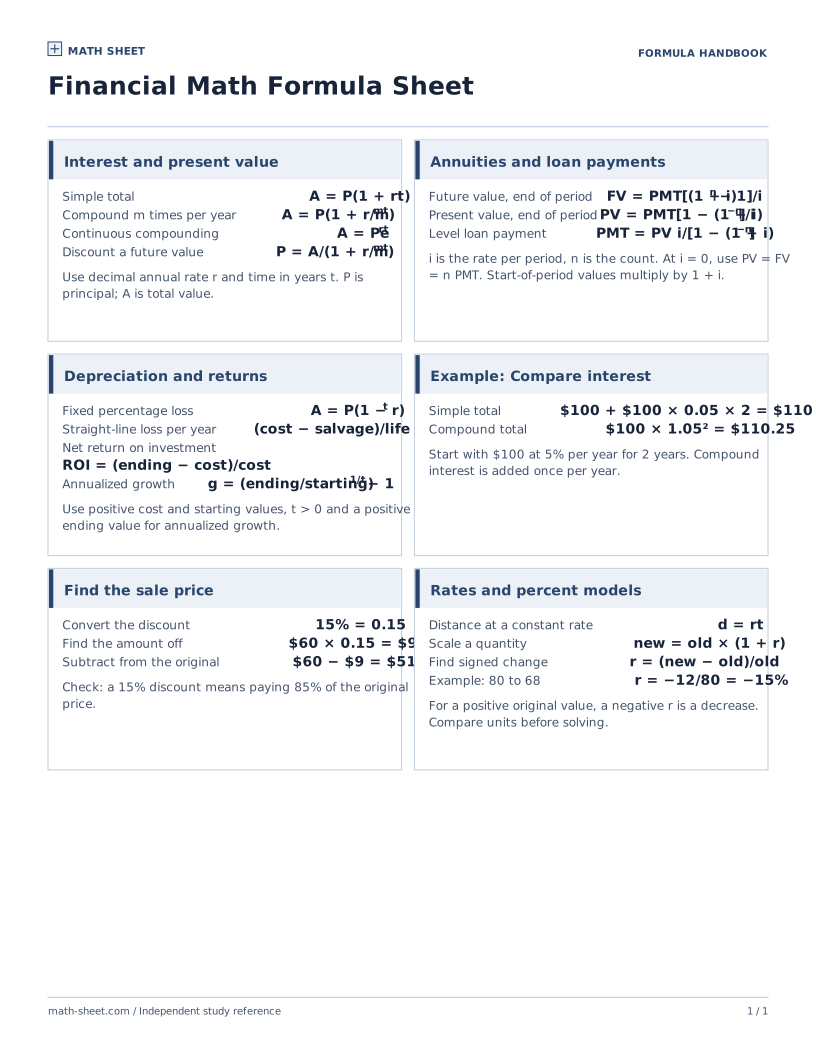
Decide whether the problem is about one starting balance, recurring payments or a change in value. Match the rate period to the payment period.

On this page

Find a formula

Open a formula for its definition and a worked example.

Interest and annual yield

  • Interest without compoundingI = Prt, A = P + I = P(1 + rt)P is the starting principal, r is the annual rate as a decimal, and t is years.

    What it does

    Simple interest grows by the same amount each year because the rate applies only to the starting principal.

    Worked example

    A $600 balance earns 4% simple interest for 3 years. Find interest and final balance.

    1. I = 600 × 0.04 × 3 = $72.
    2. A = 600 + 72 = $672.
    Link to this example
  • Compounding on a scheduleA = P(1 + r/n)ntn is the number of compounding periods per year.

    What it does

    With periodic compounding, each period earns interest on the previous balance at rate r/n.

    Worked example

    Deposit $1,000 for one year at 8% compounded quarterly. Find the balance.

    1. There are four periods at 0.08/4 = 0.02 each.
    2. A = 1,000(1.02)4 ≈ $1,082.43.
    Link to this example
  • Compounding continuouslyA = Pert

    What it does

    Continuous compounding models growth as the limit of compounding at increasingly short intervals.

    Worked example

    Find the balance after 2 years on $500 earning 3% continuously.

    1. Multiply the annual decimal rate by time: 0.03 × 2 = 0.06.
    2. A = 500e0.06 ≈ $530.92.
    Link to this example
  • Yield over one yearAPY = (1 + r/n)n − 1Multiply the resulting decimal by 100 to express it as a percent.

    What it does

    Annual percentage yield expresses the fraction gained over one year after compounding.

    Worked example

    Find APY for a nominal 12% rate compounded monthly.

    1. A unit deposit grows by a factor of (1 + 0.12/12)12 = 1.0112.
    2. Subtract 1 to obtain 0.1268, about 12.68% APY.
    Link to this example

Move a lump sum through time

  • Periodic growth and discountingFV = PV(1 + r/n)nt, PV = FV/(1 + r/n)ntUse the same rate and compounding schedule for both directions.

    What it does

    Periodic growth multiplies by a compounding factor. Discounting divides by that same factor.

    Worked example

    At 10% annually, what will $200 be worth in 2 years? What deposit grows to $242?

    1. Multiply $200 by 1.10² to obtain $242.
    2. Divide $242 by 1.10² to recover $200.
    Link to this example
  • Continuous growth and discountingFV = PV ert, PV = FV e−rt

    What it does

    With continuous interest, ert moves a balance forward, and its reciprocal moves it back.

    Worked example

    At 5% continuous interest, move $800 two years forward, then find its present value.

    1. FV = 800e0.05 × 2 ≈ $884.14.
    2. Multiplying the exact future value by e−0.10 gives $800 again.
    Link to this example
  • Approximate doubling timeYears to double ≈ 72/rpctUse a positive annual percent number, such as 6 for 6%. This estimates compound growth at moderate rates.

    What it does

    The Rule of 72 estimates the years to double at a positive compound interest rate, using the rate as a percent number.

    Worked example

    Estimate the doubling time at 8% compound interest.

    1. Divide 72 by 8, which gives about 9 years.
    2. For annual compounding, solving 1.08t = 2 gives t ≈ 9.01 years.
    Link to this example

Value of equal recurring payments

  • Value at the last end-of-period depositFVend = PMT[(1 + i)n − 1]/ii is the decimal rate per payment period and n is the number of payments. At i = 0 the value is n × PMT.

    What it does

    The future value of an ordinary annuity adds equal end-of-period deposits with the interest each has earned by the final deposit.

    Worked example

    Deposit $100 at each of two year-ends. The rate is 10% per year. Find the final balance.

    1. The first deposit grows for one year to $110. The second has just been deposited.
    2. The total is $210. The formula gives 100(1.10² − 1)/0.10 = $210.
    Link to this example
  • Value today of end-of-period paymentsPVend = PMT[1 − (1 + i)−n]/iAt i = 0 the value is n × PMT.

    What it does

    The present value of an ordinary annuity discounts each equal end-of-period payment back to today.

    Worked example

    What are payments of $121 at the end of each of the next two years worth today at 10%?

    1. Discount the first payment by 1.10 and the second by 1.10².
    2. PV = 121/1.10 + 121/1.10² = 110 + 100 = $210.
    Link to this example
  • Annuity due (beginning-of-period payments)FVdue = (1 + i)FVend, PVdue = (1 + i)PVendKeep the same valuation dates when comparing beginning- and end-of-period payments.

    What it does

    Beginning-of-period payments occur one period earlier than the matching ordinary annuity. That increases their value by a factor of 1 + i at the same comparison date.

    Worked example

    Deposit $100 now and again in one year. At 10%, find the values today and at the end of year 2.

    1. The present value is 100 + 100/1.10 ≈ $190.91.
    2. The year-2 value is 100(1.10²) + 100(1.10) = $231.
    Link to this example
  • Perpetuity (no final payment)PV = PMT/iRequires i > 0 and the first payment one period from now.

    What it does

    An ordinary perpetuity pays a fixed amount every period forever, with the first payment one period from now and a positive discount rate.

    Worked example

    Find the present value of $60 paid yearly forever at a 5% annual discount rate.

    1. PV = 60/0.05 = $1,200.
    2. At 5%, $1,200 earns exactly $60 each year.
    Link to this example

Fixed-rate amortization

  • Equal installment after each periodPMT = Pi/[1 − (1 + i)−n]P is the loan principal, i is the rate per payment period, and n is the number of payments. At i = 0 use P/n.

    What it does

    A fixed installment repays an amortizing loan over n equal periods, using the rate per payment period.

    Worked example

    A $210 loan is repaid in two year-end installments at 10% per year. Find each installment.

    1. PMT = 210(0.10)/[1 − 1.10−2].
    2. The amount is $121. Two payments of $121 discounted at 10% are worth $210 today.
    Link to this example
  • Payment and interest totalsTotal = n × PMT, interest = Total − PAssumes equal payments and excludes extra fees.

    What it does

    Add all equal installments for total paid, then remove the borrowed principal to isolate interest if there are no fees.

    Worked example

    A $900 loan is repaid in 12 payments of $85. Find total paid and total interest.

    1. Total paid = 12 × 85 = $1,020.
    2. Interest = 1,020 − 900 = $120.
    Link to this example
  • Debt remaining after installment kBk = P(1 + i)k − PMT[(1 + i)k − 1]/iAt i = 0 use B_k = P − k × PMT.

    What it does

    The remaining balance is the original debt grown to the payment date minus the accumulated value of installments already paid.

    Worked example

    A $210 loan accrues 10% per year and has two annual payments of $121. Find the balance after the first.

    1. After one year, the original balance has grown to 210 × 1.10 = $231.
    2. Subtract the $121 installment to get $110 remaining.
    Link to this example

Track an asset’s book value

  • Equal depreciation per yearD = (C − S)/n, BVt = C − tDC is initial cost, S is salvage value and n is useful life in years. Apply for 0 ≤ t ≤ n.

    What it does

    Straight-line depreciation assigns the same loss in book value to each year of useful life.

    Worked example

    Equipment costing $1,000 has a $200 salvage value after 4 years. Find book value after 3 years.

    1. Annual depreciation = (1,000 − 200)/4 = $200.
    2. Book value after 3 years is 1,000 − 3 × 200 = $400.
    Link to this example
  • Decline by a fixed proportionVt = C(1 − r)tUse the rate per period and measure t in those periods.

    What it does

    Declining-balance depreciation removes a fixed fraction of the current value in each period.

    Worked example

    Find the modeled value of a $2,000 asset after two annual declines of 20%.

    1. Keep 80% of the current value each year.
    2. V = 2,000(0.80)² = $1,280.
    Link to this example

Compare returns and pricing

  • Net investment returnROI = (proceeds − cost)/cost × 100%Use a positive cost. If a figure already represents net gain, divide it directly by cost.

    What it does

    Return on investment compares net gain or loss with the original positive investment cost.

    Worked example

    An item purchased for $160 is later sold for $200. Ignore fees. Find ROI.

    1. Net gain = 200 − 160 = $40.
    2. ROI = 40/160 = 0.25, or 25%.
    Link to this example
  • Equivalent constant yearly growthCAGR = (FV/PV)1/n − 1Use PV > 0, FV ≥ 0 and n > 0. Express the resulting decimal as a percent if desired.

    What it does

    CAGR is the constant yearly rate that would grow a positive initial value to the final value over the stated time.

    Worked example

    Find CAGR when a quantity rises from 100 to 121 over 2 years.

    1. The total growth factor is 121/100 = 1.21.
    2. The yearly factor is √1.21 = 1.10, so the rate is 10%.
    Link to this example
  • Compare margin with markupMargin = profit/revenue × 100%, markup = (price − cost)/cost × 100%Margin uses positive revenue. Markup uses positive cost.

    What it does

    Margin divides profit by revenue. Markup divides the same difference by cost.

    Worked example

    A store buys an item for $30 and sells it for $50. Find margin and markup.

    1. Profit is $20, so margin = 20/50 = 40%.
    2. Markup = 20/30 ≈ 66.7%.
    Link to this example

Preview the printable

Download the compact sheet for a quick review, or print the complete formula list from this page.

Practice these skills

Related references

Sources and review

Math Sheet prepares original print materials. See how we check formulas and printouts.

Browse all formula sheets →