
Math competitions · Fixed edition 1
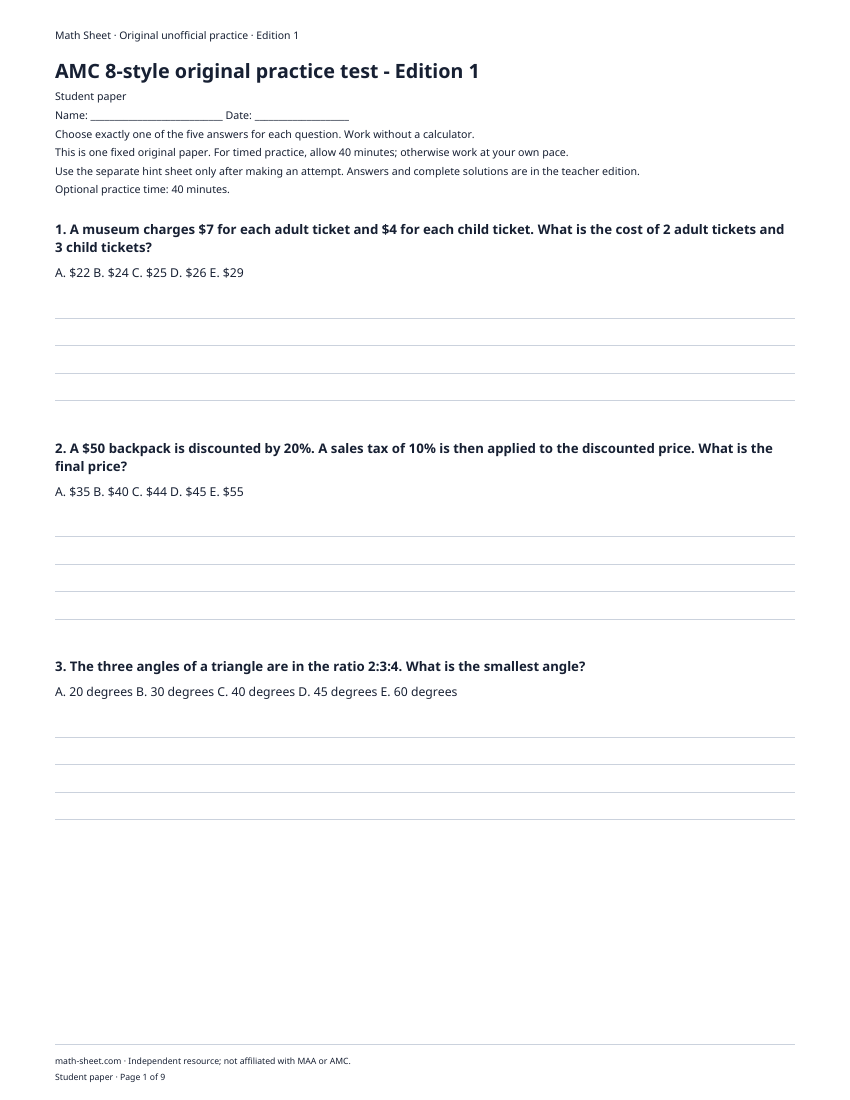
AMC 8-style practice test
25 original multiple-choice problems with an optional 40-minute practice session.
Preview and downloadOriginal unofficial practice · 12 problems · Fixed edition 1
12 original multiple-choice problems extending to advanced high-school reasoning. A focused practice set, not a full mock exam.
Fixed questions, ready to print. Each teacher copy includes all student pages followed by worked answers.
8.5 × 11 inches · Student and teacher editions
210 × 297 mm · Student and teacher editions
This finite paper contains 12 original problems. It is an independent teaching resource, not an official past paper, and is not affiliated with MAA or AMC.
The first-page preview and every PDF use the same edition-1 problem records below. Expand a question after an attempt to review its hints and complete solution.

For x > 0, log_2(x) + log_4(x) = 6. What is x?
Hint 1: Express both logarithms using base 2.
Hint 2: If t = log_2(x), then log_4(x) = t/2.
Answer: C. 16
Let t = log_2(x). Since 4 = 2^2, log_4(x) = t/2. Thus 3t/2 = 6, so t = 4 and x = 2^4 = 16. The positive value 16 satisfies the original equation.
A real angle theta satisfies sin(theta) + cos(theta) = 1/3. What is sin(2 theta)?
Hint 1: Square the given equation.
Hint 2: Use sin^2(theta) + cos^2(theta) = 1 and 2 sin(theta) cos(theta) = sin(2 theta).
Answer: A. -8/9
Squaring gives 1 + 2 sin(theta) cos(theta) = 1/9. Therefore sin(2 theta) = 1/9 - 1 = -8/9. Such angles exist because sin(theta) + cos(theta) ranges from -sqrt(2) to sqrt(2).
Let i be the imaginary unit, so i^2 = -1. What is (1 + i)^8?
Hint 1: Square 1 + i first.
Hint 2: Its square is 2i; square twice more.
Answer: D. 16
We have (1 + i)^2 = 1 + 2i + i^2 = 2i. Thus (1 + i)^4 = (2i)^2 = -4 and (1 + i)^8 = (-4)^2 = 16.
The four real roots of t^4 - 5t^2 + 4 = 0 are r_1, r_2, r_3, and r_4. What is 1/r_1^2 + 1/r_2^2 + 1/r_3^2 + 1/r_4^2?
Hint 1: Factor the equation as a quadratic in t^2.
Hint 2: The factors are (t^2 - 1)(t^2 - 4).
Answer: C. 5/2
The four roots are 1, -1, 2, and -2, all nonzero. The reciprocal squares sum to 1 + 1 + 1/4 + 1/4 = 5/2.
How many ordered pairs of integers (a, b), with 2 <= a <= 20 and 2 <= b <= 20, make log_a(b) an integer?
Hint 1: An integer logarithm means b = a^k for an integer k.
Hint 2: Here k must be positive. Count the permitted bases separately for each exponent.
Answer: D. 24
Since a and b are at least 2, k = log_a(b) must be a positive integer. For k = 1, all 19 bases work. For k = 2, the bases are 2, 3, and 4. For k = 3 only base 2 works, and for k = 4 only base 2 works.
For k >= 5, even 2^k exceeds 20. Each (a,b) has a unique exponent, so the total is 19 + 3 + 1 + 1 = 24.
Two sides of a triangle have lengths 5 and 7, and their included angle is 120 degrees. What is the circumradius of the triangle?
Hint 1: Find the third side using the law of cosines.
Hint 2: The extended sine rule gives 2R = c/sin(120 degrees).
Answer: B. sqrt(327)/3
If c is opposite the 120-degree angle, then c^2 = 5^2 + 7^2 - 2 x 5 x 7 x cos(120 degrees) = 25 + 49 + 35 = 109.
By the extended sine rule, R = c/[2 sin(120 degrees)] = sqrt(109)/sqrt(3) = sqrt(327)/3.
A nonzero complex number z satisfies z + 1/z = 1. What is z^2026 + 1/z^2026?
Hint 1: Multiply by z to find a quadratic equation.
Hint 2: The equation implies z^3 = -1, so powers repeat with period 6.
Answer: B. -1
Multiplying by z gives z^2 - z + 1 = 0. Multiplying this by z + 1 yields z^3 + 1 = 0, so z^3 = -1 and z^6 = 1. As 2026 has remainder 4 on division by 6, the required sum is z^4 + z^(-4) = z^4 + z^2.
Using z^3 = -1 gives z^4 = -z, while z^2 = z - 1. Hence the sum is -z + z - 1 = -1 for either root.
Define f(x) = (2x + 1)/(x + 2), and start with x_0 = 0 and x_(n+1) = f(x_n). What is x_5?
Hint 1: Try transforming x by T(x) = (1 + x)/(1 - x).
Hint 2: For 0 <= x < 1, T(f(x)) = 3T(x).
Answer: D. 121/122
If 0 <= x < 1, then 0 < f(x) < 1, so all required denominators are nonzero. Direct simplification gives (1 + f(x))/(1 - f(x)) = 3(1 + x)/(1 - x).
Because T(x_0) = 1, we have T(x_5) = 3^5 = 243. Solving (1 + x_5)/(1 - x_5) = 243 gives 244x_5 = 242, so x_5 = 121/122.
Two distinct integers are selected uniformly from 1 through 12, with order ignored. What is the probability that their product is a perfect square?
Hint 1: Remove square factors from each integer.
Hint 2: A product is a square exactly when the two remaining squarefree parts are equal.
Answer: C. 5/66
Write each number as a square times a squarefree integer. The only groups with at least two members are {1,4,9}, with squarefree part 1; {2,8}, with part 2; and {3,12}, with part 3. All other groups are singletons.
These give 3 + 1 + 1 = 5 successful pairs. There are 12 x 11 / 2 = 66 equally likely distinct unordered pairs, so the probability is 5/66.
Real numbers x and y satisfy x^2/9 + y^2/4 = 1. What is the greatest possible value of 2x + 3y?
Hint 1: Set u = x/3 and v = y/2, so u^2 + v^2 = 1.
Hint 2: Then 2x + 3y = 6(u + v); use (u - v)^2 >= 0.
Answer: C. 6 sqrt(2)
Let u = x/3 and v = y/2. Then u^2 + v^2 = 1, and 2x + 3y = 6(u + v). Since (u - v)^2 >= 0, (u + v)^2 <= 2(u^2 + v^2) = 2. Therefore u + v <= sqrt(2).
Equality is attainable at u = v = 1/sqrt(2), corresponding to x = 3/sqrt(2) and y = 2/sqrt(2). Thus the greatest value is 6 sqrt(2).
In the expansion of (x^2 + 1/x)^9, what is the coefficient of the term independent of x?
Hint 1: If k of the nine factors contribute x^2, the others contribute 1/x.
Hint 2: The resulting exponent is 2k - (9 - k). Set it equal to zero.
Answer: C. 84
A term with k choices of x^2 has exponent 2k - (9 - k) = 3k - 9. This is zero exactly when k = 3. Choosing those three factors can be done in 9 choose 3 = 9 x 8 x 7 / 6 = 84 ways, each with coefficient 1.
How many real angles theta in the interval 0 <= theta < 2 pi satisfy sin(3 theta) = cos(2 theta)? Angles are measured in radians.
Hint 1: Replace cos(2 theta) by sin(pi/2 - 2 theta).
Hint 2: For sin(u) = sin(v), use u = v + 2k pi or u = pi - v + 2k pi, and check for overlap.
Answer: B. 5
The equation becomes sin(3 theta) = sin(pi/2 - 2 theta). Thus either 3 theta = pi/2 - 2 theta + 2k pi, or 3 theta = pi - (pi/2 - 2 theta) + 2k pi, for an integer k.
The first family is theta = pi/10 + 2k pi/5. Exactly k = 0,1,2,3,4 lie in the given interval, giving five angles. The second family is theta = pi/2 + 2k pi, whose only angle in the interval is pi/2. It is already the first family with k = 1. Thus there are 5 distinct solutions.
Math competitions · Fixed edition 1
25 original multiple-choice problems with an optional 40-minute practice session.
Preview and download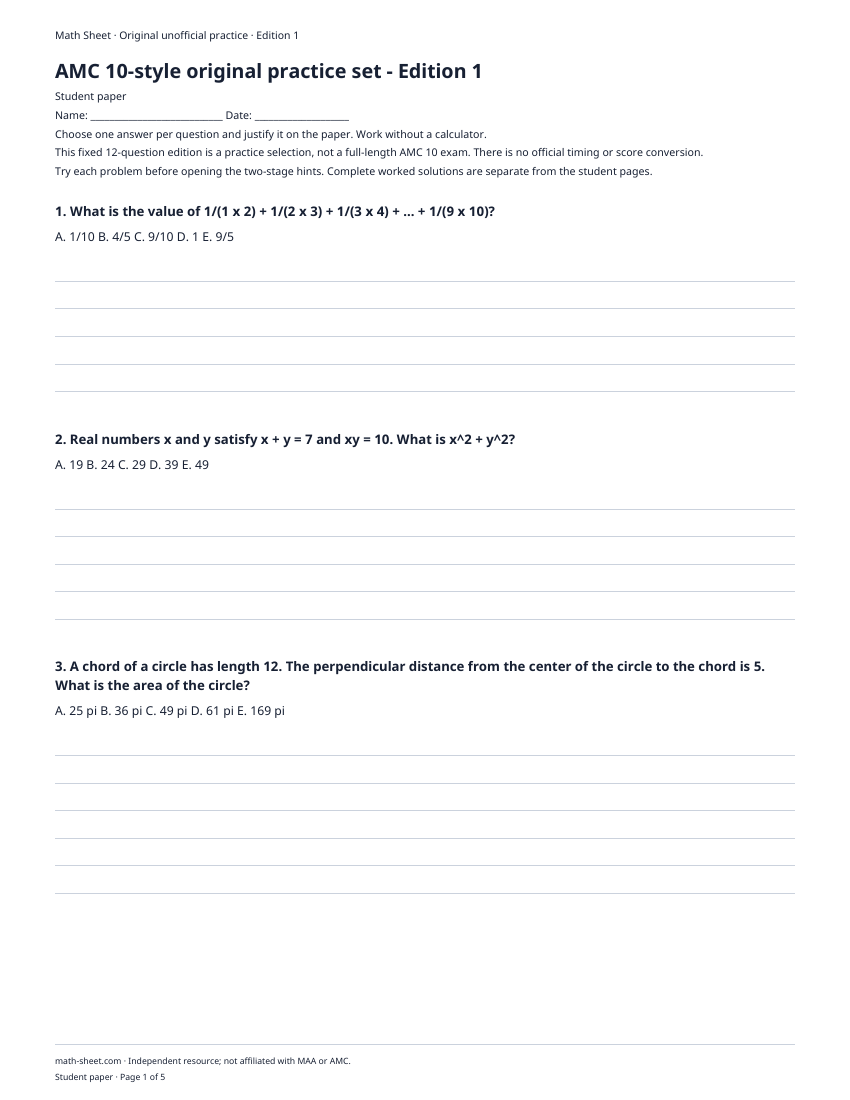
Math competitions · Fixed edition 1
12 original multiple-choice problems in algebra, geometry, counting, and number theory. A focused practice set, not a full mock exam.
Preview and downloadMath competitions · Fixed edition 1
12 original multiple-choice problems extending to advanced high-school reasoning. A focused practice set, not a full mock exam.
Preview and download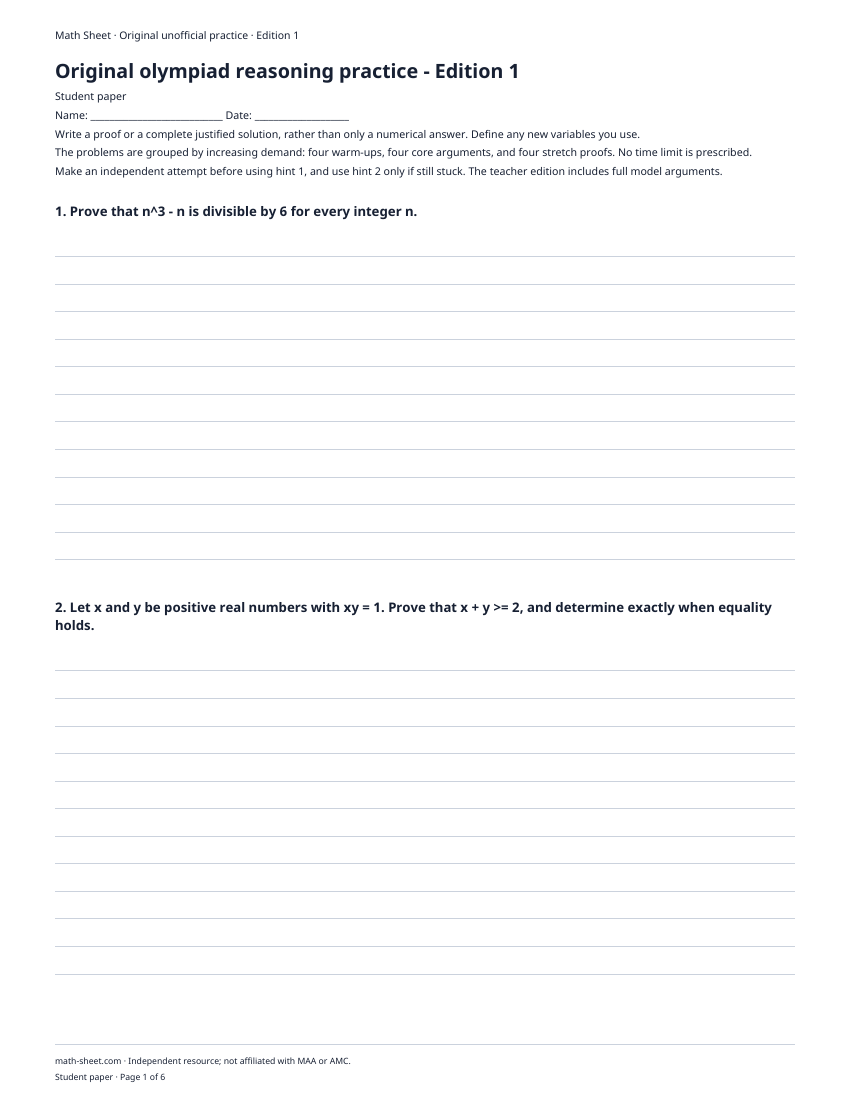
Math competitions · Fixed edition 1
12 original reasoning and proof problems progressing from foundations to challenge, with hints and worked solutions.
Preview and download