
Math competitions · Fixed edition 1
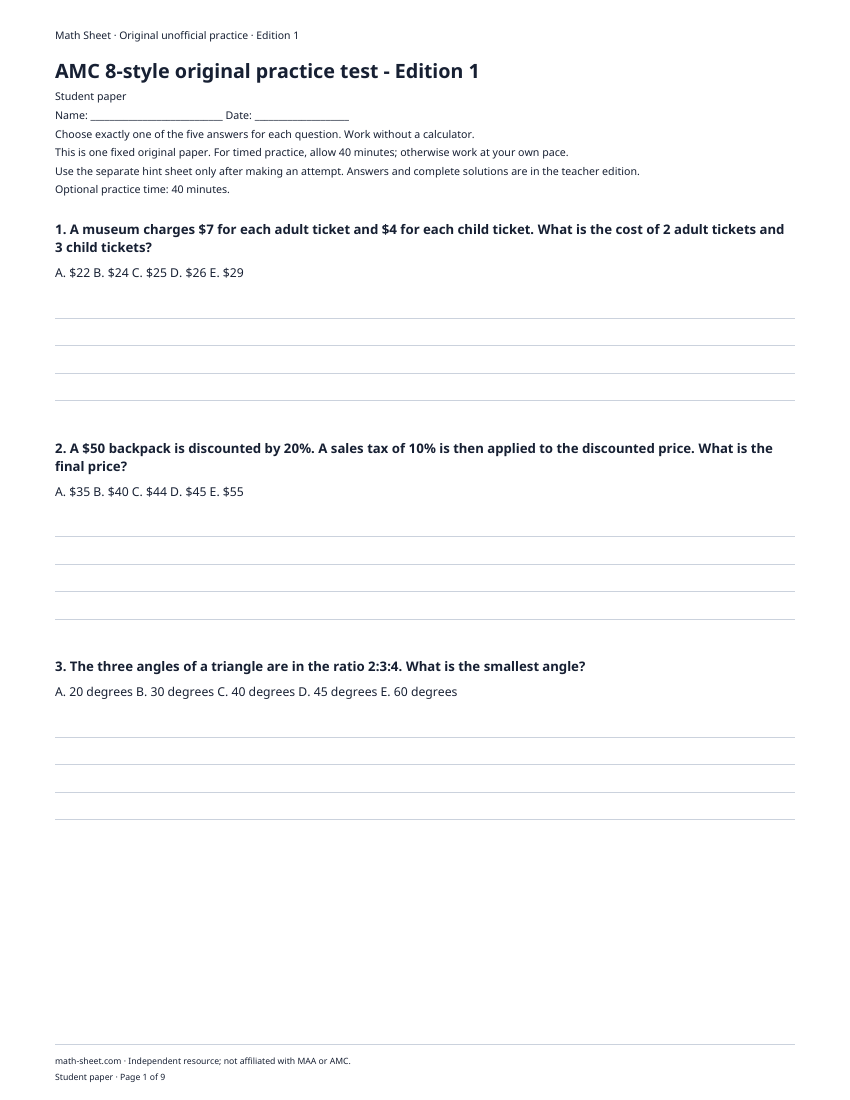
AMC 8-style practice test
25 original multiple-choice problems with an optional 40-minute practice session.
Preview and downloadOriginal unofficial practice · 12 problems · Fixed edition 1
12 original multiple-choice problems in algebra, geometry, counting, and number theory. A focused practice set, not a full mock exam.
Fixed questions, ready to print. Each teacher copy includes all student pages followed by worked answers.
8.5 × 11 inches · Student and teacher editions
210 × 297 mm · Student and teacher editions
This finite paper contains 12 original problems. It is an independent teaching resource, not an official past paper, and is not affiliated with MAA or AMC.
The first-page preview and every PDF use the same edition-1 problem records below. Expand a question after an attempt to review its hints and complete solution.
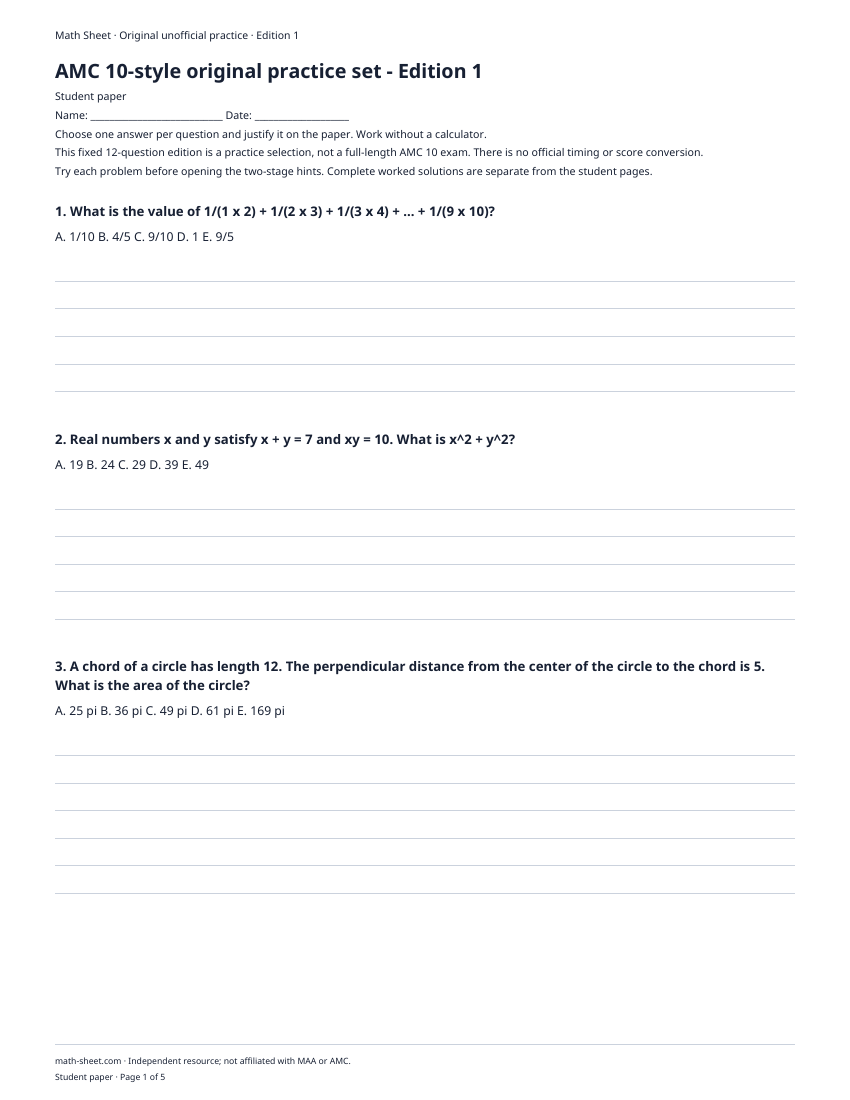
What is the value of 1/(1 x 2) + 1/(2 x 3) + 1/(3 x 4) + ... + 1/(9 x 10)?
Hint 1: Rewrite each term as a difference of two fractions.
Hint 2: Use 1/[k(k + 1)] = 1/k - 1/(k + 1).
Answer: C. 9/10
The sum is (1 - 1/2) + (1/2 - 1/3) + ... + (1/9 - 1/10). All intermediate fractions cancel, leaving 1 - 1/10 = 9/10.
Real numbers x and y satisfy x + y = 7 and xy = 10. What is x^2 + y^2?
Hint 1: Square x + y.
Hint 2: The expansion contains x^2 + y^2 plus 2xy.
Answer: C. 29
The identity (x + y)^2 = x^2 + y^2 + 2xy gives x^2 + y^2 = 49 - 20 = 29. The given conditions are consistent, for example x = 2 and y = 5.
A chord of a circle has length 12. The perpendicular distance from the center of the circle to the chord is 5. What is the area of the circle?
Hint 1: The perpendicular from the center bisects the chord.
Hint 2: Use a right triangle with legs 5 and 6 and hypotenuse equal to the radius.
Answer: D. 61 pi
The half-chord has length 6. By the Pythagorean theorem, the radius satisfies r^2 = 5^2 + 6^2 = 61. Thus the circle has area pi r^2 = 61 pi.
What is the smallest positive integer that leaves remainder 1 on division by 4, remainder 2 on division by 5, and remainder 3 on division by 6?
Hint 1: Each remainder is 3 less than its divisor.
Hint 2: Add 3 to the unknown number; the result is divisible by 4, 5, and 6.
Answer: D. 57
If n is the required number, n + 3 is a positive common multiple of 4, 5, and 6. Their least common multiple is 60, so the smallest positive candidate is n = 60 - 3 = 57. It gives the three required remainders.
Three fair six-sided dice are rolled. What is the probability that the largest result is exactly 5?
Hint 1: Count results whose entries are at most 5.
Hint 2: Subtract those whose entries are all at most 4.
Answer: C. 61/216
There are 6^3 = 216 equally likely ordered results. Exactly 5^3 - 4^3 = 125 - 64 = 61 have all entries at most 5 and at least one entry equal to 5. Therefore the probability is 61/216.
The roots of t^2 - 5t + 3 = 0 are r and s. What is r^3 + s^3?
Hint 1: The sum and product of the roots are 5 and 3.
Hint 2: Expand (r + s)^3 and group the mixed terms as 3rs(r + s).
Answer: D. 80
From the coefficients, r + s = 5 and rs = 3. Thus r^3 + s^3 = (r + s)^3 - 3rs(r + s) = 125 - 45 = 80.
Triangle ABC has area 84. D is the midpoint of BC. E lies on AC with AE:EC = 1:2. Segments AD and BE meet at P. What is the area of triangle ABP?
Hint 1: Use coordinates based on the two sides from A; area ratios do not depend on the triangle's shape.
Hint 2: Set A = (0, 0), B = (1, 0), C = (0, 1). Then D = (1/2, 1/2) and E = (0, 1/3).
Answer: B. 21
Use oblique coordinates with vectors AB and AC as basis vectors. Then D = (1/2, 1/2), E = (0, 1/3), and points on AD have equal coordinates. A point on BE has coordinates (1 - t, t/3). Equating them gives 1 - t = t/3, so t = 3/4 and P = (1/4, 1/4).
Triangles ABP and ABC share base AB. The altitude of P above AB is 1/4 the altitude of C, because the AC-coordinate is 1/4. Their area ratio is 1/4, so the required area is 84/4 = 21.
How many length-six strings made from the letters A, B, and C contain an even number of each letter? Zero occurrences count as even.
Hint 1: The possible occurrence-count patterns are (6,0,0), (4,2,0), and (2,2,2), in any order.
Hint 2: Count the choices of letters as well as their positions.
Answer: D. 183
For pattern (6,0,0), choose the repeated letter in 3 ways. For pattern (4,2,0), choose the letter used four times in 3 ways and the letter used twice in 2 ways; choose its two positions in 15 ways. This gives 3 x 2 x 15 = 90.
For pattern (2,2,2), choose the two A positions in 15 ways and the two B positions among the remaining four in 6 ways; C fills the rest. This gives 90. The disjoint cases total 3 + 90 + 90 = 183.
How many three-digit numbers use three different digits from 1, 2, 3, 4, 5, and 6 and are divisible by 3?
Hint 1: Group the digits by their remainder on division by 3.
Hint 2: Each remainder class has only two digits, so a valid triple must use one from each class.
Answer: C. 48
The remainder classes are {3,6}, {1,4}, and {2,5}. A sum of three remainders is 0 modulo 3 only if all three remainders are equal or all are different. Equal remainders would require three digits from a class of size two, which is impossible.
Choose one digit from each class in 2 x 2 x 2 = 8 ways. Each triple has 6 orders, all producing three-digit numbers, so the answer is 8 x 6 = 48.
Real numbers x, y, and z satisfy x + y + z = 0 and x^2 + y^2 + z^2 = 14. What is x^4 + y^4 + z^4?
Hint 1: First find xy + yz + zx by squaring x + y + z.
Hint 2: Square xy + yz + zx; the extra mixed term contains xyz(x + y + z).
Answer: D. 98
Squaring x + y + z = 0 gives xy + yz + zx = -7. Squaring this relation gives x^2 y^2 + y^2 z^2 + z^2 x^2 + 2xyz(x + y + z) = 49. The last term is zero, so the sum of pairwise squared products is 49.
Now 14^2 = (x^2 + y^2 + z^2)^2 = x^4 + y^4 + z^4 + 2 x 49. Hence x^4 + y^4 + z^4 = 196 - 98 = 98.
A sequence starts with a_1 = 2 and satisfies a_(n+1) = 1/(1 - a_n). What is a_2026?
Hint 1: Calculate the next three terms.
Hint 2: Check that the terms 2, -1, and 1/2 repeat, and none makes a denominator zero.
Answer: E. 2
Starting at 2 gives a_2 = -1, a_3 = 1/2, and a_4 = 2. Since the recurrence is deterministic and all three denominators are nonzero, these three values repeat forever. Because 2026 = 3 x 675 + 1, a_2026 = a_1 = 2.
Four red counters and four blue counters are placed in a uniformly random order. What is the probability that every initial segment of the order contains at least as many red counters as blue counters?
Hint 1: There are 70 equally likely color orders. Count the orders that first let blue move ahead.
Hint 2: For a bad order, interchange red and blue up to and including the first prefix with one more blue than red.
Answer: C. 1/5
There are 8 choose 4 = 70 color orders. For each bad order, find the first prefix with one more blue than red, and swap both colors throughout that prefix. The resulting order has 5 red and 3 blue counters.
This is a bijection: every order with 5 red and 3 blue first reaches a prefix with one more red than blue; swapping that prefix recovers a unique bad order with 4 of each color. There are 8 choose 3 = 56 such orders, so 70 - 56 = 14 are good. The probability is 14/70 = 1/5.
Math competitions · Fixed edition 1
25 original multiple-choice problems with an optional 40-minute practice session.
Preview and downloadMath competitions · Fixed edition 1
12 original multiple-choice problems in algebra, geometry, counting, and number theory. A focused practice set, not a full mock exam.
Preview and download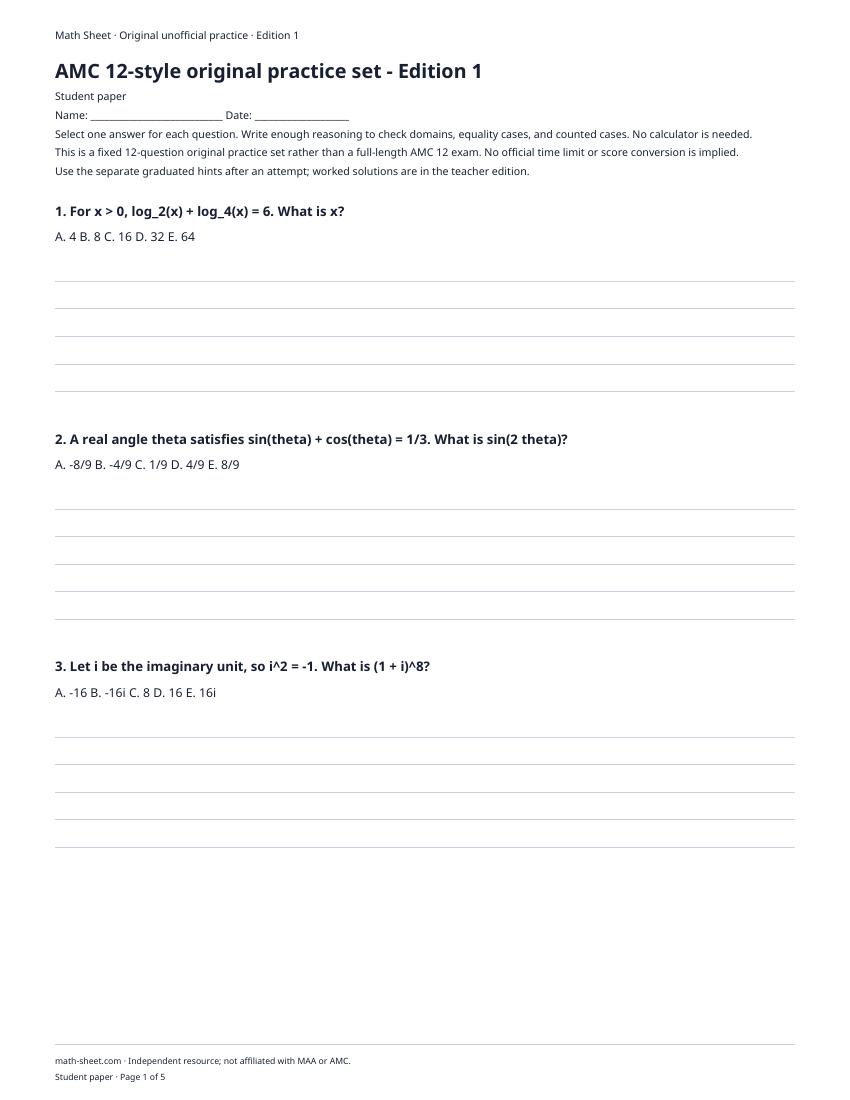
Math competitions · Fixed edition 1
12 original multiple-choice problems extending to advanced high-school reasoning. A focused practice set, not a full mock exam.
Preview and download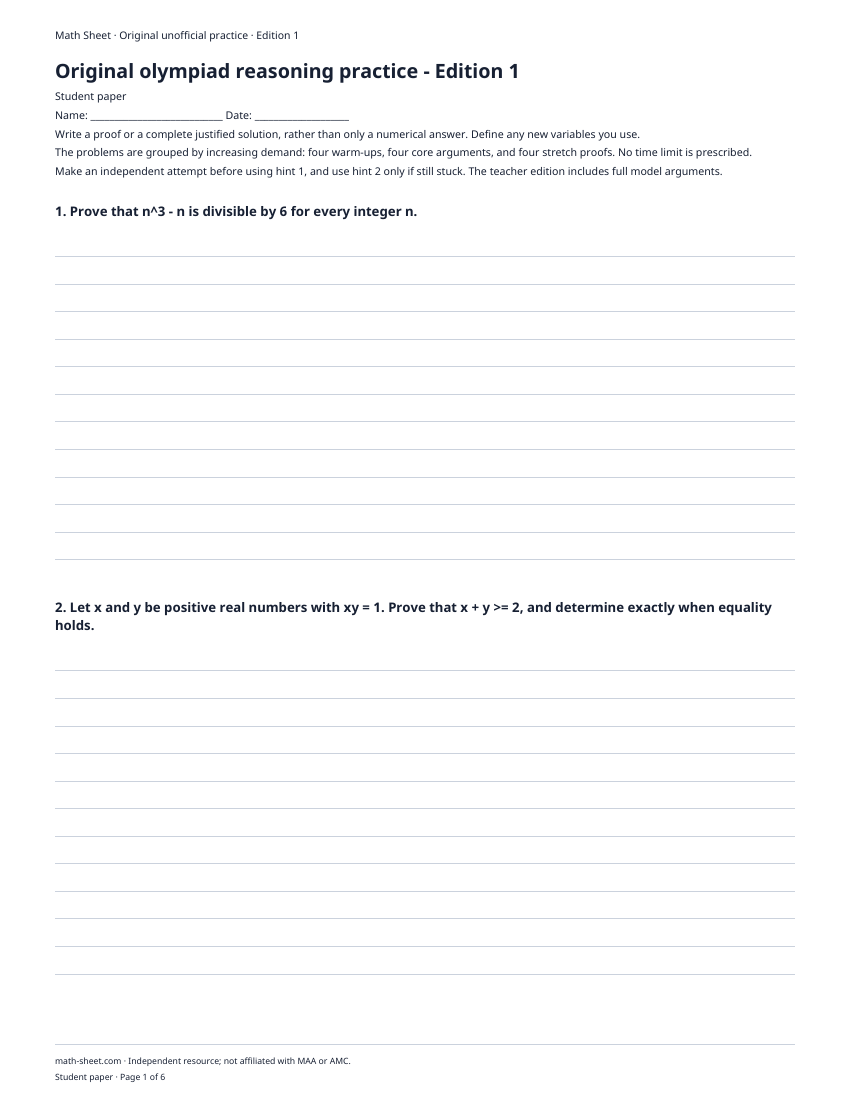
Math competitions · Fixed edition 1
12 original reasoning and proof problems progressing from foundations to challenge, with hints and worked solutions.
Preview and download