
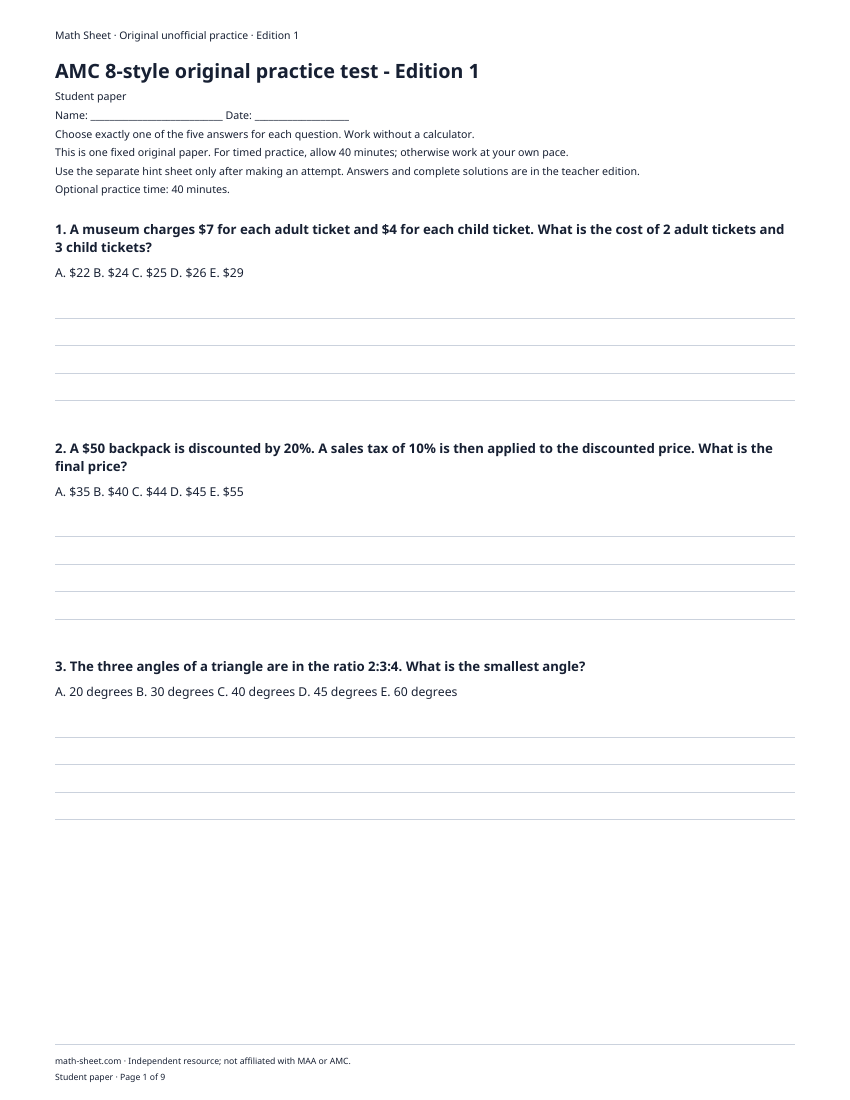
Math competitions · Fixed edition 1
AMC 8-style practice test
25 original multiple-choice problems with an optional 40-minute practice session.
Preview and downloadOriginal unofficial practice · 25 problems · Fixed edition 1
25 original multiple-choice problems with an optional 40-minute practice session.
Fixed questions, ready to print. Each teacher copy includes all student pages followed by worked answers.
8.5 × 11 inches · Student and teacher editions
210 × 297 mm · Student and teacher editions
This finite paper contains 25 original problems. It is an independent teaching resource, not an official past paper, and is not affiliated with MAA or AMC.
The first-page preview and every PDF use the same edition-1 problem records below. Expand a question after an attempt to review its hints and complete solution.
A museum charges $7 for each adult ticket and $4 for each child ticket. What is the cost of 2 adult tickets and 3 child tickets?
Hint 1: Find the adult-ticket cost and the child-ticket cost separately.
Hint 2: The two costs are 2 x $7 and 3 x $4.
Answer: D. $26
The adult tickets cost 2 x $7 = $14, and the child tickets cost 3 x $4 = $12. The total is $14 + $12 = $26.
A $50 backpack is discounted by 20%. A sales tax of 10% is then applied to the discounted price. What is the final price?
Hint 1: Apply the discount before calculating the tax.
Hint 2: After the discount, the price is 80% of $50.
Answer: C. $44
The discounted price is 0.80 x $50 = $40. The tax is 0.10 x $40 = $4, so the final price is $44.
The three angles of a triangle are in the ratio 2:3:4. What is the smallest angle?
Hint 1: The angles of a triangle add to 180 degrees.
Hint 2: There are 2 + 3 + 4 = 9 equal angle-parts.
Answer: C. 40 degrees
Each part is 180/9 = 20 degrees. The smallest angle has 2 parts, so it measures 40 degrees.
A two-digit number is formed using two different digits from 3, 5, and 7. How many such numbers are divisible by 5?
Hint 1: A number divisible by 5 must end in 0 or 5.
Hint 2: Here the units digit must be 5. List the possible tens digits.
Answer: B. 2
The units digit must be 5, since 0 is unavailable. The tens digit can be 3 or 7. The numbers are 35 and 75, giving 2 numbers.
A rectangle has perimeter 30 cm. Its length is twice its width. What is its area?
Hint 1: Half the perimeter is the length plus the width.
Hint 2: If the width is w, then the length plus the width is 3w.
Answer: D. 50 square cm
The length plus the width is 30/2 = 15 cm. Thus 3w = 15 and w = 5 cm. The length is 10 cm, giving area 10 x 5 = 50 square cm.
Five numbers have mean 12. One of the numbers, 8, is removed. What is the mean of the remaining four numbers?
Hint 1: Recover the sum of the five numbers from their mean.
Hint 2: Subtract 8 from that sum, then divide by 4.
Answer: D. 13
The original sum is 5 x 12 = 60. The remaining sum is 60 - 8 = 52, so the new mean is 52/4 = 13.
How many integers from 1 through 60, inclusive, are divisible by 4 or by 6?
Hint 1: Count multiples of 4 and multiples of 6.
Hint 2: Multiples of 12 appear in both lists, so subtract their count once.
Answer: C. 20
There are 15 multiples of 4 and 10 multiples of 6. The 5 multiples of 12 were counted twice. Therefore the required count is 15 + 10 - 5 = 20.
A fair six-sided die is rolled twice. What is the probability that the sum of the two results is odd?
Hint 1: An odd sum uses one odd result and one even result.
Hint 2: There are 3 odd and 3 even faces; count both possible orders.
Answer: C. 1/2
Of the 36 equally likely ordered results, 3 x 3 = 9 are odd then even, and another 9 are even then odd. The probability is 18/36 = 1/2.
A sequence starts at 3. To obtain the next terms, add 2, then 4, then 6, and continue adding consecutive positive even numbers. What is the eighth term?
Hint 1: To reach the eighth term, make seven additions.
Hint 2: Pair terms in 2 + 4 + 6 + 8 + 10 + 12 + 14.
Answer: D. 59
The seventh addition is 14. The seven added numbers sum to 7 x (2 + 14)/2 = 56. Thus the eighth term is 3 + 56 = 59.
On a square grid, a robot travels from (0, 0) to (3, 2), using only steps one unit right or one unit up. How many routes avoid the point (1, 1)?
Hint 1: Count all routes, then subtract the routes that visit (1, 1).
Hint 2: There are 2 routes to (1, 1) and 3 routes from there to (3, 2).
Answer: B. 4
Every route consists of 3 right steps and 2 up steps, so there are 10 ways to choose the positions of the up steps. A route through (1, 1) has 2 choices before that point and 3 after it, giving 6 routes. Therefore 10 - 6 = 4 routes avoid the point.
A team plays 12 games. It earns 3 points for a win, 1 point for a tie, and 0 points for a loss. It has 4 ties and 22 points. How many losses does it have?
Hint 1: Remove the points earned in tied games.
Hint 2: The wins account for 22 - 4 = 18 points.
Answer: C. 2
The team has 18/3 = 6 wins. Its 12 games consist of 6 wins, 4 ties, and 12 - 6 - 4 = 2 losses.
A rectangular floor is 84 cm by 60 cm. It is covered with identical square tiles of the largest possible whole-number side length, with no gaps or cutting. How many tiles are needed?
Hint 1: The tile side length must divide both 84 and 60.
Hint 2: Their greatest common divisor is 12.
Answer: D. 35
The largest possible tile side is gcd(84, 60) = 12 cm. There are 84/12 = 7 tiles along one side and 60/12 = 5 along the other, so 7 x 5 = 35 tiles are needed.
A tank is one-third full. Adding 12 liters makes it five-sixths full. What is the tank's capacity?
Hint 1: Find what fraction of the capacity was added.
Hint 2: The increase is 5/6 - 1/3 = 1/2 of the tank.
Answer: C. 24 liters
The added 12 liters fill 1/2 of the tank. The full capacity is therefore 12 divided by 1/2, or 24 liters.
All six faces of a cube are painted. The cube is then cut into 27 equal small cubes in a 3 by 3 by 3 arrangement. How many small cubes have exactly two painted faces?
Hint 1: Small cubes with exactly two painted faces lie on edges but not at corners.
Hint 2: Each of the large cube's 12 edges has one noncorner small cube.
Answer: C. 12
A corner small cube has three painted faces. On each edge, the one small cube between the corners has exactly two painted faces. The 12 edges give 12 such cubes; face-interior and interior cubes have fewer painted faces.
How many ordered pairs of positive integers (x, y) satisfy x + 2y = 15?
Hint 1: Solve for x in terms of y and require x >= 1.
Hint 2: The possible values of y are the integers from 1 through 7.
Answer: C. 7
We have x = 15 - 2y. Positivity gives 1 <= y <= 7. Each of these seven integer values gives exactly one positive x, so there are 7 ordered pairs.
Triangle ABC has area 72 square units. M is the midpoint of AB. N lies on AC with AN:NC = 1:2. What is the area of triangle AMN?
Hint 1: Triangles with the same altitude have areas in the ratio of their bases.
Hint 2: First replace AB with AM, then replace AC with AN.
Answer: B. 12
Triangle AMC has half the area of ABC because AM = AB/2 and the two triangles share the altitude from C. Its area is 36. Since AN = AC/3, triangle AMN has one-third of the area of AMC, or 12 square units.
How many integers from 1 through 100 leave remainder 2 when divided by 5 and remainder 3 when divided by 7?
Hint 1: List the numbers that are 3 more than a multiple of 7.
Hint 2: After finding the first common solution, add 35 to find the next.
Answer: C. 3
Among 3, 10, 17, 24, and 31, only 17 has remainder 2 on division by 5. Both remainders repeat every 35, giving 17, 52, and 87 in the required range. The next is 122, so there are 3.
A bag contains 3 red counters and 2 blue counters. Two counters are chosen uniformly without replacement. What is the probability that they have the same color?
Hint 1: Count unordered pairs of counters.
Hint 2: There are 3 pairs of red counters and 1 pair of blue counters.
Answer: C. 2/5
There are 5 x 4 / 2 = 10 equally likely unordered pairs. Of these, 3 x 2 / 2 = 3 are red-red, and 1 is blue-blue. Thus the probability is 4/10 = 2/5.
A three-digit palindrome has hundreds digit 2 and is divisible by 9. What is the number?
Hint 1: A palindrome reads the same in either direction.
Hint 2: Write its digits as 2, b, 2 and use the divisibility-by-9 digit-sum test.
Answer: D. 252
The number has the form 2b2, whose digit sum is b + 4. For 0 <= b <= 9, this sum lies from 4 through 13, so the only possible multiple of 9 is 9. Therefore b = 5 and the number is 252.
Six chairs are in a row. In how many ways can two of the chairs be selected so that they are not adjacent? The two selected chairs are not assigned to particular people.
Hint 1: Start with all selections of two chairs.
Hint 2: There are 5 adjacent pairs to exclude.
Answer: C. 10
There are 6 x 5 / 2 = 15 unordered selections of two chairs. Exactly 5 selections use adjacent chairs, namely consecutive positions 1-2 through 5-6. Hence 15 - 5 = 10 selections are allowed.
At 3:20 on a clock whose hands move continuously, what is the smaller angle between the hour hand and the minute hand?
Hint 1: The hour hand has moved beyond 3 by 3:20.
Hint 2: The minute hand is 120 degrees clockwise from 12; the hour hand moves 0.5 degree each minute.
Answer: B. 20 degrees
At 3:00 the hour hand is 90 degrees clockwise from 12. In 20 minutes it moves 10 degrees, reaching 100 degrees. The minute hand is at 20 x 6 = 120 degrees. Their smaller separation is 120 - 100 = 20 degrees.
A 4 by 4 board consists of 16 unit squares. How many squares of all sizes have sides along the grid lines?
Hint 1: Count separately by side length.
Hint 2: There are 16 of side 1, 9 of side 2, and so on.
Answer: D. 30
The possible side lengths are 1, 2, 3, and 4. A square of side k has (5 - k)^2 possible positions. The total is 16 + 9 + 4 + 1 = 30.
Use the digits 1, 2, 3, and 4 exactly once to form two two-digit numbers. What is the smallest possible positive difference between the two numbers?
Hint 1: Let the larger number have the larger tens digit.
Hint 2: With consecutive tens digits, the difference is 10 plus the difference of the units digits.
Answer: C. 7
If the tens digits differ by at least 2, the difference is at least 20 - 3 = 17. If they are consecutive, check the three possible pairs of tens digits. Tens 1 and 2 leave units 3 and 4, giving minimum difference 9; tens 2 and 3 leave 1 and 4, giving 10 - 3 = 7; tens 3 and 4 give 9. Thus 31 - 24 = 7 is the minimum.
Positive integers a and b satisfy a + b = 12. Their product is not divisible by 3. What is the greatest possible product?
Hint 1: For a fixed sum, products increase as the two numbers get closer together.
Hint 2: The closest pair is 6 and 6, but its product is divisible by 3. Try the next closest pair.
Answer: D. 35
Since (a - b)^2 >= 0, we have ab <= (a + b)^2/4 = 36, with equality only at a = b = 6. That pair is forbidden. The next integer below 36 is 35, and it is attained by 5 and 7. Since 35 is not divisible by 3, the greatest allowed product is 35.
Two players alternate removing 1, 2, or 3 stones from a pile of 30 stones. The player who removes the last stone wins. Which first move guarantees the first player a win if they continue to play correctly?
Hint 1: Look at piles of 4 stones and then 8 stones.
Hint 2: Leave a multiple of 4, then make each pair of moves remove 4 stones.
Answer: B. Remove 2 stones
Remove 2 stones, leaving 28. Whenever the opponent removes r stones, remove 4 - r stones. This is always a legal move and returns a multiple of 4 to the opponent, eventually leaving 0 after your move. A first move of 1 or 3 leaves 29 or 27; the opponent can then leave 28 or 24 and use the same strategy. Thus only removing 2 guarantees a win.
Math competitions · Fixed edition 1
25 original multiple-choice problems with an optional 40-minute practice session.
Preview and download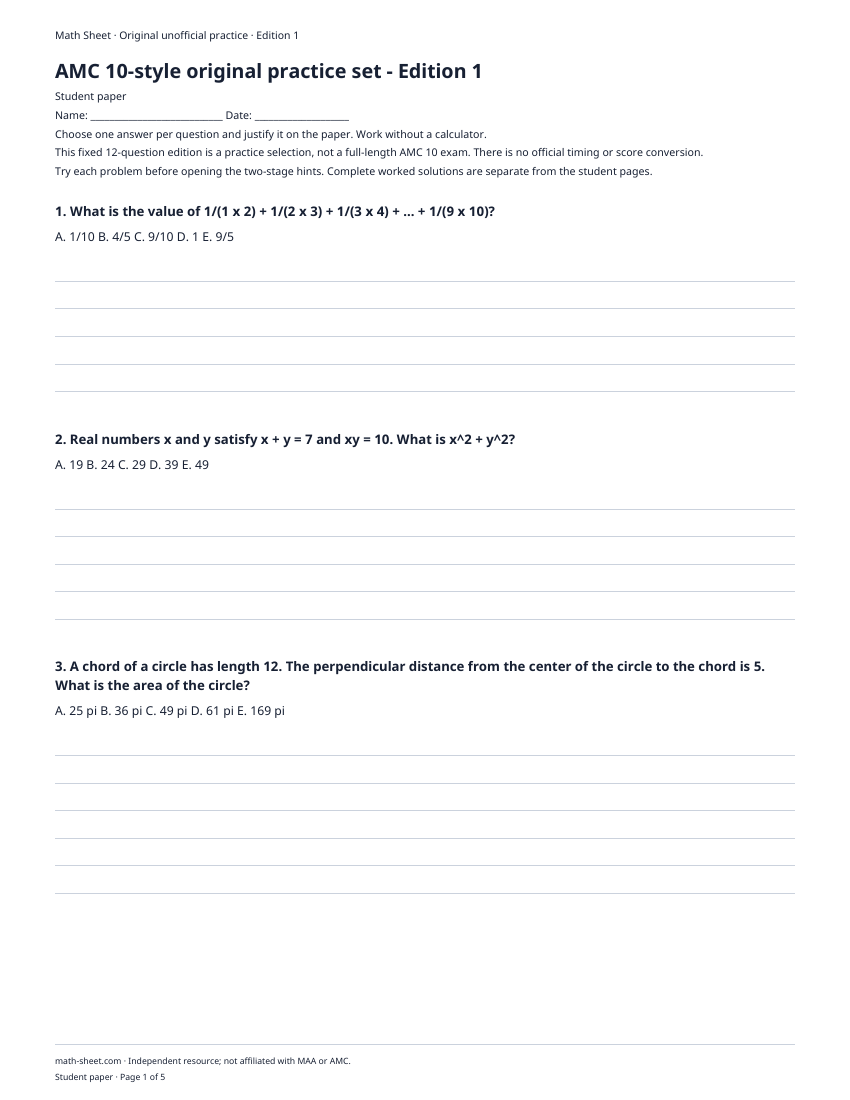
Math competitions · Fixed edition 1
12 original multiple-choice problems in algebra, geometry, counting, and number theory. A focused practice set, not a full mock exam.
Preview and download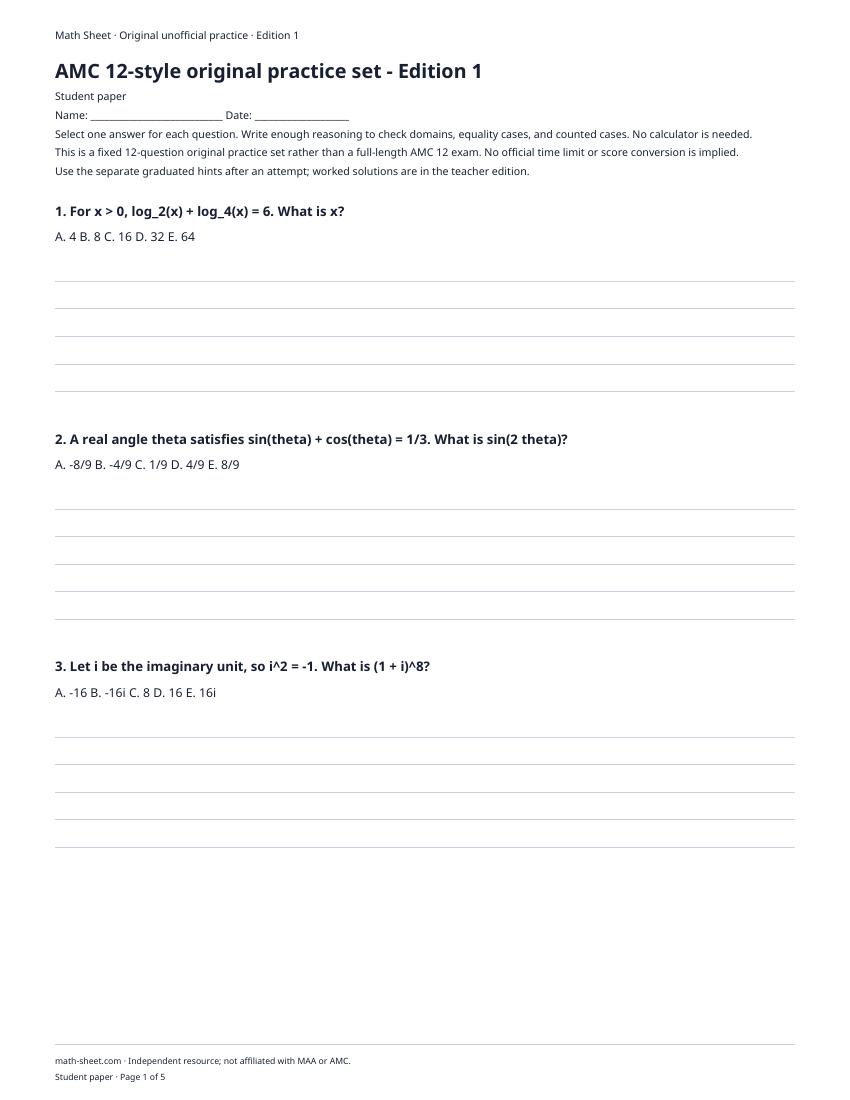
Math competitions · Fixed edition 1
12 original multiple-choice problems extending to advanced high-school reasoning. A focused practice set, not a full mock exam.
Preview and download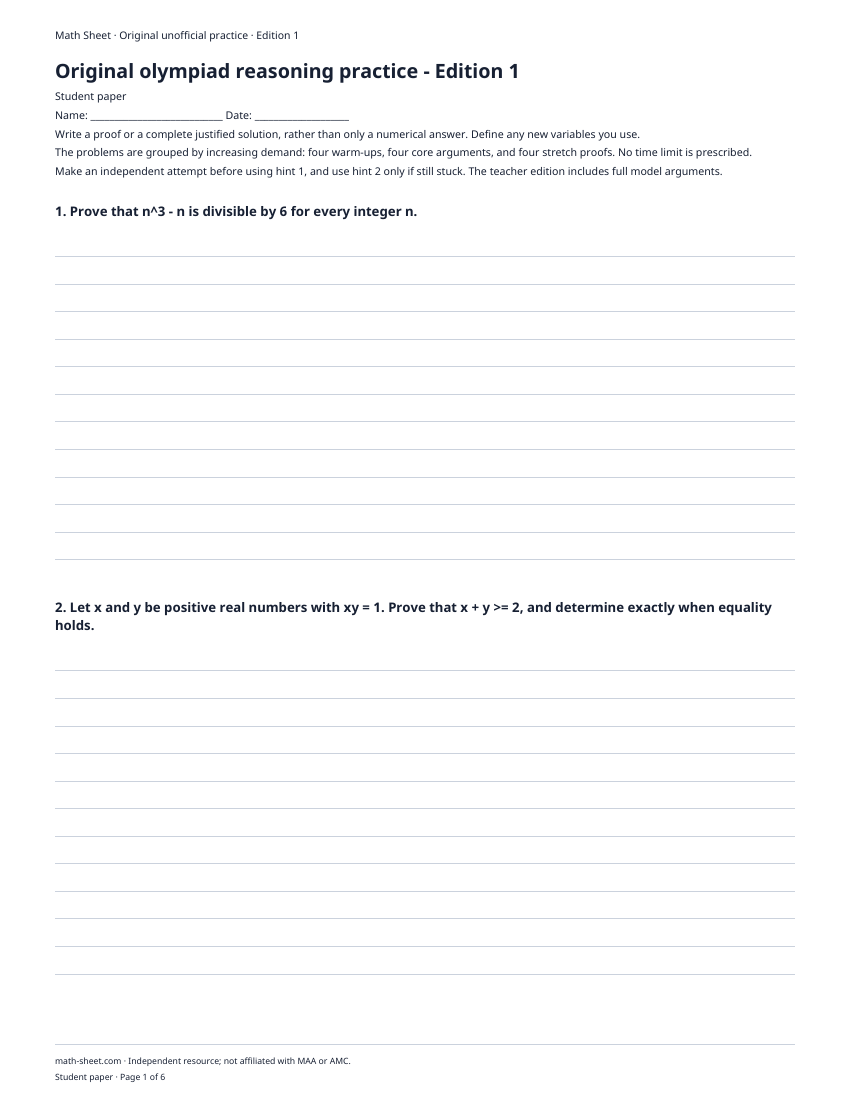
Math competitions · Fixed edition 1
12 original reasoning and proof problems progressing from foundations to challenge, with hints and worked solutions.
Preview and download