Probability practice

Independence and Base Rates worksheets

Check independence in rational tables and compare Bayesian posteriors under different priors.

Ready-made English PDF · fixed settings

Customization below makes a separate PDF.

Fixed English ready-made files. Custom settings below apply only to the configured PDF.

Ready to print

Start with a ready-made worksheet

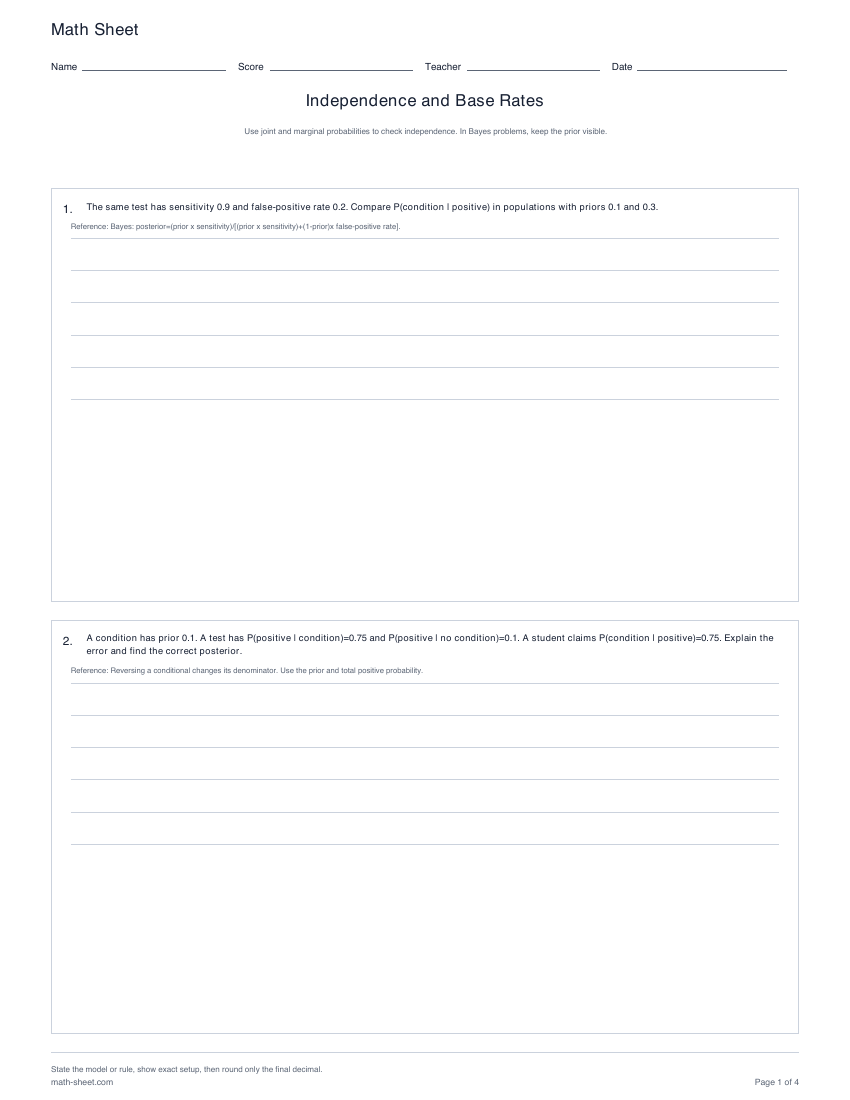
Use joint and marginal probabilities to check independence. In Bayes problems, keep the prior visible.

Download the practice pages alone, or include a separate answer key or teacher model. Longer activities may use more than one page.

Customize this worksheet

Paper sizes and printing help · More probability activities

Make the mathematical structure visible

Each problem prints the support, table, model assumptions, or sample convention needed to solve it on paper. Student pages reserve workspace; teacher downloads append a separate worked key generated from the same validated document.

Learning objective

What this activity builds

Distinguish independence from association and preserve the prior when reversing conditional probabilities.

Worked example

If P(A)=1/2, P(B)=1/4, and P(A and B)=1/8, are A and B independent?

Yes, because (1/2)(1/4)=1/8.

The joint equals the product of marginals.

Teaching notes

Make the practice count

  • Complete all four table cells.
  • Compare posteriors with the same likelihoods.
  • Name the direction of every conditional.

Make it yours

Customize the practice

Choose your options, update the preview, then download the exact same pages.

Choose one or more bounded question types, problem count, paper size, and seed.

Worksheet settings

Question types
Page note and reproducible seed

The same settings and seed make the same questions. Shared links include your page note; leave personal information out.

Configured PDF · Independence and Base Rates · US Letter

Preview ready. Download includes these exact pages.

4 student pages
Enlarged pages scroll. PDF size stays the same.
Math SheetNameScoreTeacherDateIndependence and Base RatesUse joint and marginal probabilities to check independence. In Bayes problems, keep the prior visible.1.The same test has sensitivity 0.9 and false-positive rate 0.2. Compare P(condition | positive) in populations with priors 0.1 and 0.3.Reference: Bayes: posterior=(prior x sensitivity)/[(prior x sensitivity)+(1-prior)x false-positive rate].2.A condition has prior 0.1. A test has P(positive | condition)=0.75 and P(positive | no condition)=0.1. A student claims P(condition | positive)=0.75. Explain theerror and find the correct posterior.Reference: Reversing a conditional changes its denominator. Use the prior and total positive probability.State the model or rule, show exact setup, then round only the final decimal.math-sheet.comPage 1 of 4
Math SheetNameScoreTeacherDateIndependence and Base RatesUse joint and marginal probabilities to check independence. In Bayes problems, keep the prior visible.3.A 96-person table has 48 in A, 24 in B, and 12 in both A and B. Complete the four cell counts and decide whether A and B are independent.Reference: Events are independent exactly when P(A intersection B)=P(A)P(B).4.The same test has sensitivity 0.8 and false-positive rate 0.2. Compare P(condition | positive) in populations with priors 0.1 and 0.3.Reference: Bayes: posterior=(prior x sensitivity)/[(prior x sensitivity)+(1-prior)x false-positive rate].State the model or rule, show exact setup, then round only the final decimal.math-sheet.comPage 2 of 4
Math SheetNameScoreTeacherDateIndependence and Base RatesUse joint and marginal probabilities to check independence. In Bayes problems, keep the prior visible.5.A 112-person table has 56 in A, 28 in B, and 14 in both A and B. Complete the four cell counts and decide whether A and B are independent.Reference: Events are independent exactly when P(A intersection B)=P(A)P(B).6.A condition has prior 0.1. A test has P(positive | condition)=0.75 and P(positive | no condition)=0.05. A student claims P(condition | positive)=0.75. Explain theerror and find the correct posterior.Reference: Reversing a conditional changes its denominator. Use the prior and total positive probability.State the model or rule, show exact setup, then round only the final decimal.math-sheet.comPage 3 of 4
Math SheetNameScoreTeacherDateIndependence and Base RatesUse joint and marginal probabilities to check independence. In Bayes problems, keep the prior visible.7.A 128-person table has 64 in A, 32 in B, and 16 in both A and B. Complete the four cell counts and decide whether A and B are independent.Reference: Events are independent exactly when P(A intersection B)=P(A)P(B).8.The same test has sensitivity 0.8 and false-positive rate 0.1. Compare P(condition | positive) in populations with priors 0.01 and 0.4.Reference: Bayes: posterior=(prior x sensitivity)/[(prior x sensitivity)+(1-prior)x false-positive rate].State the model or rule, show exact setup, then round only the final decimal.math-sheet.comPage 4 of 4

A useful next step

Related activities