Probability practice

Discrete CDFs, Transformations, and Moments worksheets

Build step CDFs, find quantiles, merge transformed PMFs, and apply weighted moment rules.

Ready-made English PDF · fixed settings

Customization below makes a separate PDF.

Fixed English ready-made files. Custom settings below apply only to the configured PDF.

Ready to print

Start with a ready-made worksheet

Use F(x)=P(X<=x). For quantiles, choose the smallest support value whose CDF reaches the target.

Download the practice pages alone, or include a separate answer key or teacher model. Longer activities may use more than one page.

Customize this worksheet

Paper sizes and printing help · More probability activities

Make the mathematical structure visible

Each problem prints the support, table, model assumptions, or sample convention needed to solve it on paper. Student pages reserve workspace; teacher downloads append a separate worked key generated from the same validated document.

Learning objective

What this activity builds

Move accurately among finite PMFs, CDFs, quantiles, transformations, expectation, variance, and standard deviation.

Worked example

If X is equally likely to be -1 or 1, find the PMF of X squared.

P(X squared=1)=1.

Both original support points merge at one transformed value.

Teaching notes

Make the practice count

  • Accumulate CDF probabilities from left to right.
  • Merge equal transformed values.
  • Square the affine scale factor for variance.

Make it yours

Customize the practice

Choose your options, update the preview, then download the exact same pages.

Choose one or more bounded question types, problem count, paper size, and seed.

Worksheet settings

Question types
Page note and reproducible seed

The same settings and seed make the same questions. Shared links include your page note; leave personal information out.

Configured PDF · Discrete CDFs, Transformations, and Moments · US Letter

Preview ready. Download includes these exact pages.

4 student pages
Enlarged pages scroll. PDF size stays the same.
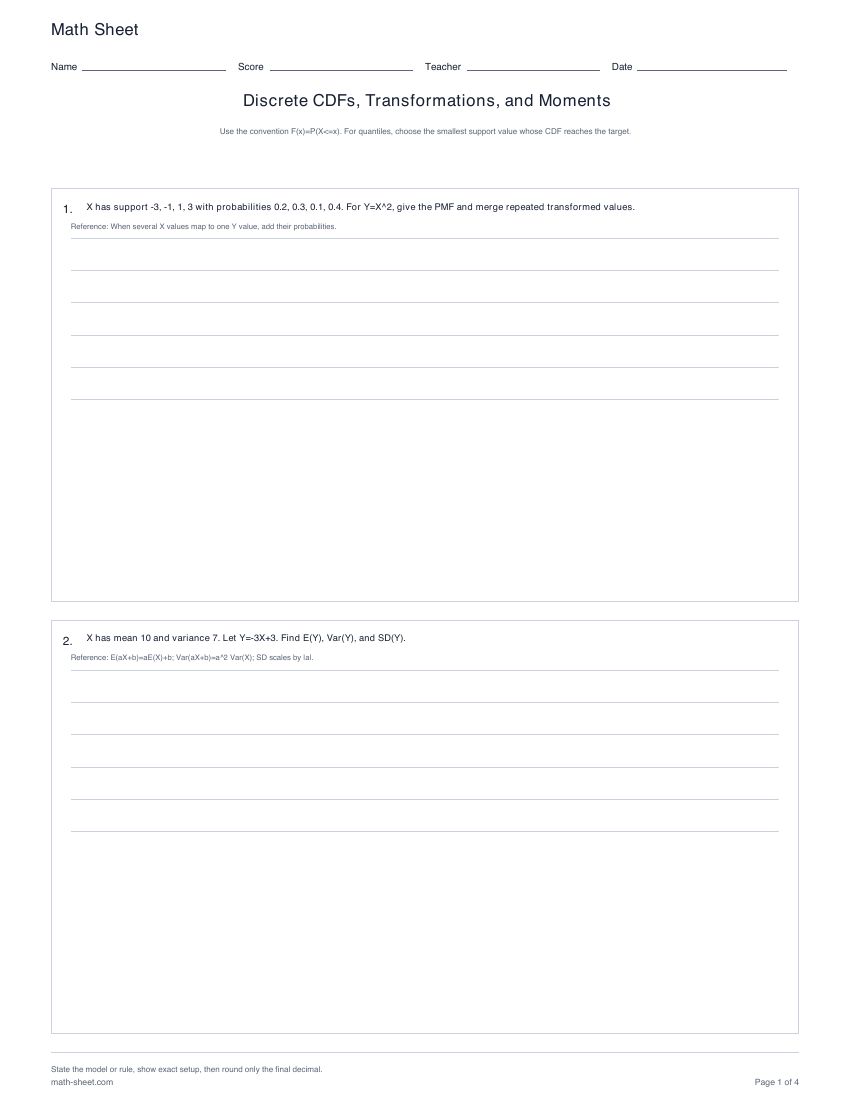
Math SheetNameScoreTeacherDateDiscrete CDFs, Transformations, and MomentsUse the convention F(x)=P(X<=x). For quantiles, choose the smallest support value whose CDF reaches the target.1.X has support -3, -1, 1, 3 with probabilities 0.2, 0.3, 0.1, 0.4. For Y=X^2, give the PMF and merge repeated transformed values.Reference: When several X values map to one Y value, add their probabilities.2.X has mean 10 and variance 7. Let Y=-3X+3. Find E(Y), Var(Y), and SD(Y).Reference: E(aX+b)=aE(X)+b; Var(aX+b)=a^2 Var(X); SD scales by |a|.State the model or rule, show exact setup, then round only the final decimal.math-sheet.comPage 1 of 4
Math SheetNameScoreTeacherDateDiscrete CDFs, Transformations, and MomentsUse the convention F(x)=P(X<=x). For quantiles, choose the smallest support value whose CDF reaches the target.3.X is equally likely to be 6 or 10; Y is equally likely to be 4 or 12. Compare their means and standard deviations.Reference: Equal means do not imply equal spread. Compute probability-weighted variance around the common mean.4.For support 7, 9, 11, 13 with probabilities 0.25, 0.25, 0.25, 0.25, evaluate F(6), F(10), and F(14).Reference: A discrete CDF is right-continuous and constant between support points.State the model or rule, show exact setup, then round only the final decimal.math-sheet.comPage 2 of 4
Math SheetNameScoreTeacherDateDiscrete CDFs, Transformations, and MomentsUse the convention F(x)=P(X<=x). For quantiles, choose the smallest support value whose CDF reaches the target.5.X has support 8, 10, 12, 14, 16 with probabilities 0.1, 0.15, 0.2, 0.25, 0.3 in matching order. Make a PMF table and a step-CDF table.Reference: F(x)=P(X<=x). The CDF is 0 below the support and 1 at or above its largest value.6.Independent X and Y have E(X)=11.6, Var(X)=2.44, E(Y)=2, and Var(Y)=2. Find the mean, variance, and SD of X+Y.Reference: Means always add. Variances add here because independence makes covariance zero.State the model or rule, show exact setup, then round only the final decimal.math-sheet.comPage 3 of 4
Math SheetNameScoreTeacherDateDiscrete CDFs, Transformations, and MomentsUse the convention F(x)=P(X<=x). For quantiles, choose the smallest support value whose CDF reaches the target.7.X has support 10, 12, 14, 16 with probabilities 0.25, 0.25, 0.25, 0.25. Find E(X), E(X^2), Var(X), and SD(X).Reference: Use probability-weighted sums; Var(X)=E(X^2)-[E(X)]^2 and SD is the positive square root.8.X has support 11, 13, 15, 17, 19 with probabilities 0.1, 0.15, 0.2, 0.25, 0.3. Using q_p=min{x in support: F(x)>=p}, find q_0.7.Reference: Choose the first support point whose cumulative probability reaches or exceeds p.State the model or rule, show exact setup, then round only the final decimal.math-sheet.comPage 4 of 4

A useful next step

Related activities