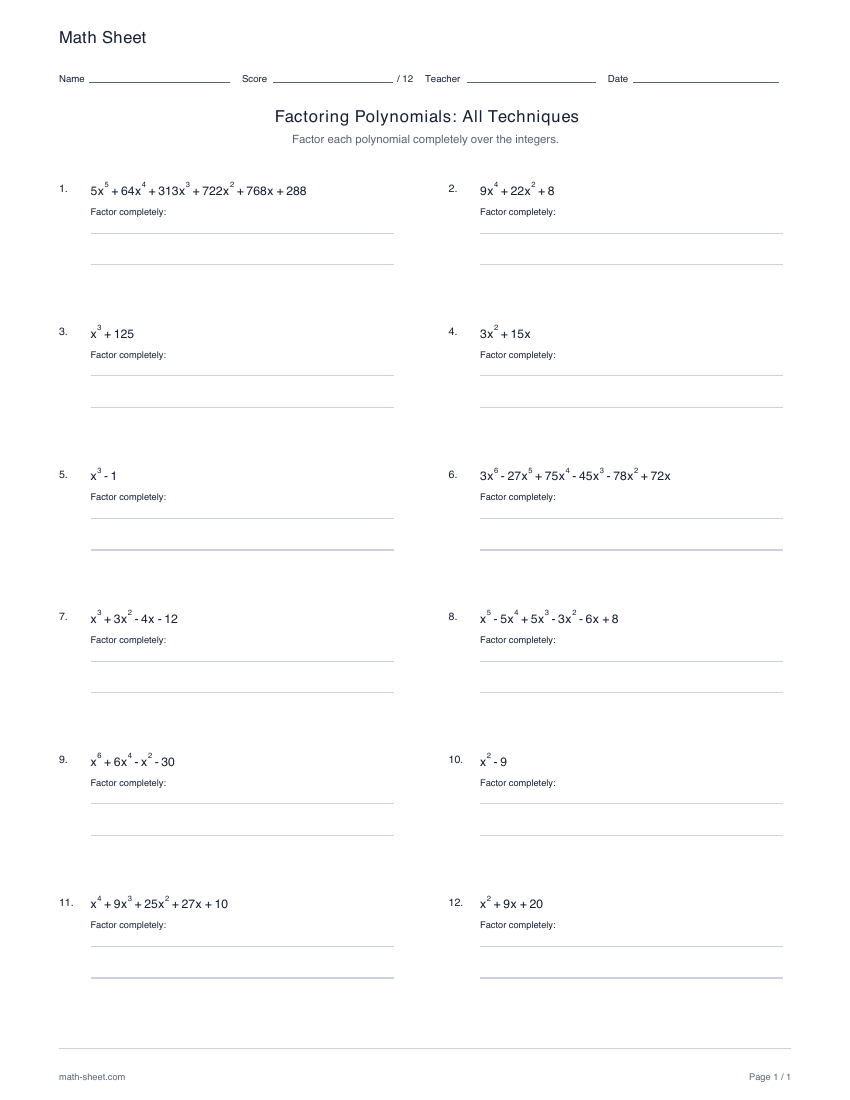
The first four problems start from complete factors, the next four build a primitive integer polynomial from exact zeros, and the final four start from an expanded polynomial that must be factored completely.
Use conjugate closure for irrational and nonreal zeros, preserve every multiplicity, and clear denominators only after forming the monic product. The worked key checks the primitive integer result exactly.
Learning objective
What this activity builds
Move exactly among factors, zeros with multiplicity and primitive positive-leading integer polynomials.
Worked example
Build a polynomial from zeros 5 and ±sqrt(2)i/4.
8x³ - 40x² + x - 5.
The conjugate pair gives x² + 1/8. Multiply by x - 5, clear denominators, divide any common coefficient factor and keep the leading coefficient positive.
Teaching notes
Make the practice count
Preserve every stated multiplicity.
Pair irrational and nonreal conjugates before multiplying.
Clear all denominators before dividing the coefficient GCD.
Continue factoring until no quadratic factor splits over the rationals.
Make it yours
Customize the practice
Choose your options, update the preview, then download the exact same pages.
Each English-only sheet has 12 tasks in three fixed sections. Imaginary mode uses all-nonreal zeros and even degrees.
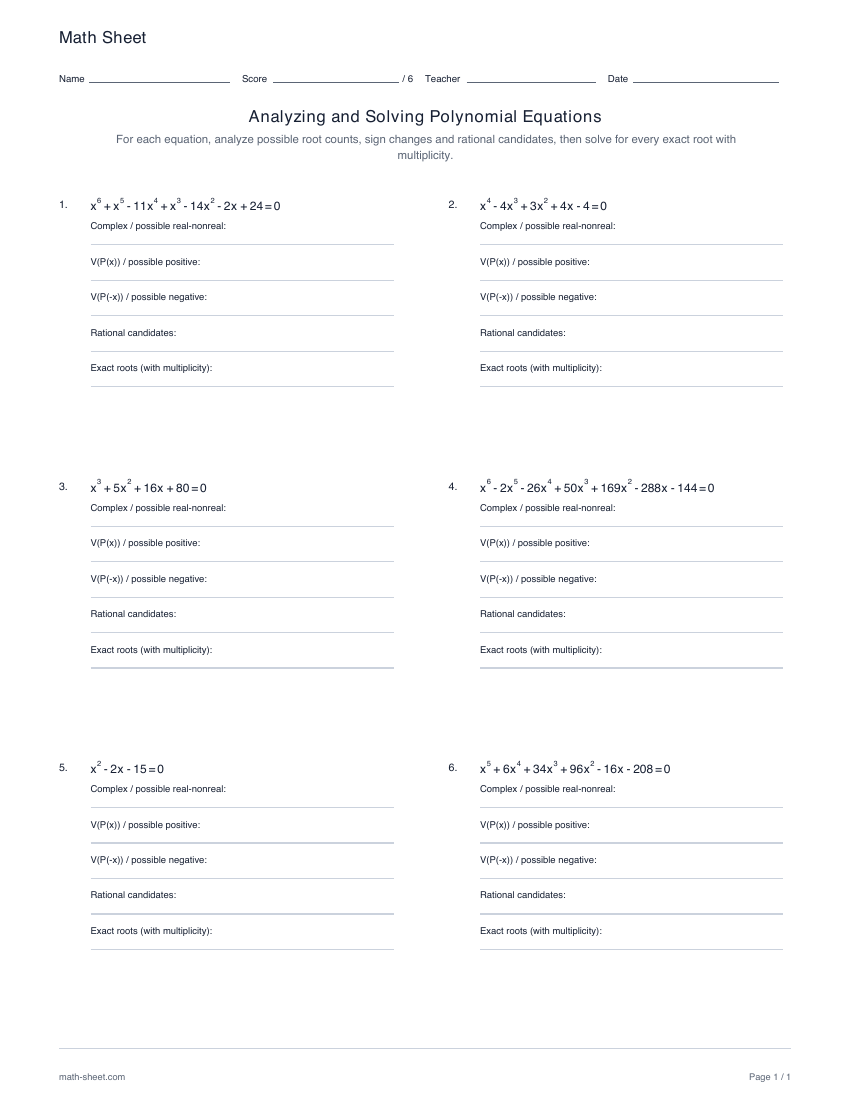
Analyze and solve six expanded monic polynomial equations of selected degrees two through six. Each exact key separates degree and Descartes possibilities from rational candidates and the complete roots with multiplicity.
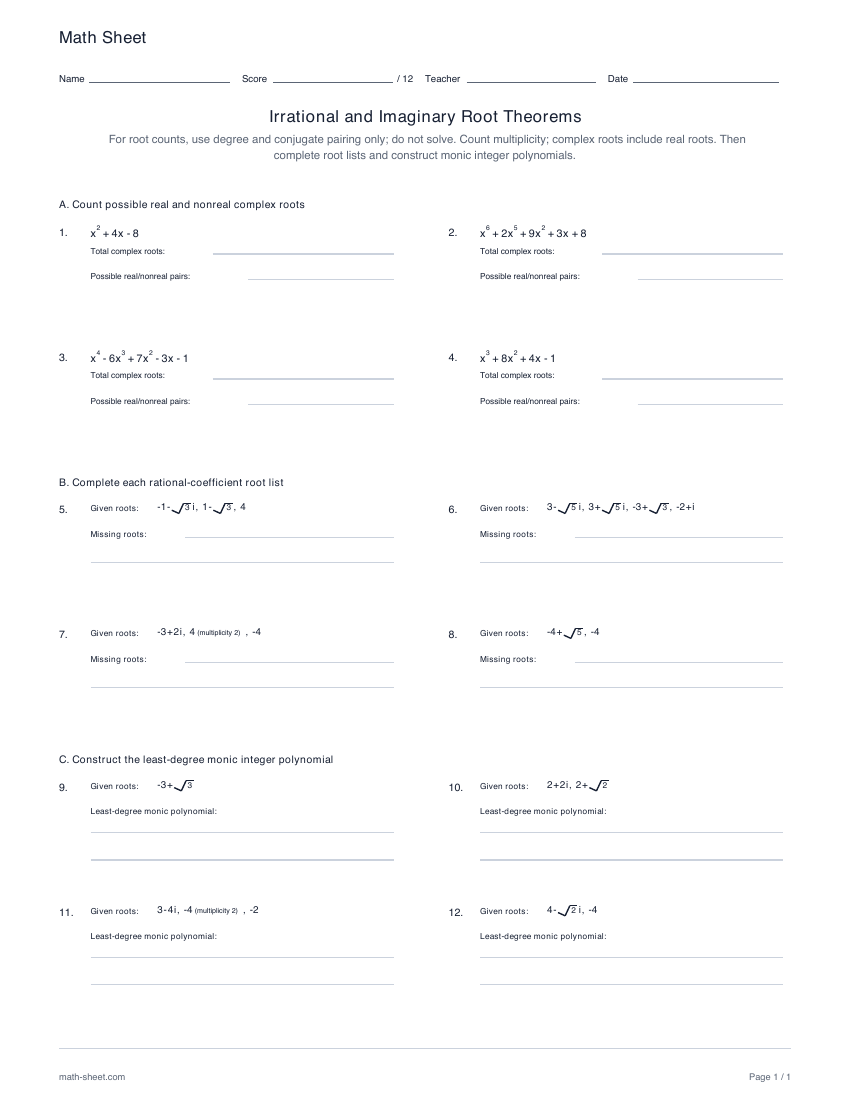
Use degree and conjugate pairing only—not polynomial solving—to list possible real and nonreal complex-root counts, counting multiplicity and including real roots in the complex total. Complete rational-coefficient root lists and construct least-degree monic integer polynomials.