Polynomials practice

Factoring polynomials with all techniques worksheets

Factor twelve expanded polynomials completely over the integers, mixing greatest common factors, quadratics, grouping, cube identities, substitution patterns, repeated factors and irreducible quadratic factors.

Ready-made English PDF · fixed settings

Customization below makes a separate PDF.

Fixed English ready-made files. Custom settings below apply only to the configured PDF.

Ready to print

Start with a ready-made worksheet

Factor each polynomial completely over the integers.

Download the practice pages alone, or include a separate answer key or teacher model. Longer activities may use more than one page.

Customize this worksheet

Paper sizes and printing help · More polynomials activities

Open a focused studio preset

These links set the editable studio below. Download there for the selected settings; ready-made files above keep their default edition.

Choose a method, then factor completely

Start with the full numerical and variable common factor. Then use the polynomial’s term count and exponent pattern to choose quadratic factoring, grouping, a cube identity, difference of squares or an even-power substitution.

Inspect every resulting factor again. Repeated factors keep their multiplicity, and a primitive quadratic remains only when its discriminant is not a perfect square. Multiply the complete product to check the original coefficients.

Learning objective

What this activity builds

Choose an efficient factoring method, extract the full content and continue until every remaining factor is primitive and irreducible over the rationals.

Worked example

Factor 2x⁴ − 32 completely.

2(x − 2)(x + 2)(x² + 4).

Extract 2, factor x⁴ − 16 as a difference of squares, then factor x² − 4. The quadratic x² + 4 is irreducible over the rationals.

Teaching notes

Make the practice count

  • Extract the full positive numerical and variable common factor first.
  • Check term count and exponent patterns before choosing grouping, cubes, difference of squares or substitution.
  • Repeat a method when a new factor can still be reduced.
  • Retain a primitive quadratic only when its discriminant is not a perfect square.
  • Multiply the complete product to verify every coefficient of the original polynomial.

Plan a complete polynomial factoring worksheet

Use quadratic and cubic degrees for a shorter decision chain, then degrees four through six for repeated patterns and even-power substitutions. Degree alone does not identify the technique: remove the numerical and variable greatest common factor before inspecting term count, exponents and signs. The mixed preset combines both degree groups.

Complete means every remaining nonconstant factor is irreducible over the rationals. For x⁴ − 5x² + 4, let u = x² to get (u − 1)(u − 4). Substitute back and continue: (x − 1)(x + 1)(x − 2)(x + 2). By contrast, x² + 4 stays quadratic when factoring over the integers.

Is this a worksheet for one factoring technique?

No. This is mixed-technique practice for choosing a method and carrying it to completion. Use the related cube or grouping activities below when a learner needs a focused introduction to one method.

What changes when I choose a degree preset?

The editable studio selects the polynomial degree group for twelve questions. Its download and worked key follow that selection. The ready-made files above retain the default mixed-degree edition; their contents do not change with a query link.

How should I check a complete factorization?

Multiply every factor, including the numerical content and repeated factors, to recover the original polynomial. A correct first step can still be incomplete, so inspect each factor again before comparing with the key.

Make it yours

Customize the practice

Choose your options, update the preview, then download the exact same pages.

Choose quadratic/cubic, higher-degree or mixed practice. Every twelve-question key shows a complete exact factorization.

Worksheet settings

Page note and reproducible seed

The same settings and seed make the same questions. Shared links include your page note; leave personal information out. Notes use the selected language’s supported characters; English accepts basic Latin text.

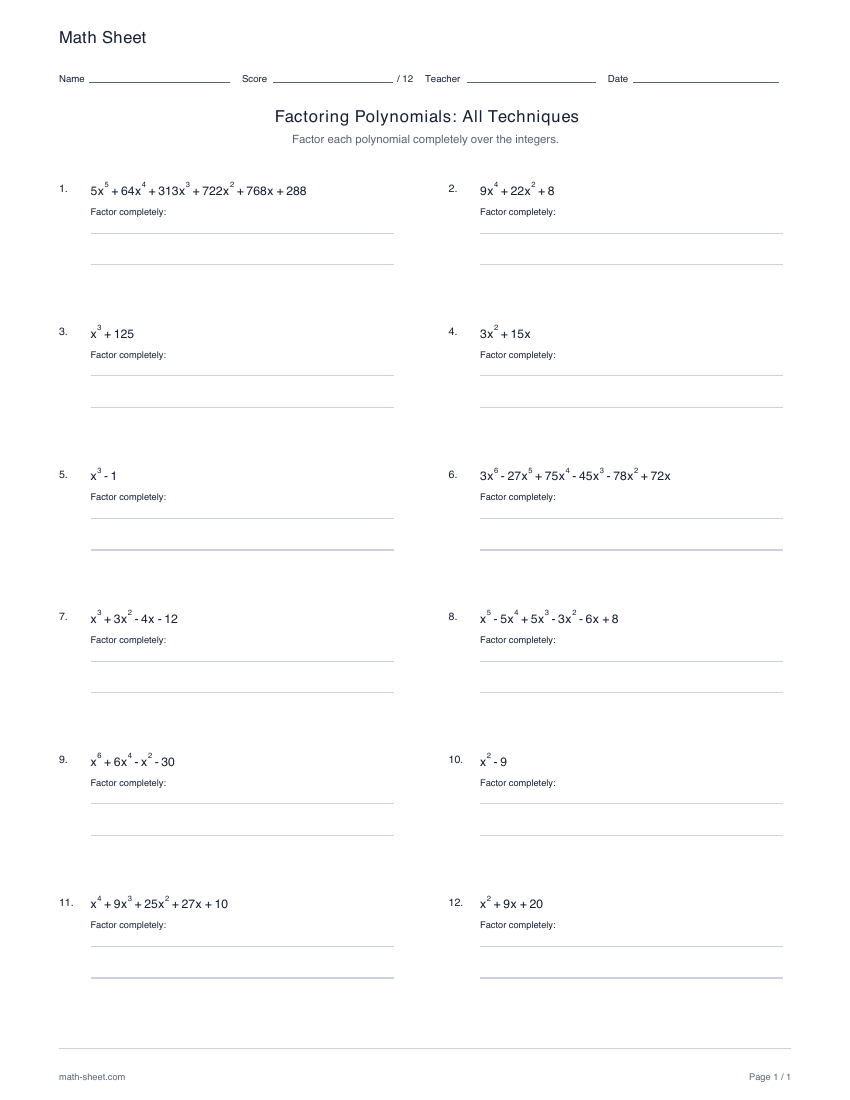
Configured PDF · Factoring Polynomials: All Techniques · US Letter

Preview ready. Download includes these exact pages.

1 student page
Enlarged pages scroll. PDF size stays the same.
Math SheetNameScore/ 12TeacherDateFactoring Polynomials: All TechniquesFactor each polynomial completely over the integers.1.5x5+64x4+313x3+722x2+768x+288Factor completely:2.9x4+22x2+8Factor completely:3.x3+125Factor completely:4.3x2+15xFactor completely:5.x3-1Factor completely:6.3x6-27x5+75x4-45x3-78x2+72xFactor completely:7.x3+3x2-4x-12Factor completely:8.x5-5x4+5x3-3x2-6x+8Factor completely:9.x6+6x4-x2-30Factor completely:10.x2-9Factor completely:11.x4+9x3+25x2+27x+10Factor completely:12.x2+9x+20Factor completely:math-sheet.comPage 1 / 1

A useful next step

Related activities

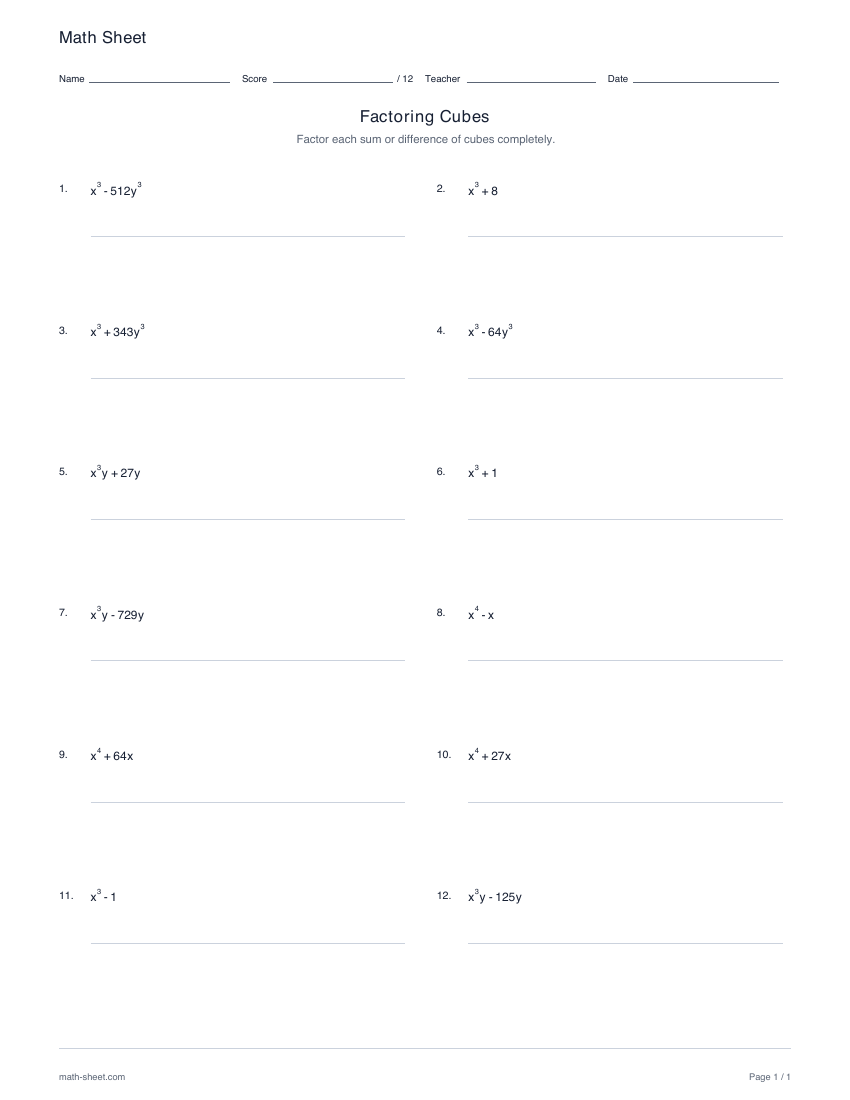
First page preview: Factoring sums and differences of cubes worksheets

Polynomials

Factoring sums and differences of cubes worksheets

Factor twelve sums and differences of cubes completely. Choose common variable factors, displayed leading coefficients, or mixed practice with exact complete products.

Preview and download
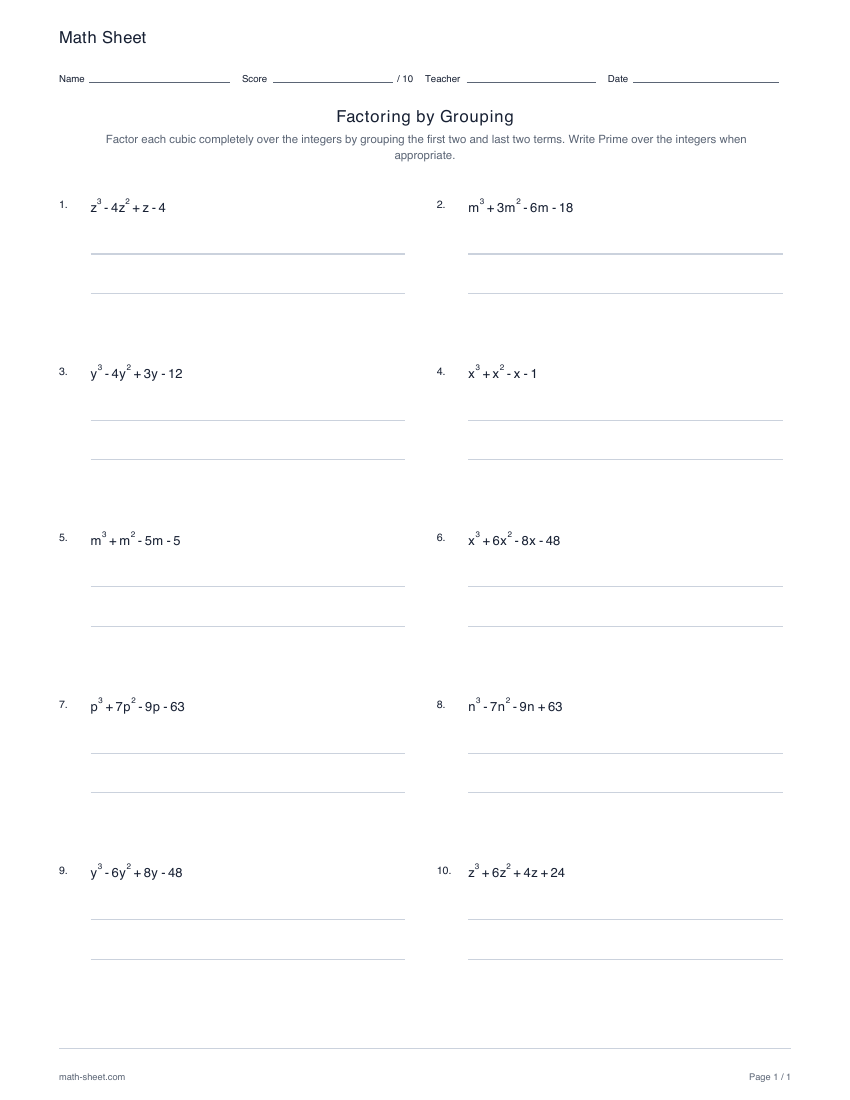
First page preview: Factoring by grouping worksheets

Polynomials

Factoring by grouping worksheets

Factor ten four-term cubics completely over the integers. Choose displayed monic, nonmonic or mixed leading coefficients and factorable-only practice or a set with three primitive prime cubics.

Preview and download
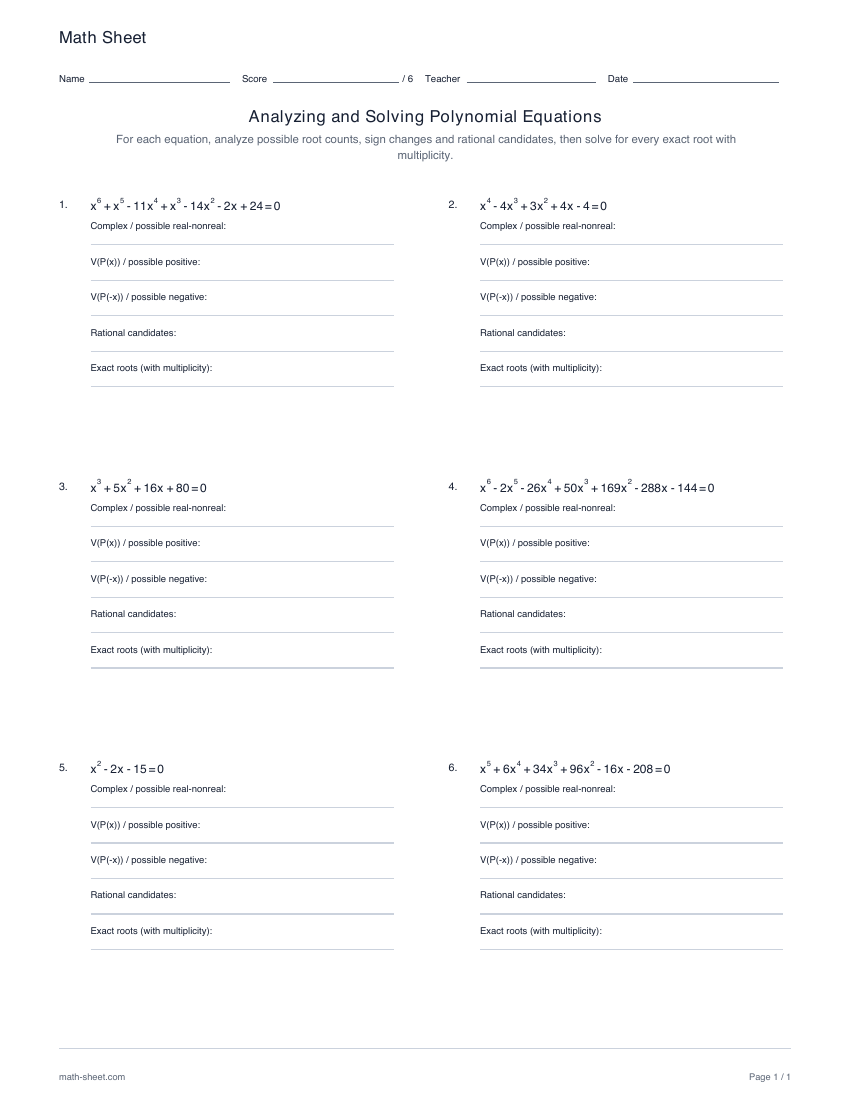
First page preview: Analyzing and solving polynomial equations worksheets

Polynomials

Analyzing and solving polynomial equations worksheets

Analyze and solve six expanded monic polynomial equations of selected degrees two through six. Each exact key separates degree and Descartes possibilities from rational candidates and the complete roots with multiplicity.

Preview and download