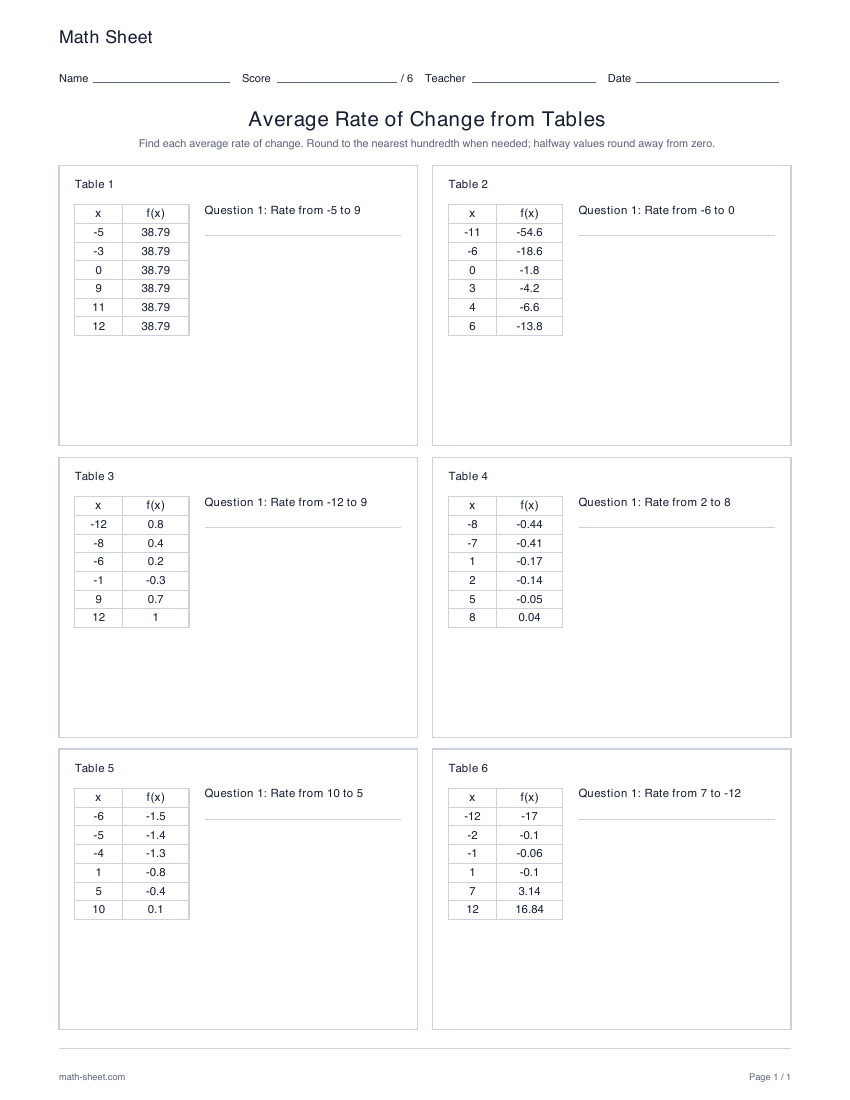
Every worksheet contains six tables with six input-output pairs each. Choose six questions for one interval per table, or twelve questions for two intervals per table. Each calculation earns one mark.
Read the values directly from the table. The average rate is the change in f(x) divided by the change in x; it does not require guessing a formula for the function.
The answer key repeats each table and shows the substituted calculation, the exact result, and an approximate decimal when needed. Round halfway values away from zero: 0.125 becomes 0.13 and −0.125 becomes −0.13.
Learning objective
What this activity builds
Read two input-output pairs from a table and divide the change in output by the matching change in input.
Worked example
If f(−2) = 1.5 and f(4) = 6, what is the average rate?
(6 − 1.5) ÷ (4 − (−2)) = 4.5 ÷ 6 = 0.75.
The output increases by 4.5 as the input increases by 6. Dividing these changes gives 0.75 per input unit. Reversing both subtraction orders produces the same quotient.
Teaching notes
Make the practice count
Mark both requested rows before doing any arithmetic.
Keep the subtraction order the same in the numerator and denominator.
Use the two specified inputs, even when other rows appear between them.
Compare two intervals from the same table in the 12-question setting.
Keep exact values until the final step; round a halfway value away from zero.
Make it yours
Customize the practice
Choose your options, update the preview, then download the exact same pages.
Choose the practice settings, update the preview and print the same questions with a separate answer key.
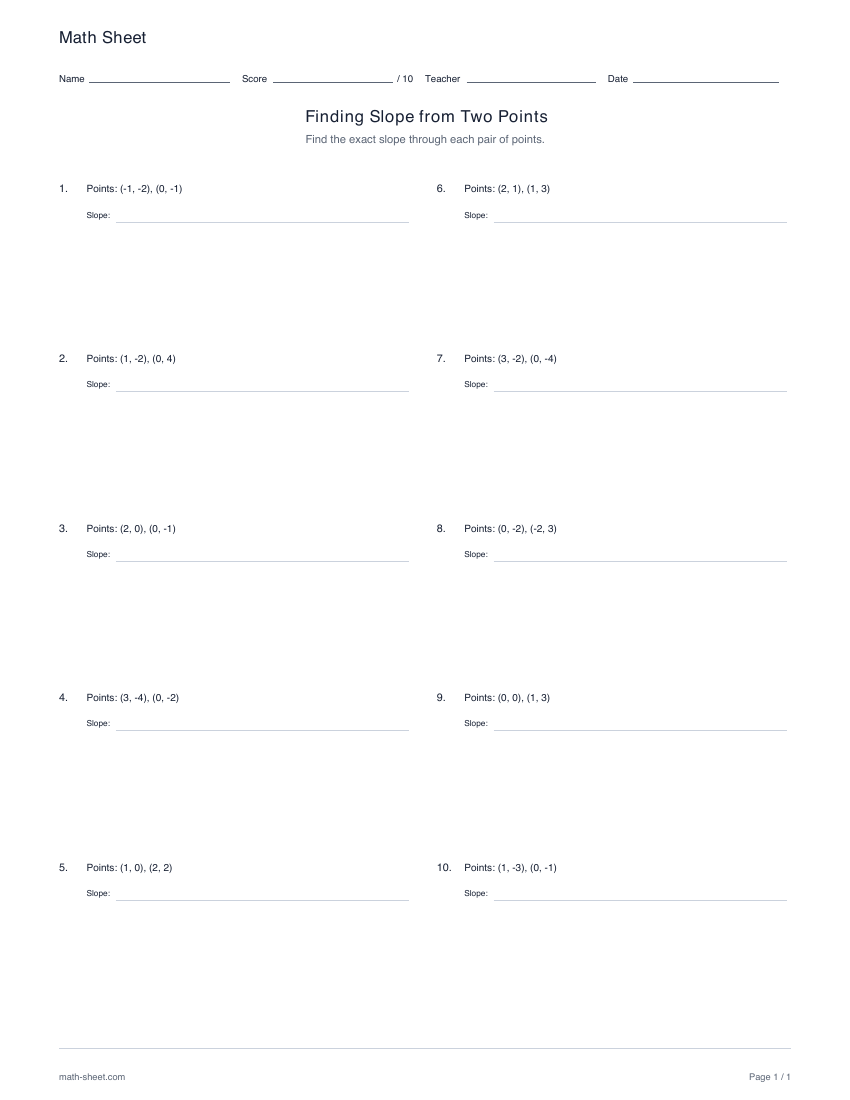
Calculate exact slopes from ten pairs of integer-coordinate points. Practice signed differences and reduced fractions, with a separate key that explains the slope calculation.
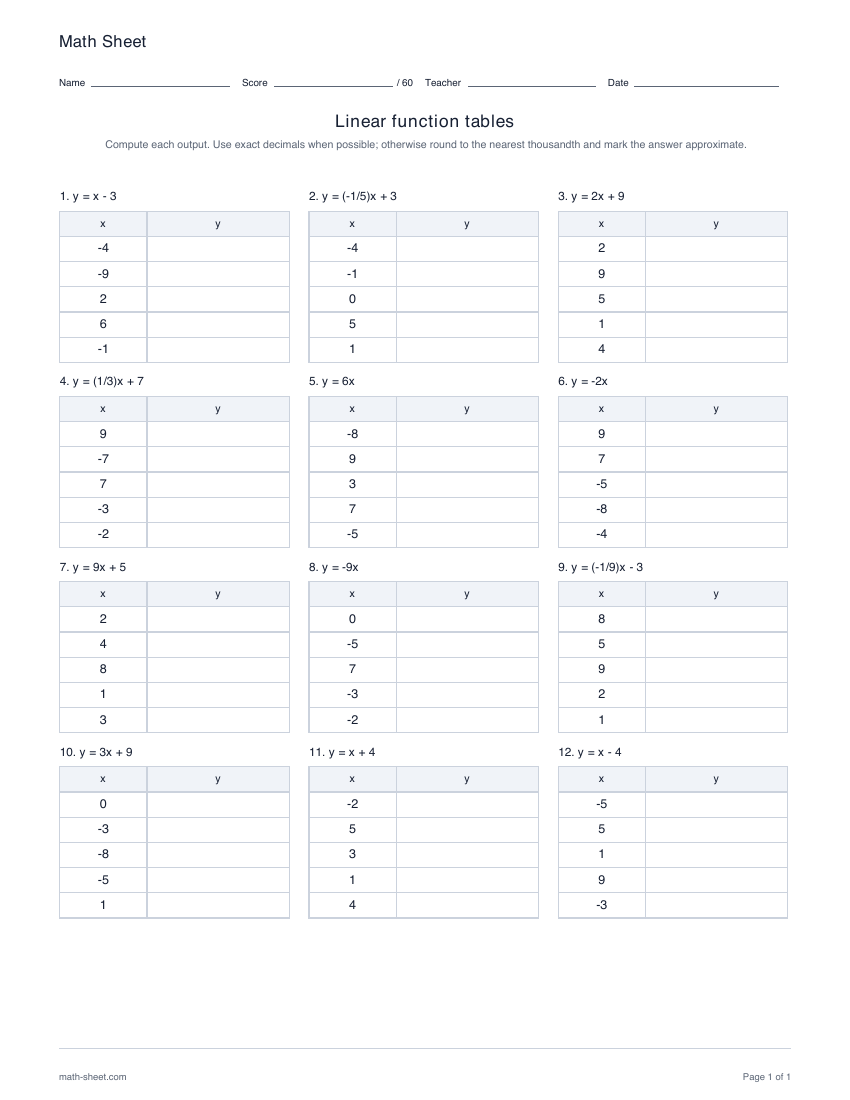
Substitute five inputs into each of twelve linear rules. Choose whole or fractional slopes, signed or nonnegative inputs, and decimal or exact fraction answers.
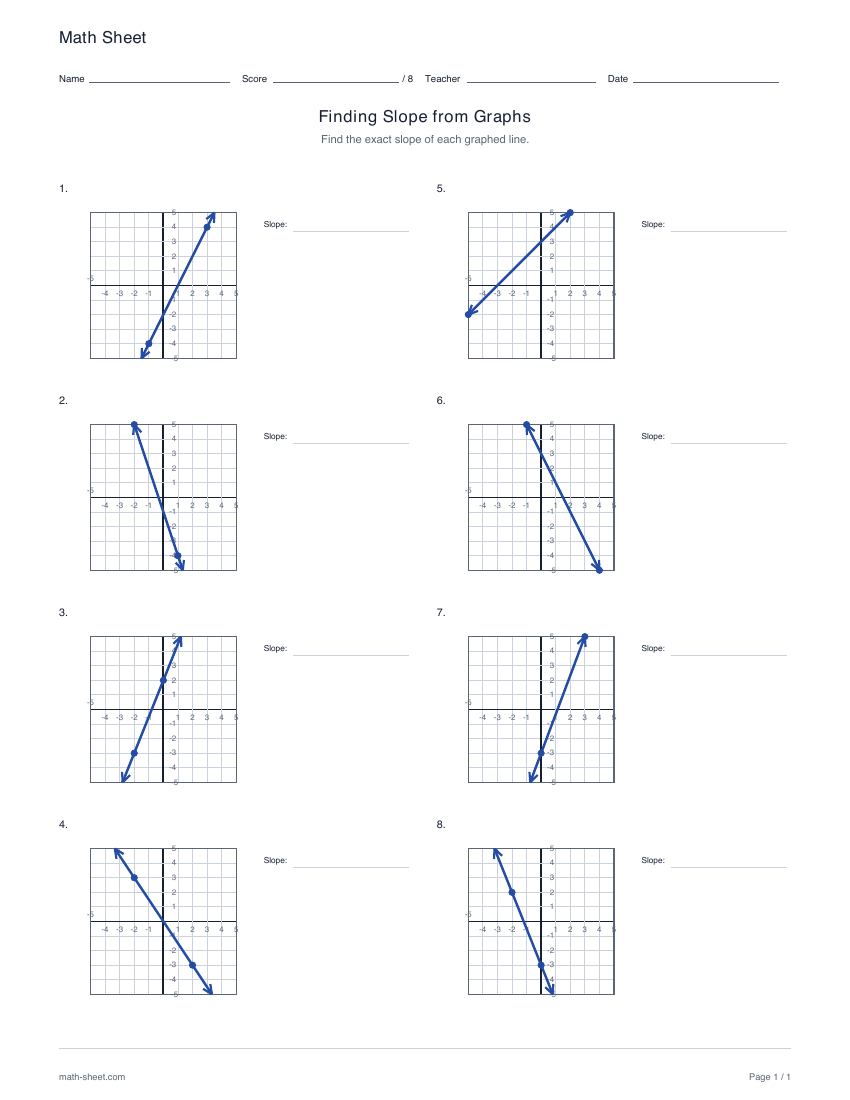
Read eight graphed lines and find each exact slope. Use the coordinate scale to compare rise and run, then check a separate answer key with worked calculations.