Probability practice

Bernoulli and Normal Model Selection worksheets

Distinguish Bernoulli from binomial counts and identify normal support, PDF parameters, variance, and standard deviation.

Ready-made English PDF · fixed settings

Customization below makes a separate PDF.

Fixed English ready-made files. Custom settings below apply only to the configured PDF.

Ready to print

Start with a ready-made worksheet

Identify the random variable and parameters before calculating. Distinguish a normal variance from its standard deviation.

Download the practice pages alone, or include a separate answer key or teacher model. Longer activities may use more than one page.

Customize this worksheet

Paper sizes and printing help · More probability activities

Make the mathematical structure visible

Each problem prints the support, table, model assumptions, or sample convention needed to solve it on paper. Student pages reserve workspace; teacher downloads append a separate worked key generated from the same validated document.

Learning objective

What this activity builds

Select an appropriate elementary probability model and interpret its parameters before calculating.

Worked example

One trial succeeds with probability 0.4. Name the model.

Bernoulli(0.4).

A Bernoulli variable records one binary trial; a binomial variable counts several.

Teaching notes

Make the practice count

  • State whether one trial or a fixed count is observed.
  • Read N(mu,sigma squared) carefully.
  • Check whether a continuous bell-shaped model is plausible.

Make it yours

Customize the practice

Choose your options, update the preview, then download the exact same pages.

Choose one or more bounded question types, problem count, paper size, and seed.

Worksheet settings

Question types
Page note and reproducible seed

The same settings and seed make the same questions. Shared links include your page note; leave personal information out.

Configured PDF · Bernoulli and Normal Model Selection · US Letter

Preview ready. Download includes these exact pages.

4 student pages
Enlarged pages scroll. PDF size stays the same.
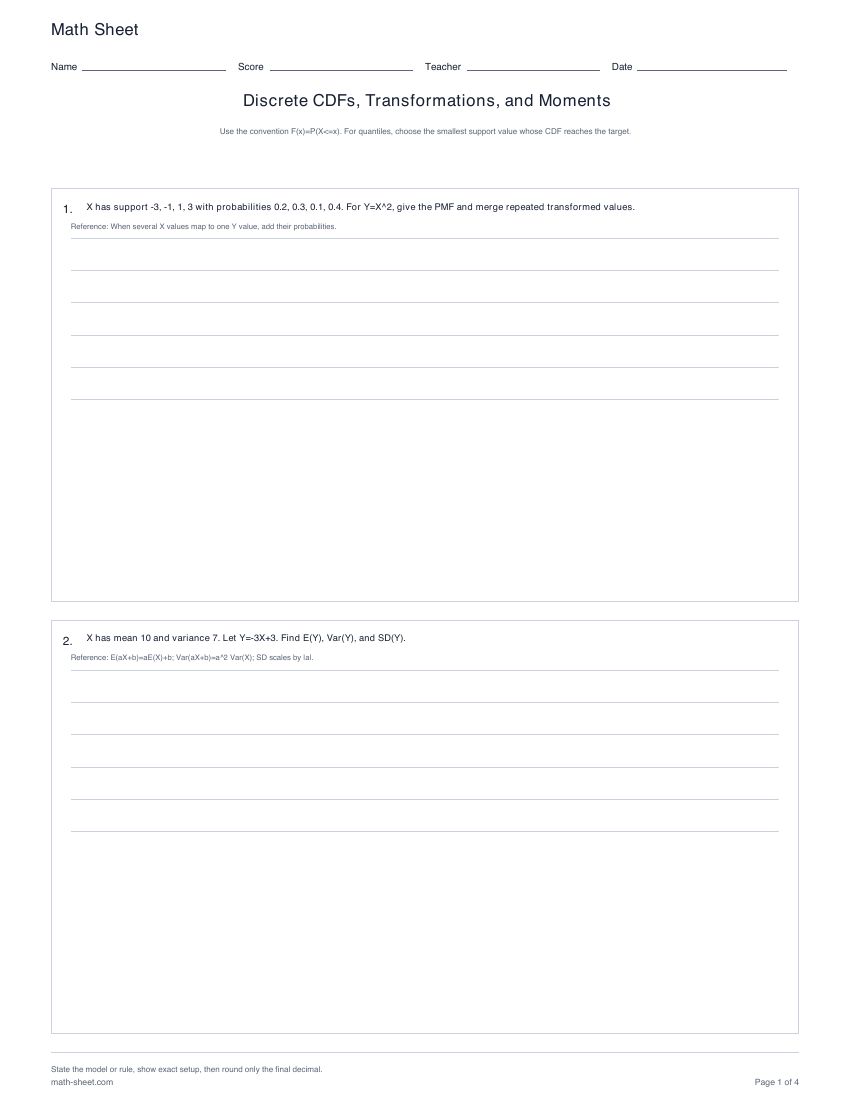
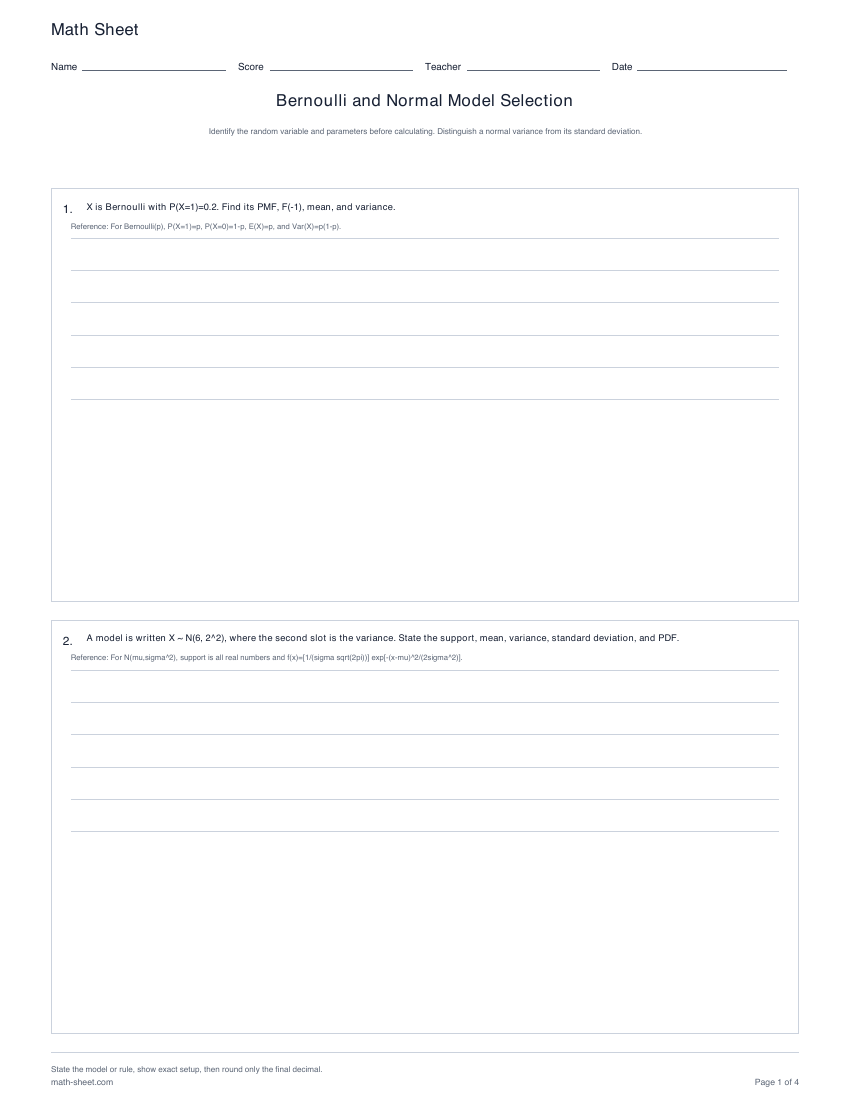
Math SheetNameScoreTeacherDateBernoulli and Normal Model SelectionIdentify the random variable and parameters before calculating. Distinguish a normal variance from its standard deviation.1.X is Bernoulli with P(X=1)=0.2. Find its PMF, F(-1), mean, and variance.Reference: For Bernoulli(p), P(X=1)=p, P(X=0)=1-p, E(X)=p, and Var(X)=p(1-p).2.A model is written X ~ N(6, 2^2), where the second slot is the variance. State the support, mean, variance, standard deviation, and PDF.Reference: For N(mu,sigma^2), support is all real numbers and f(x)=[1/(sigma sqrt(2pi))] exp[-(x-mu)^2/(2sigma^2)].State the model or rule, show exact setup, then round only the final decimal.math-sheet.comPage 1 of 4
Math SheetNameScoreTeacherDateBernoulli and Normal Model SelectionIdentify the random variable and parameters before calculating. Distinguish a normal variance from its standard deviation.3.A measurement is continuous, roughly symmetric and bell-shaped with center 7 and standard deviation 3; let X be one measurement. Is a normal modelsuitable? If so, standardize x=7.Reference: A normal model is plausible for an unbounded-looking continuous bell-shaped measurement without strong skew or discrete counts. Standardize z=(x-mu)/sigma.4.In inspection batch 4, 12 independent components each pass with probability 0.65. Let X count passes. Choose Bernoulli or binomial and state its parameters.Reference: Bernoulli records one binary trial. Binomial counts successes in a fixed number n of independent trials with common p.State the model or rule, show exact setup, then round only the final decimal.math-sheet.comPage 2 of 4
Math SheetNameScoreTeacherDateBernoulli and Normal Model SelectionIdentify the random variable and parameters before calculating. Distinguish a normal variance from its standard deviation.5.In inspection batch 5, a randomly selected component either passes or fails, with pass probability 0.8. Define X=1 for pass and 0 for fail. Choose Bernoulli orbinomial and state its parameter.Reference: Bernoulli records one binary trial. Binomial counts successes in a fixed number n of independent trials with common p.6.X is Bernoulli with P(X=1)=0.2. Find its PMF, F(1), mean, and variance.Reference: For Bernoulli(p), P(X=1)=p, P(X=0)=1-p, E(X)=p, and Var(X)=p(1-p).State the model or rule, show exact setup, then round only the final decimal.math-sheet.comPage 3 of 4
Math SheetNameScoreTeacherDateBernoulli and Normal Model SelectionIdentify the random variable and parameters before calculating. Distinguish a normal variance from its standard deviation.7.A measurement is continuous, roughly symmetric and bell-shaped with center 0 and standard deviation 2; let X be one measurement. Is a normal modelsuitable? If so, standardize x=-2.Reference: A normal model is plausible for an unbounded-looking continuous bell-shaped measurement without strong skew or discrete counts. Standardize z=(x-mu)/sigma.8.A model is written X ~ N(1, 3^2), where the second slot is the variance. State the support, mean, variance, standard deviation, and PDF.Reference: For N(mu,sigma^2), support is all real numbers and f(x)=[1/(sigma sqrt(2pi))] exp[-(x-mu)^2/(2sigma^2)].State the model or rule, show exact setup, then round only the final decimal.math-sheet.comPage 4 of 4

A useful next step

Related activities

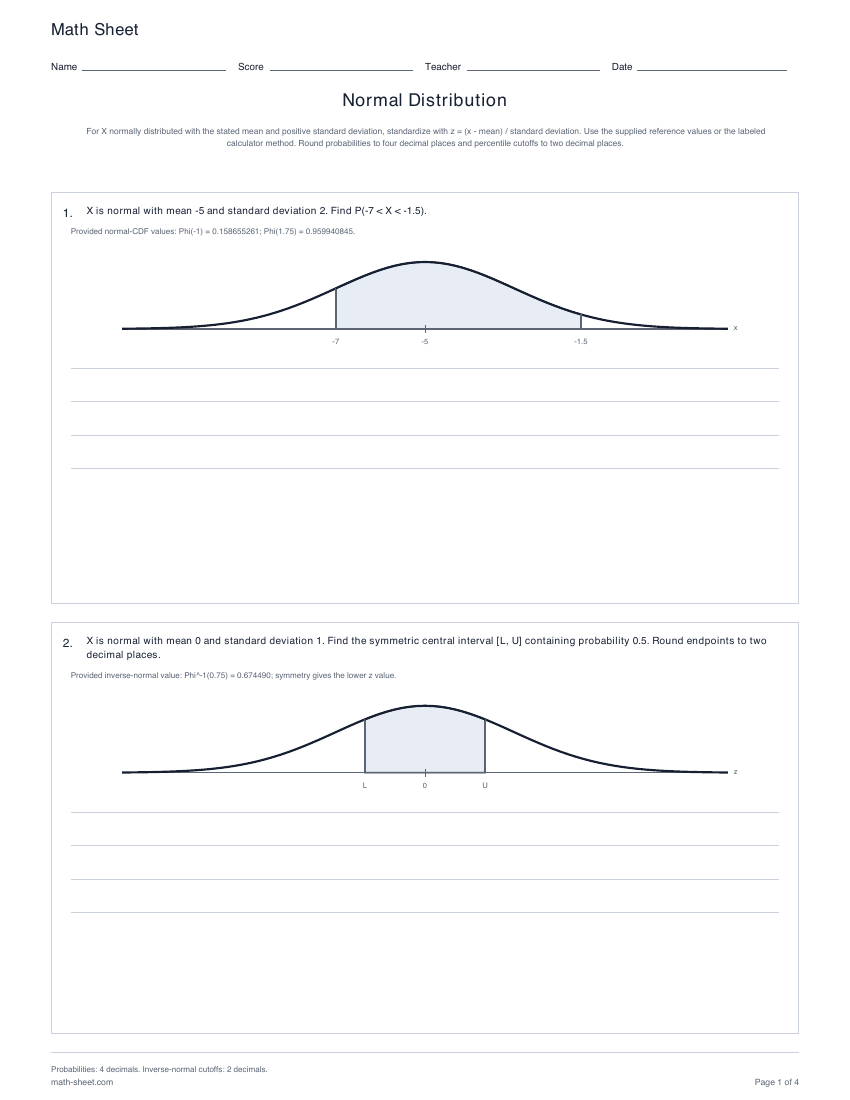
Printable normal distribution worksheets preview

Statistics

Normal Distribution worksheets

Standardize normal values, find below, above, and between probabilities, and invert the model for percentiles and central intervals.

Preview and download