Choose 20 conversion questions or an optional English 10-task understanding lesson with coefficient normalization, misconception checks and a separate reasoning key.
Choose the optional English understanding lesson for ten tasks: convert in both directions, normalize coefficients, explain exponent zero, diagnose mistakes and check an independent measurement. Foundation and Extended change the decimal precision and power range. The separate key shows equivalent steps and magnitude checks.
Conversion practice keeps the existing twenty questions, exponent-sign choices, optional exponent zero and worksheet languages. Ready-made downloads remain the original practice sheets.
Learning objective
What this activity builds
Use powers of ten to represent large and small positive numbers without changing their value.
Worked example
Write 0.000728 in scientific notation. Then convert 4.26 × 10⁵ to an ordinary number.
0.000728 = 7.28 × 10⁻⁴; 4.26 × 10⁵ = 426,000.
Moving the point four places to the right gives 7.28; the negative exponent compensates by dividing by 10,000. In the reverse direction, multiply 4.26 by 100,000, shifting its point five places to the right to obtain 426,000.
Teaching notes
Make the practice count
Choose Understanding lesson in the settings for 10 tasks: guided conversions, zero exponent, coefficient normalization, two error checks and an independent measurement task. Its separate key explains how each transformation preserves the value. Foundation uses one decimal digit and powers -4 to 4; Extended uses three decimal digits with internal zeros and powers -8 to 8. The lesson is English only and fixes exponent coverage; the practice exponent and language controls are disabled with an explanation.
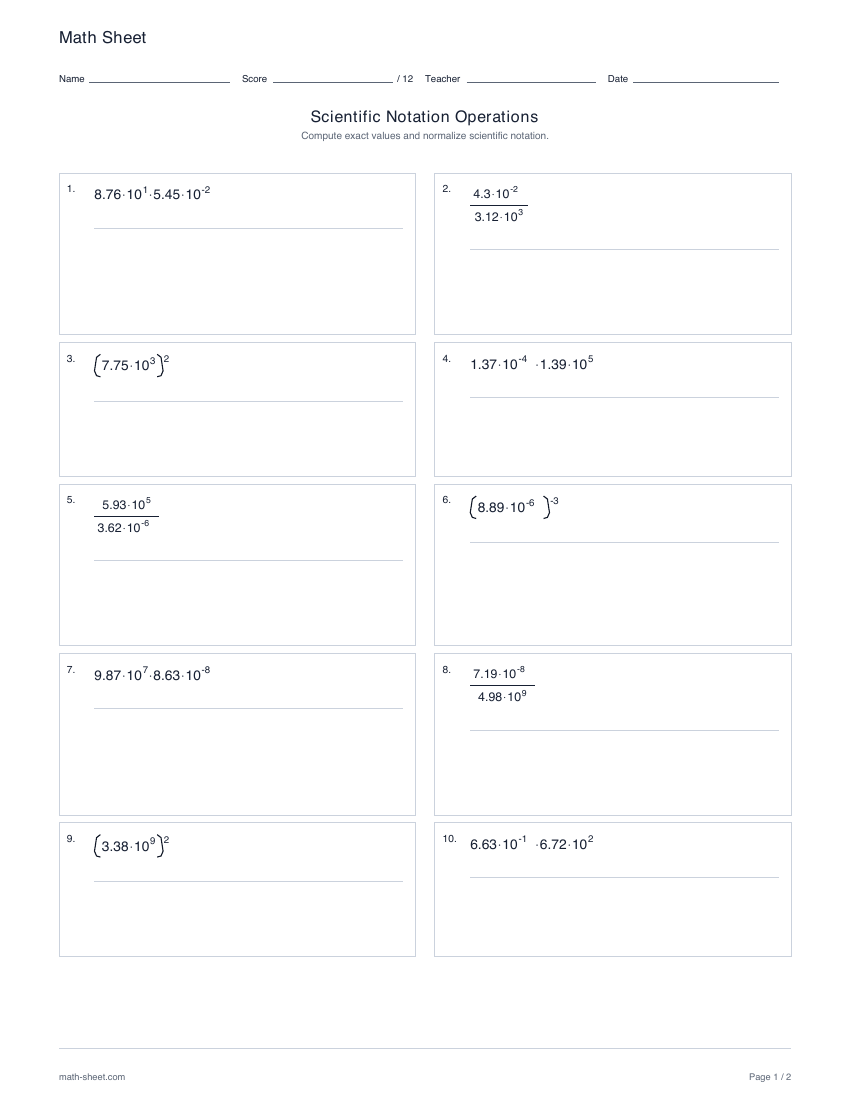
This page practices conversion in both directions. For calculations, use Scientific Notation Operations to multiply, divide or raise scientific-notation numbers to powers; addition and subtraction are outside that activity’s scope.
The absolute exponent ranges from 1 to 9. Enable exponent zero to include numbers already between 1 and 10.
Mixed practice includes positive and negative exponents in both conversion directions. Enabling zero includes it in each half too.
A coefficient can have up to four fractional digits. Trailing zeros with no numerical effect are omitted; these are value-conversion exercises, not significant-figure tests.
Count place shifts before adding any zeros. A negative exponent means the ordinary number is less than one.
Exponents are raised above the baseline in both the preview and downloaded PDF. Long notes or translated instructions can add pages.
Make it yours
Customize the practice
Choose your options, update the preview, then download the exact same pages.
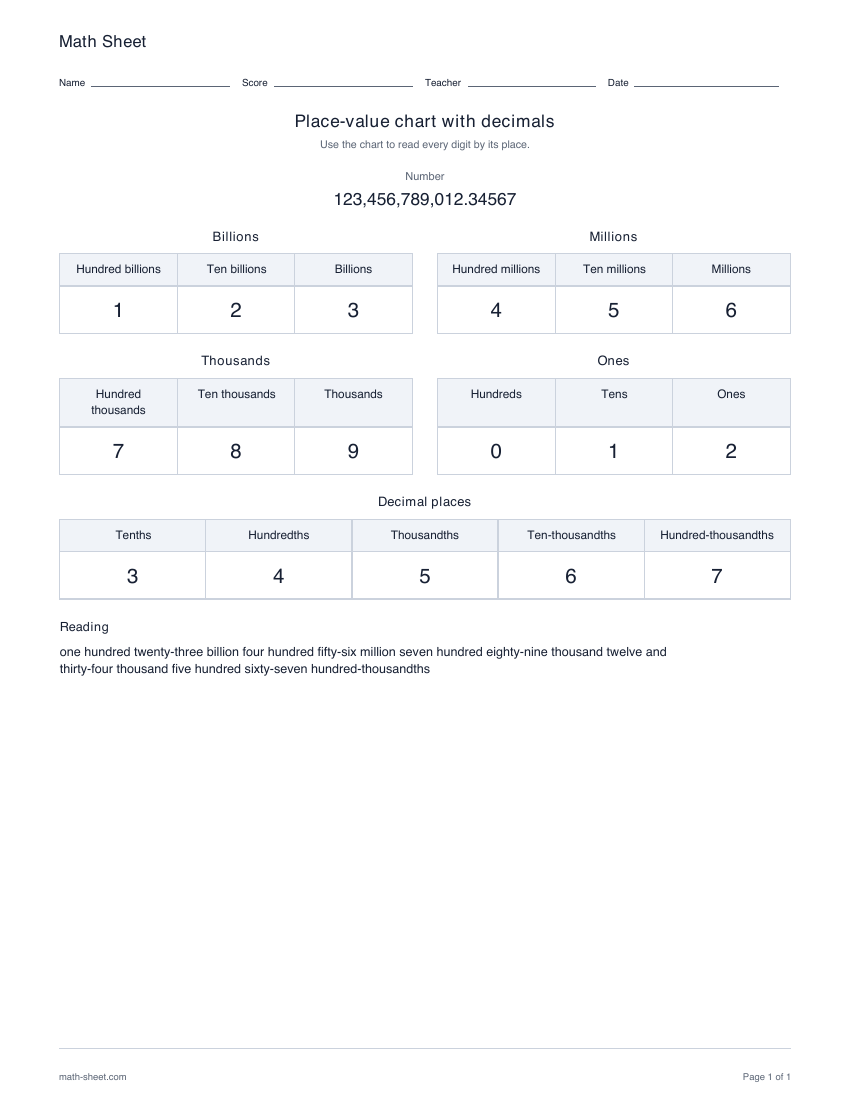
Connect twelve whole-number places with five fractional places, through hundred-thousandths. The fixed example 123,456,789,012.34567 includes a complete number reading.
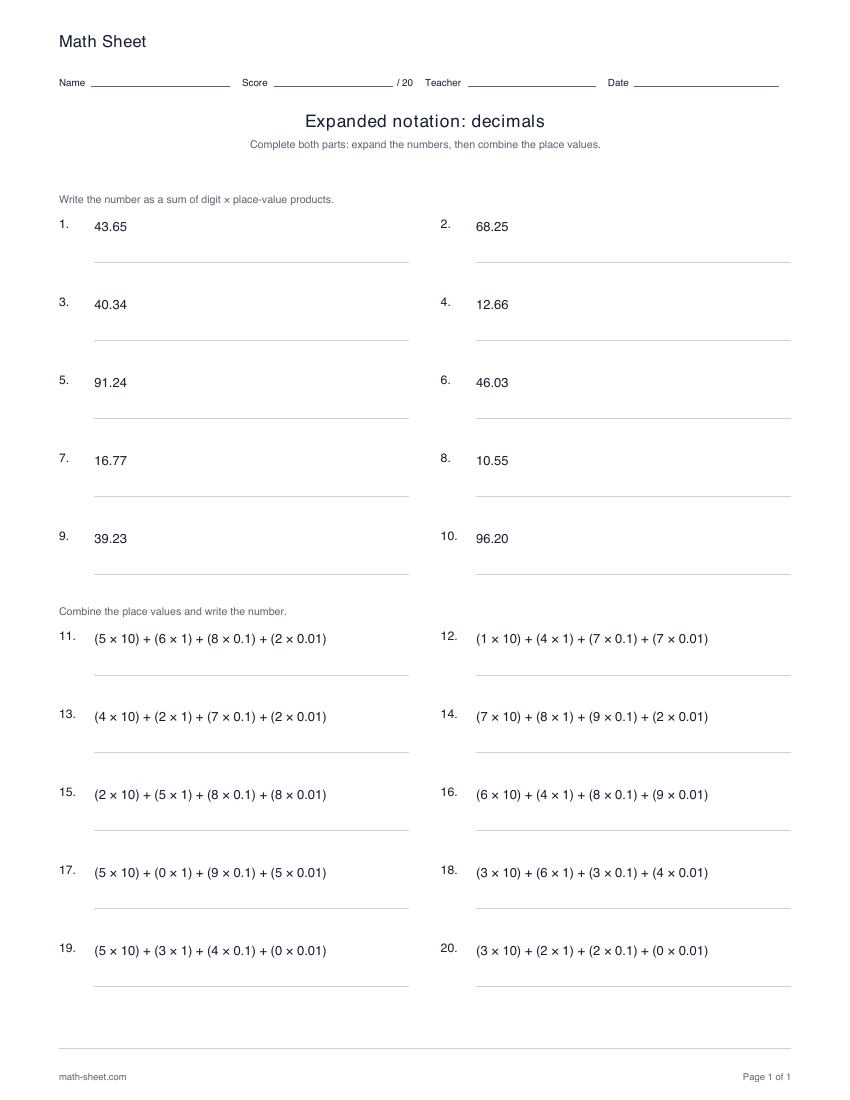
Expand decimals into digit-times-place products and reverse the process. Select 2–4 whole-number digits, 1–3 decimal places, and whether zero digits may appear.
Preview and download →
Conversion first, scientific notation operations next
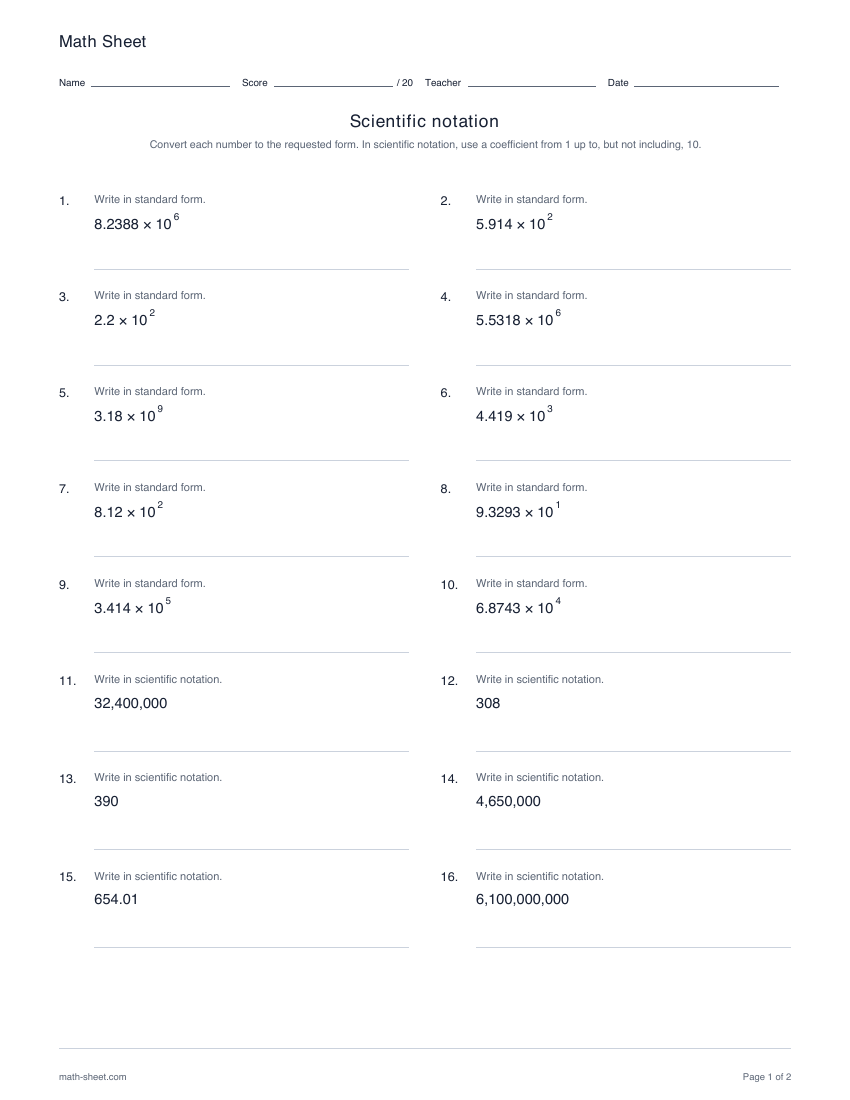
This worksheet converts values in both directions: ten questions to standard form and ten to scientific notation. Keep 1 ≤ coefficient < 10. Positive and negative powers describe large and small positive numbers; they do not make the coefficient negative. Significant figures and arithmetic operations are separate tasks.