
Calculus
Average rate of change over an interval
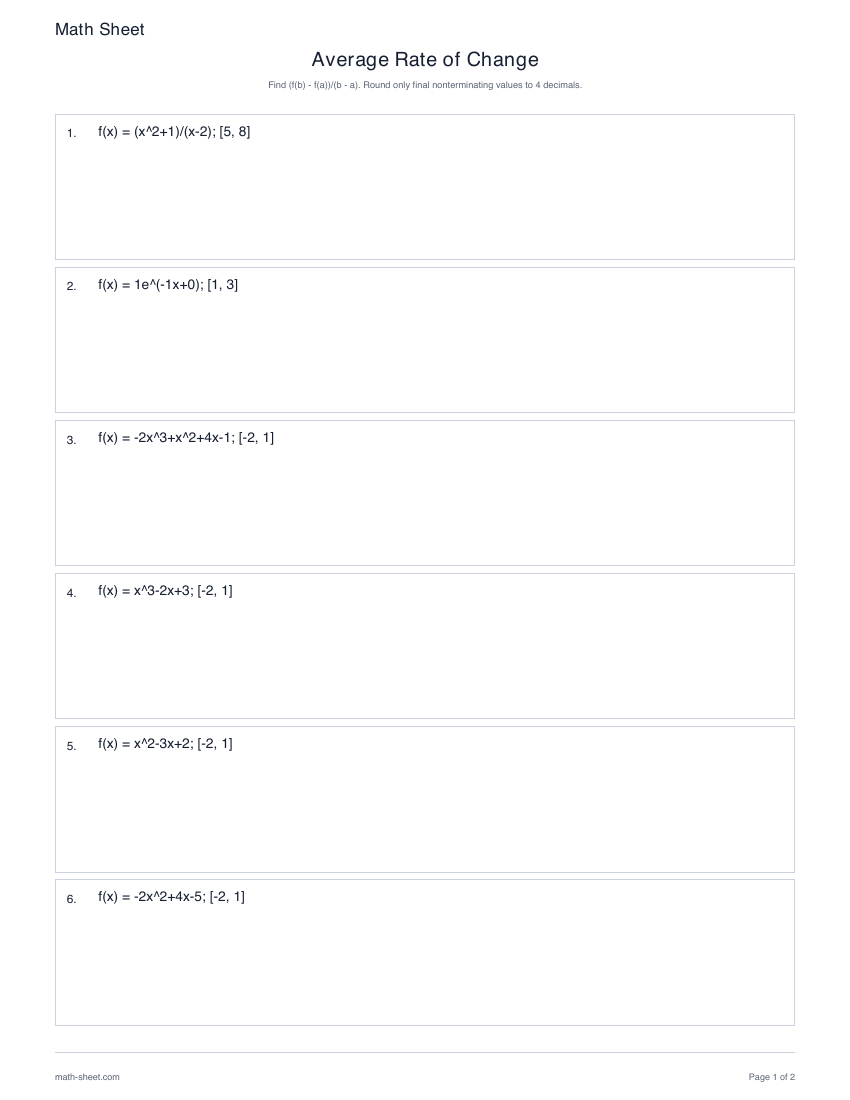
Find twelve finite-interval rates for quadratic, cubic, rational and natural exponential functions.
Preview and downloadGeneral functions practice
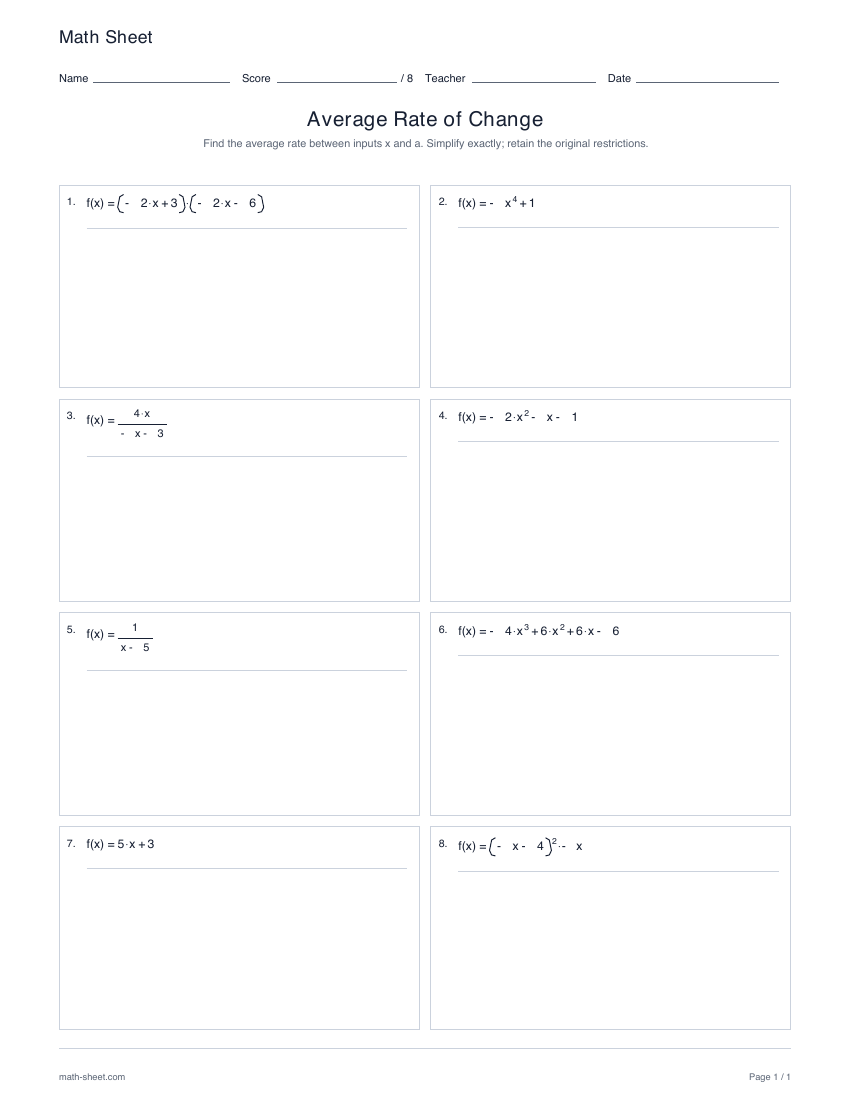
Simplify eight difference quotients with polynomial, factored and rational functions. Choose two inputs or an increment, add a formula reminder and print worked answers.
Ready-made English PDF · fixed settings
Customization below makes a separate PDF.
Fixed English ready-made files. Custom settings below apply only to the configured PDF.
Ready to print
Use the requested inputs to form the change in output divided by the change in input. Substitute with parentheses, factor the numerator and simplify. Keep all original denominator restrictions.
Download the practice pages alone, or include a separate answer key or teacher model. Longer activities may use more than one page.
Customize this worksheetPaper sizes and printing help · More general functions activities
Choose the two-point quotient (f(x) − f(a)) ÷ (x − a), or the increment quotient (f(x + h) − f(x)) ÷ h. Each sheet has eight functions: expanded and factored polynomials, an affine fraction, a reciprocal and an affine-over-linear rational function.
Print the formula as a reminder or leave it out for independent practice. Keeping the seed preserves the functions across both choices, so you can compare the two methods on the same examples.
The worked key shows substitution, a factored cancellation step, the simplified result and the original restrictions. For rational functions, both substituted denominators must remain nonzero.
Learning objective
Build a difference quotient from a function, simplify exactly and preserve the restrictions from the original quotient.
Worked example
((x + h)² + 3 − (x² + 3)) ÷ h = (2xh + h²) ÷ h = 2x + h, with h ≠ 0.
Expand the complete squared input before subtracting f(x). The constant terms cancel. Factor h out of the numerator, then cancel it while retaining the original restriction h ≠ 0.
Teaching notes
Make it yours
Choose your options, update the preview, then download the exact same pages.
Choose the practice settings, update the preview and print the same questions with a separate answer key.
A useful next step
Calculus
Find twelve finite-interval rates for quadratic, cubic, rational and natural exponential functions.
Preview and download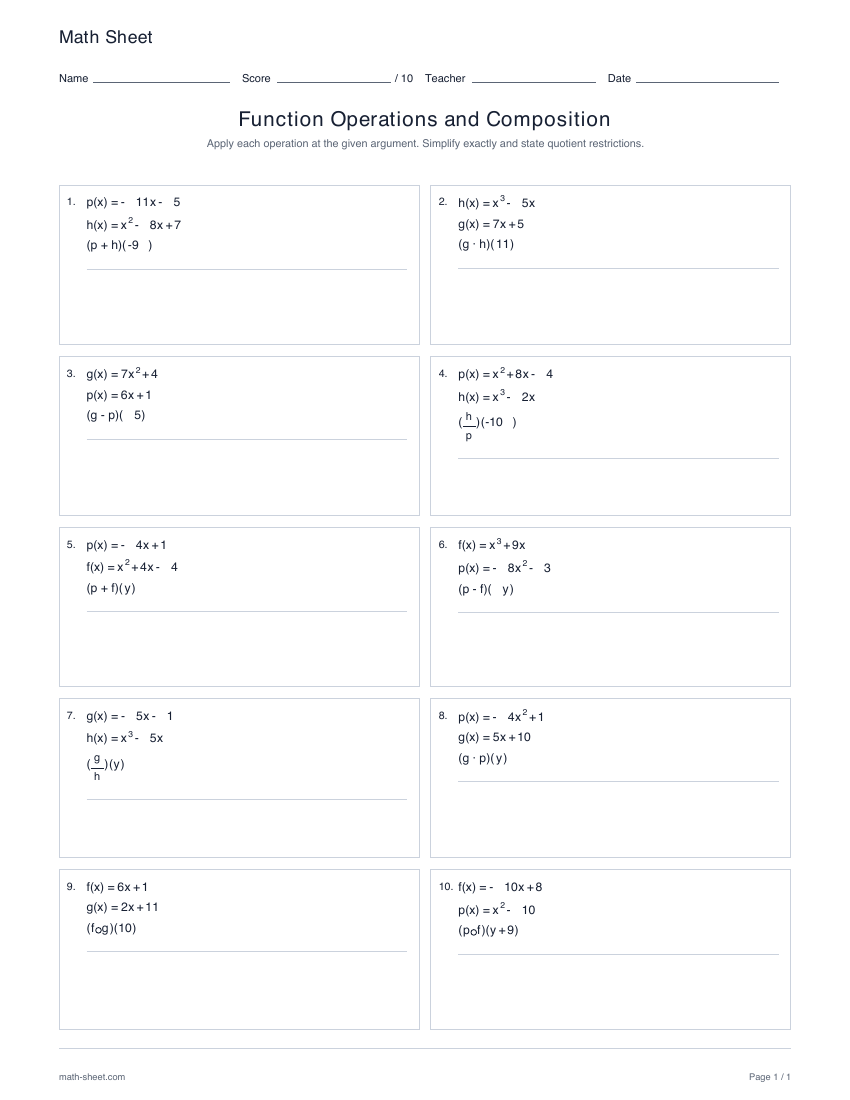
General functions
Add, subtract, multiply, divide and compose polynomial functions. Choose numbers, variables or mixed inputs, with ten questions and a separate worked answer key.
Preview and download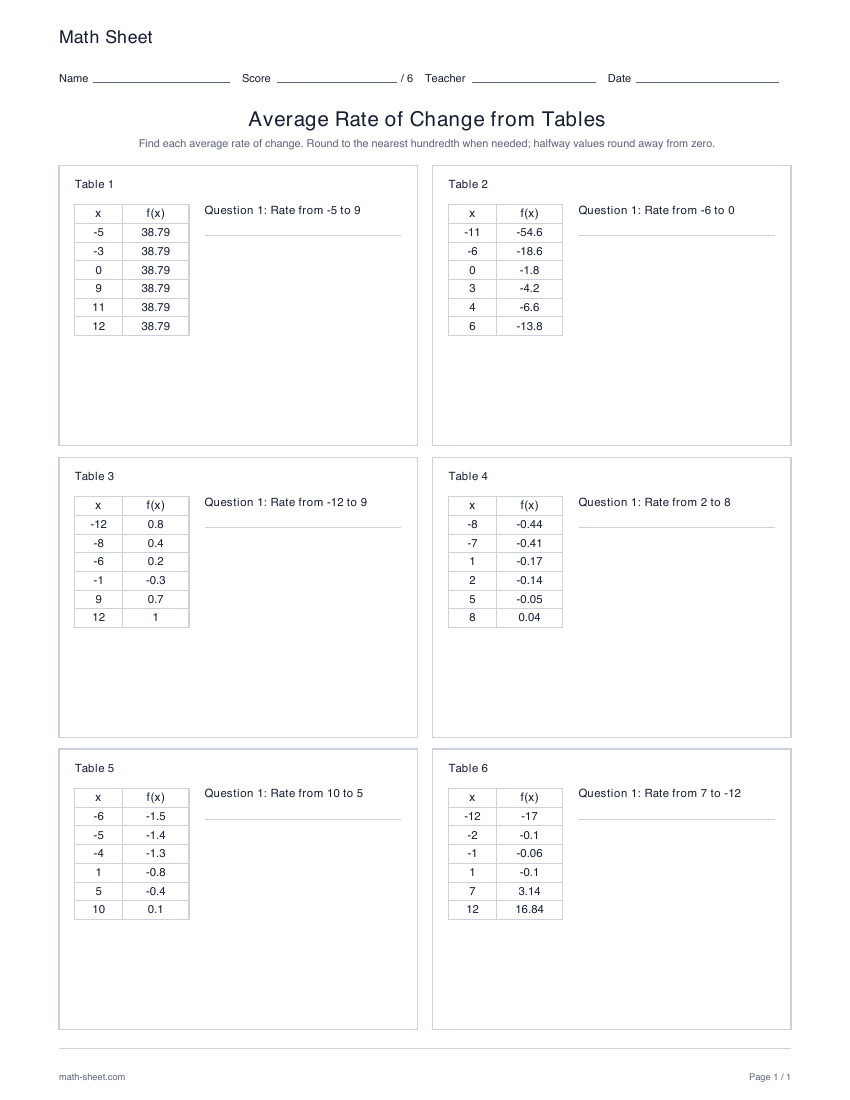
General functions
Find average rates from six function tables. Choose 6 or 12 questions, print Letter or A4, and check each result with a separate worked answer key.
Preview and download