
Fractions
Find the greatest common factor
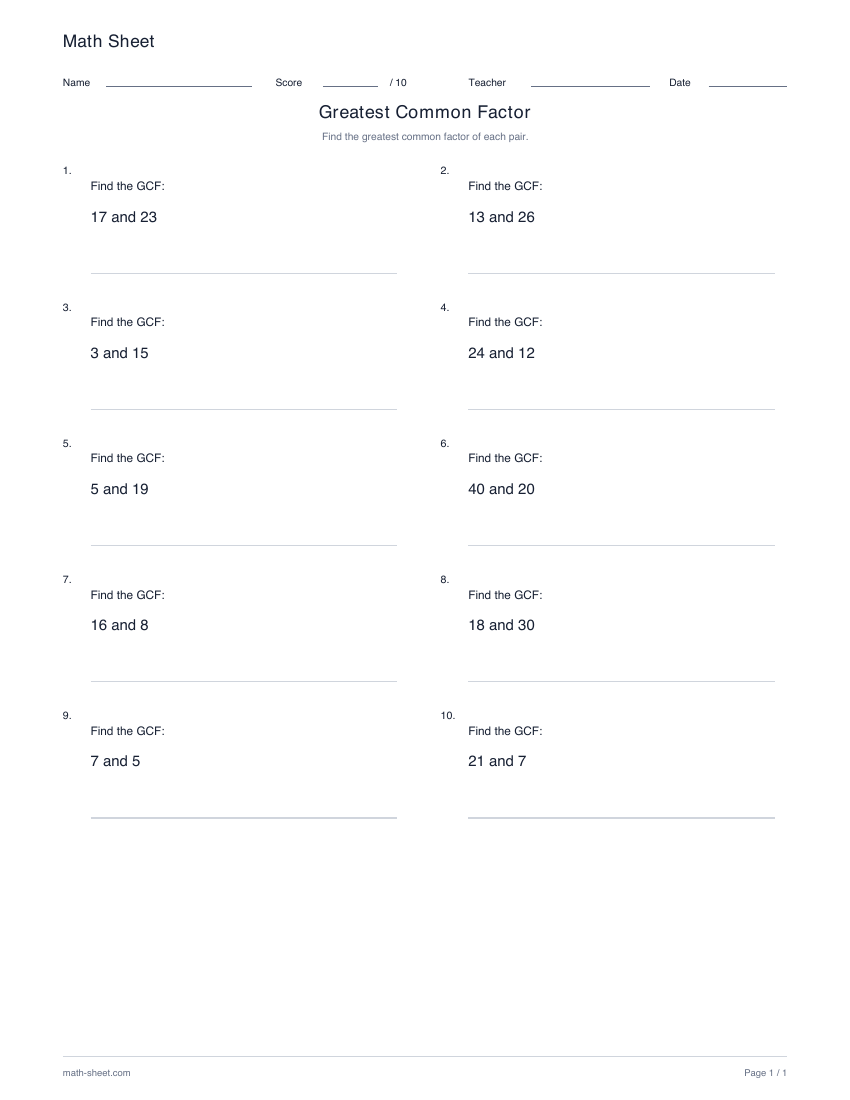
Find the greatest common factor of positive integer pairs. Choose a maximum of 24, 40, 60 or 120 and 10, 15 or 20 questions, with a separate answer key.
Preview and downloadFractions practice
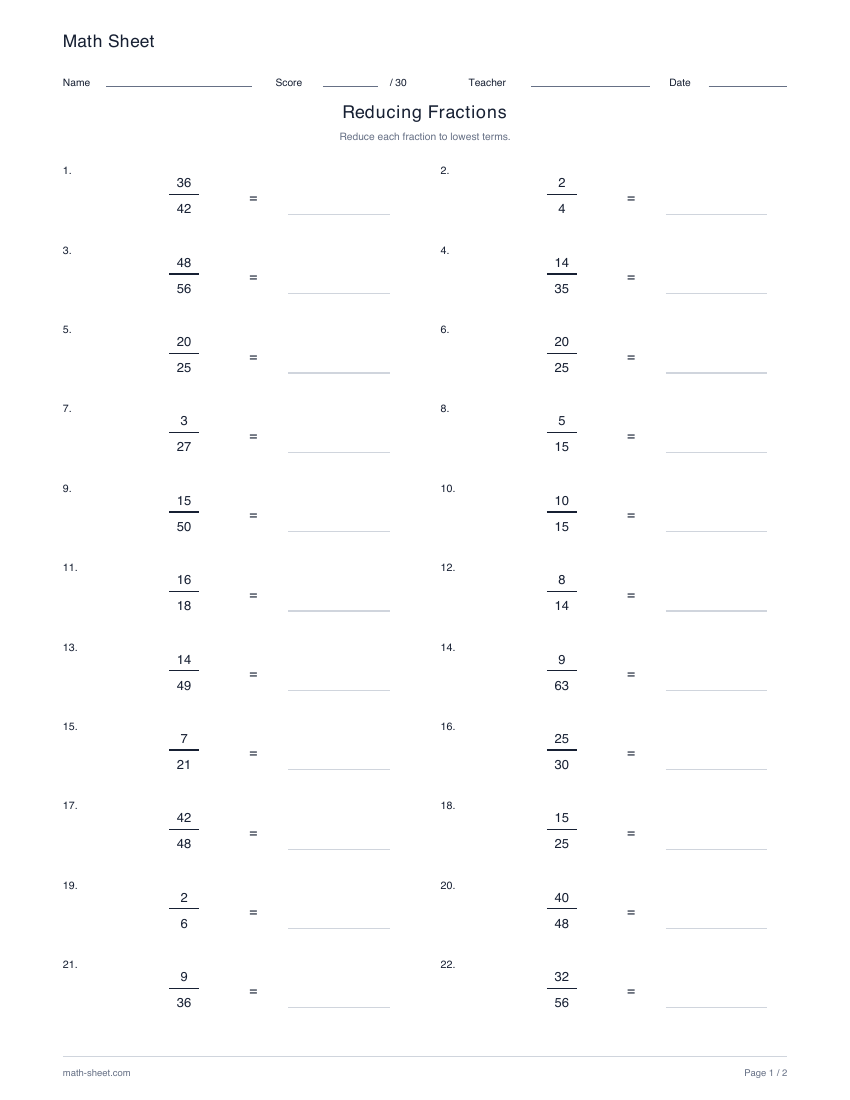
Print simplifying fractions worksheets for positive proper fractions, with a separate key. Choose answer denominators, 10, 20 or 30 questions and optional no-repeat practice.
Ready-made English PDF · fixed settings
Customization below makes a separate PDF.
Fixed English ready-made files. Custom settings below apply only to the configured PDF.
Ready to print
Find a factor shared by the numerator and denominator. Divide both by it and continue until no common factor greater than one remains. Using the greatest common factor completes the reduction in one step.
Download the practice pages alone, or include a separate answer key or teacher model. Longer activities may use more than one page.
Customize this worksheetLearning objective
Simplify a fraction while explaining why its value is unchanged and recognizing when simplification is complete.
Worked example
3/4.
The greatest common factor of 18 and 24 is 6. Dividing both by 6 gives 3/4. Since 3 and 4 share no factor greater than one, this is the lowest-terms form.
Teaching notes
For a short diagnostic session, select Understanding lesson: 10 tasks. This English sequence mixes reduction, already-simplest and equivalence decisions, two kinds of error explanation, shaded and unshaded equal-cell models, and a context requiring the learner to identify the whole. It uses a fixed small-number scope and separate worked explanations; the drill controls are inactive while selected.
The denominator set controls the reduced answers, rather than the larger fractions printed as questions. For example, 18/24 → 3/4 uses answer denominator 4. Each question multiplies a lowest-terms fraction by a common factor from 2 through 9, so question denominators can exceed the selected set.
All generated fractions are positive and proper: the numerator is greater than zero and smaller than the denominator. This worksheet does not include negative, improper or mixed-number reduction.
Turn on No repeated questions to prevent the same displayed input fraction from appearing twice on one sheet. Equivalent fractions with different numerators and denominators may still have the same simplified answer. Leave it off to reproduce older saved worksheets with their original settings and seeds.
The selected range describes the denominator after reduction. Choosing 2 through 10 can produce a question such as 18/24 because its simplified answer, 3/4, has denominator 4.
Make it yours
Choose your options, update the preview, then download the exact same pages.
Understanding lesson: exactly 10 English tasks with small whole-number inputs (denominators up to 60). Denominator set, drill count and no-repeat settings are inactive. Uncheck the lesson or reset settings to return to configurable drills.
A useful next step
Fractions
Find the greatest common factor of positive integer pairs. Choose a maximum of 24, 40, 60 or 120 and 10, 15 or 20 questions, with a separate answer key.
Preview and download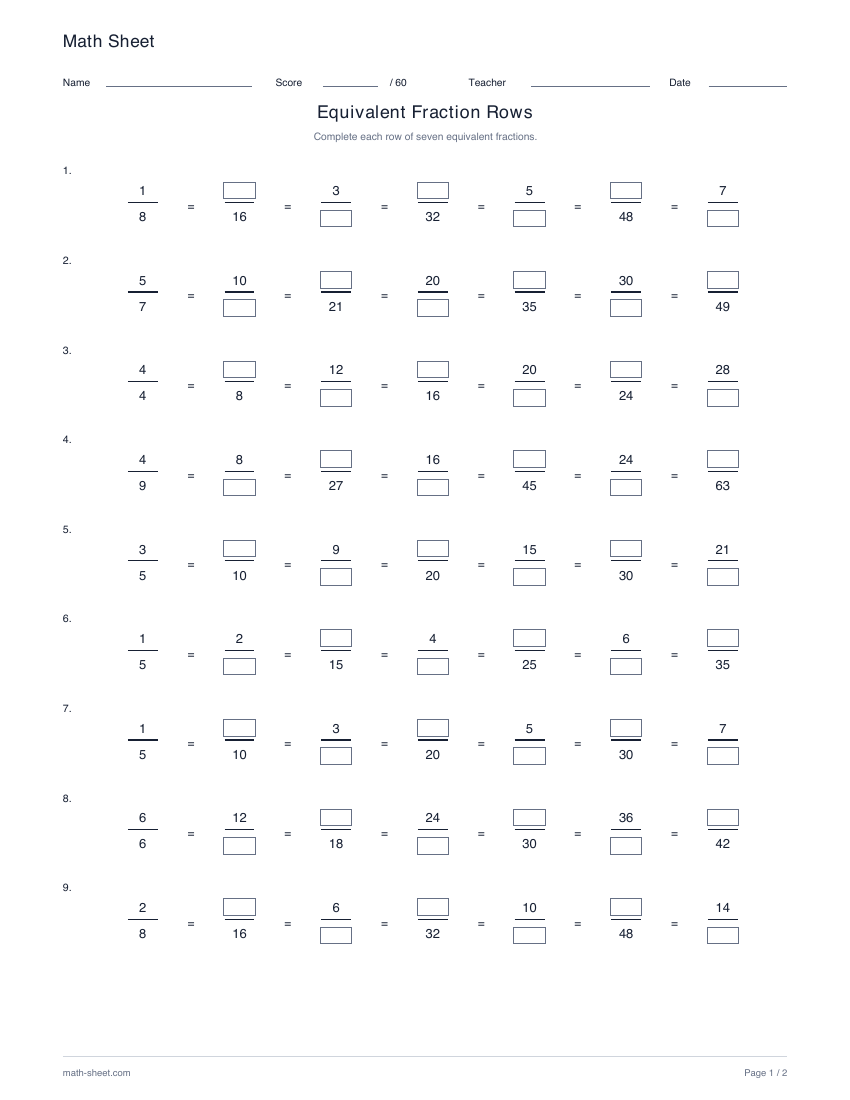
Fractions
Print an equivalent fractions worksheet with 10 rows of seven equal fractions, six one-part blanks per row, four denominator sets, and a separate answer key.
Preview and download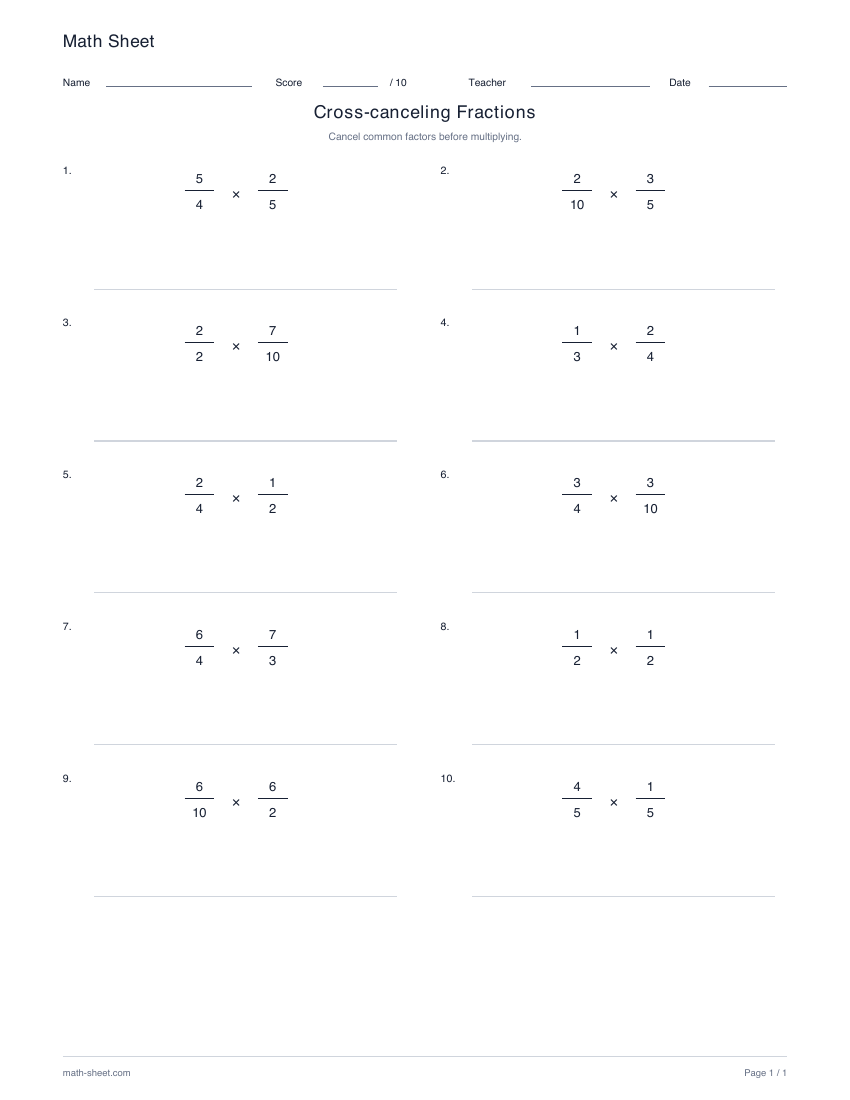
Fractions
Reduce common numerator and denominator factors before multiplication to keep the product calculation manageable.
Preview and downloadReducing and simplifying name the same task: divide numerator and denominator by a common factor without changing the value. For 36/42, dividing both by 6 gives 6/7. The denominator selector describes the reduced answer (7 here); the printed question can have a larger denominator. These are positive proper fractions. Choose the no-repeat option for distinct printed questions.