
Complex numbers
Graphing complex numbers worksheets
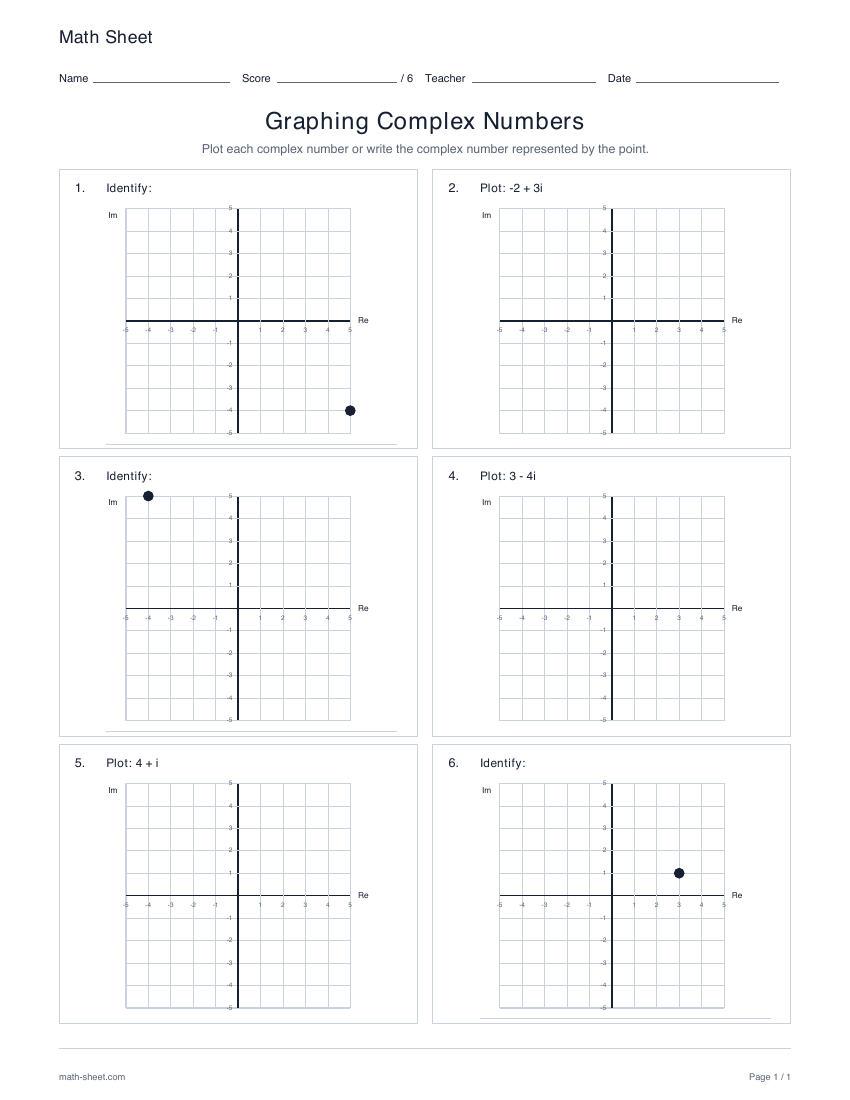
Plot complex numbers and read a + bi from points on the complex plane. Choose six plotting questions, six identification questions or a balanced mixture.
Preview and downloadTwo components. One number.
Connect a + bi with a point on the plane. Find its distance from the origin, calculate with i and use a conjugate to simplify a quotient.
Choose a practice sheetBuild the next skill
Read the two components, locate the point and calculate its distance from the origin.
Complex numbers
Plot complex numbers and read a + bi from points on the complex plane. Choose six plotting questions, six identification questions or a balanced mixture.
Preview and download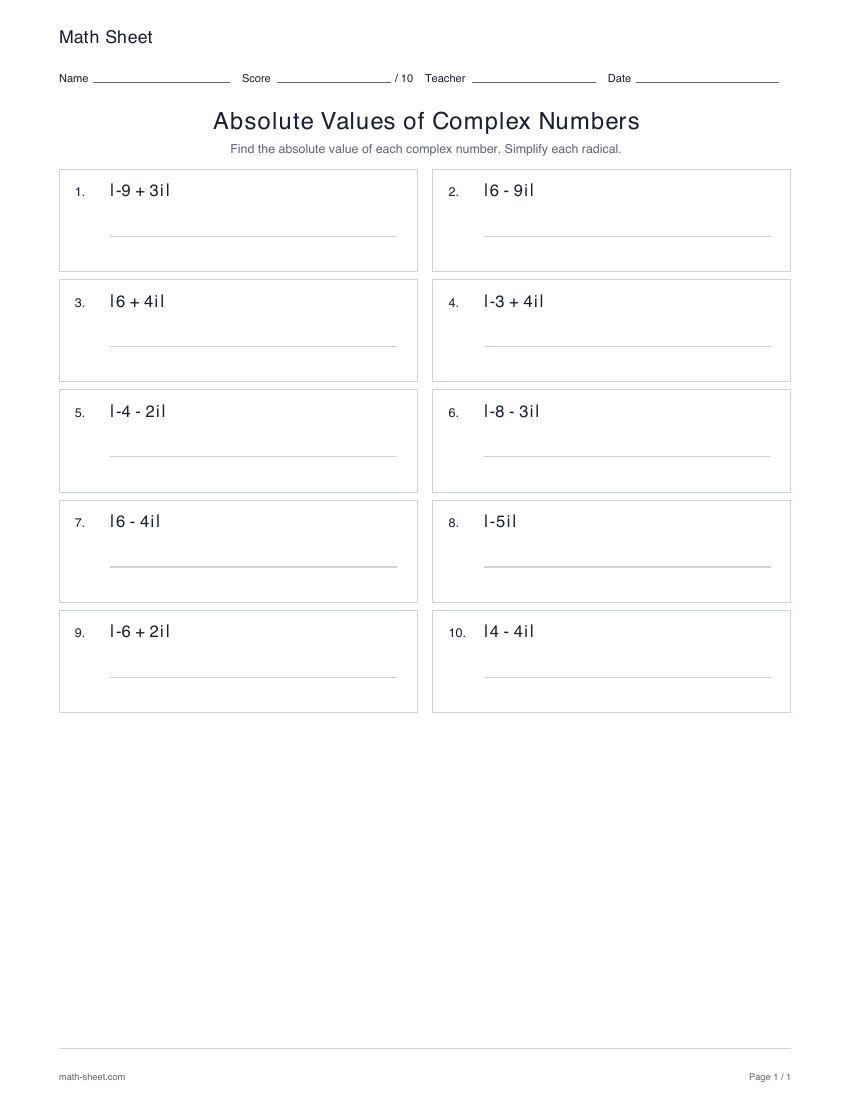
Complex numbers
Find the modulus of ten complex numbers. Connect real and imaginary components with distance from the origin, then check exact, simplified radical answers.
Preview and download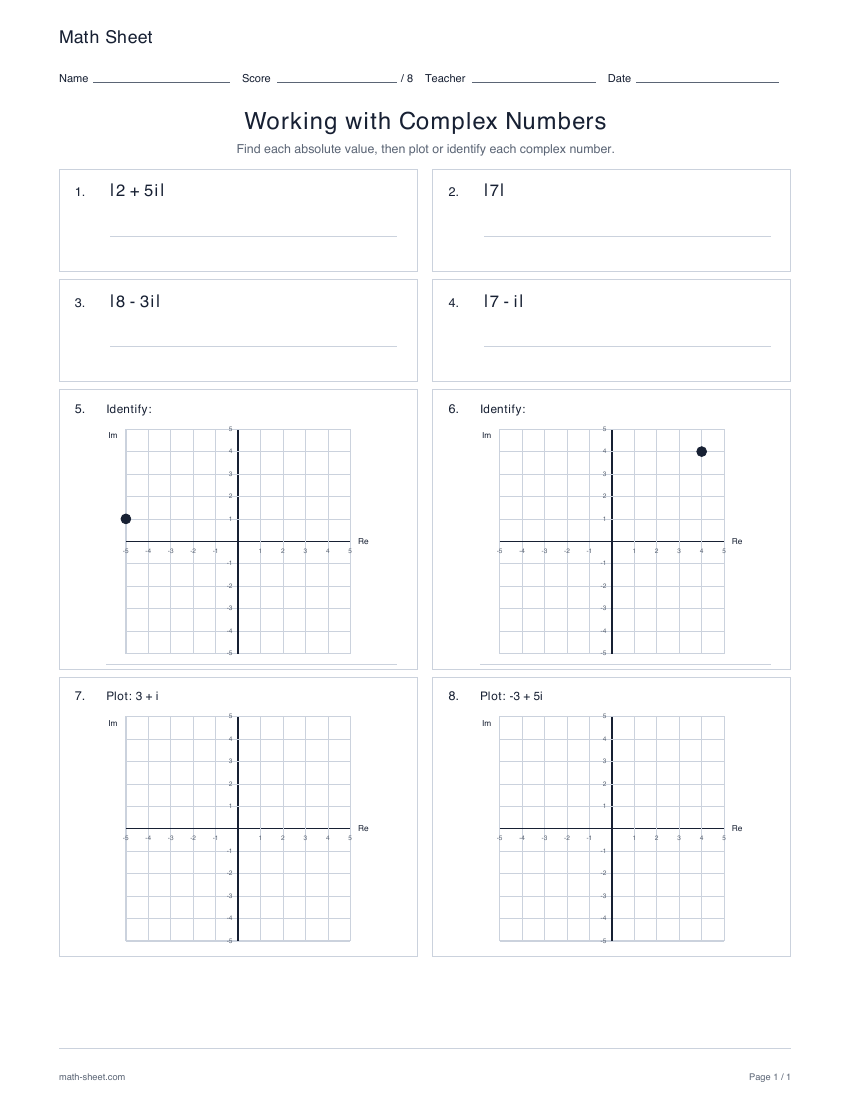
Complex numbers
Combine four modulus questions with four complex-plane questions. Choose plotting, identifying points or both, with a separate key for the same generated set.
Preview and downloadBuild the next skill
Combine like terms, expand products and use conjugates to simplify quotients.
Complex numbers
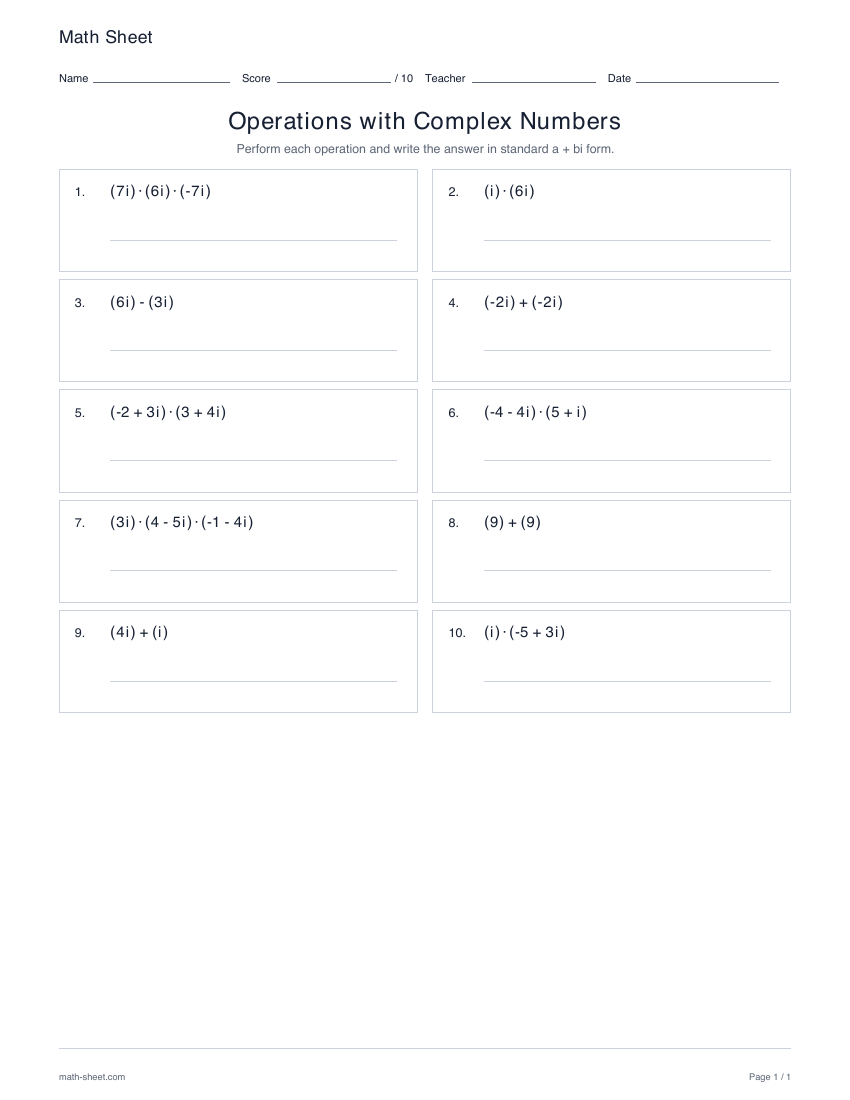
Add, subtract and multiply complex numbers in ten-question sets. Select sums and differences, imaginary monomial products or binomial products and squares.
Preview and download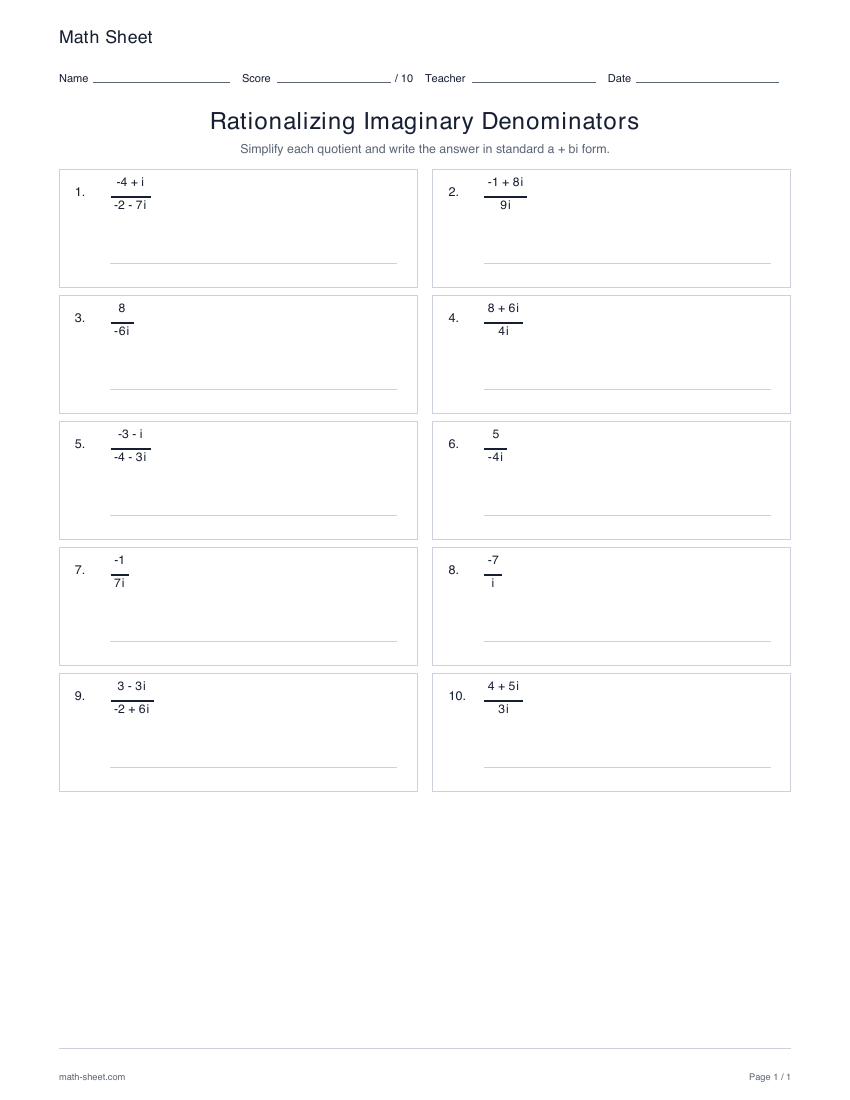
Complex numbers
Rewrite ten complex quotients with real denominators. Select real-over-imaginary, binomial-over-imaginary or binomial-over-binomial questions and print worked answers.
Preview and downloadKeep one idea in focus before combining skills. Each link opens the same generator with a useful selection already set.
Use each pair of signed components to place a point on its own plane.
Open this practice →Write a complex number from a plotted location.
Open this practice →Keep the focus on real and imaginary sums and differences.
Open this practice →Simplify products of imaginary factors and distribute one over a binomial.
Open this practice →Practice binomial products, squares and products with an imaginary factor.
Open this practice →Rewrite a real number divided by a nonzero multiple of i.
Open this practice →Make a two-term complex denominator real, then reduce the quotient.
Open this practice →For z = −4 + 3i, the real part is −4, the imaginary part is 3, and the modulus is 5. The coefficient 3 is a real number even though it is called the imaginary part.
The point (−4, 3) gives a position. The distance √(16 + 9) gives a magnitude. Complex numbers with different positions can have the same magnitude.
A quick diagnostic is to ask for all three quantities before handing out a mixed review sheet.
Use a focused set when one step needs attention. The combined review checks position and distance; the operations and rationalization sheets practice a different skill.
The imaginary unit i is defined by this property. Complex arithmetic extends real arithmetic while keeping distribution and the usual addition and multiplication rules.
For a + 3i, the imaginary part is the real coefficient 3. The imaginary term is 3i. The vertical coordinate is therefore 3.
These worksheets use exact answers. Leave a modulus as a simplified radical when necessary, and keep rationalized quotients as reduced fractions.
The graph worksheet has three plotting and three identification questions. The review has four modulus questions followed by two of each graph type.
Course placement differs across school systems. Choose by readiness: signed coordinates, radicals, distribution and basic algebra. The Algebra 2 guide connects these resources with prerequisites.
Custom sheets support Letter/A4 and English, German, Albanian, Spanish, Italian, French, Turkish and Norwegian Bokmål. Ready-made downloads are English.
Simplify square roots before using them to express a modulus exactly.
Practice square roots →Practice distribution with real variables before adding the identity i² = −1.
Practice binomial multiplication →Choose a learning sequence and return to a foundation when a specific step needs work.
Explore Algebra 2 practice →