Worked example
Expand and simplify −3(2x − 5) + 4x.
−6x + 15 + 4x = −2x + 15.
The factor −3 multiplies both 2x and −5. Their products are −6x and +15. Finally combine −6x + 4x into −2x; the constant remains 15.
Choose a distributive property worksheet
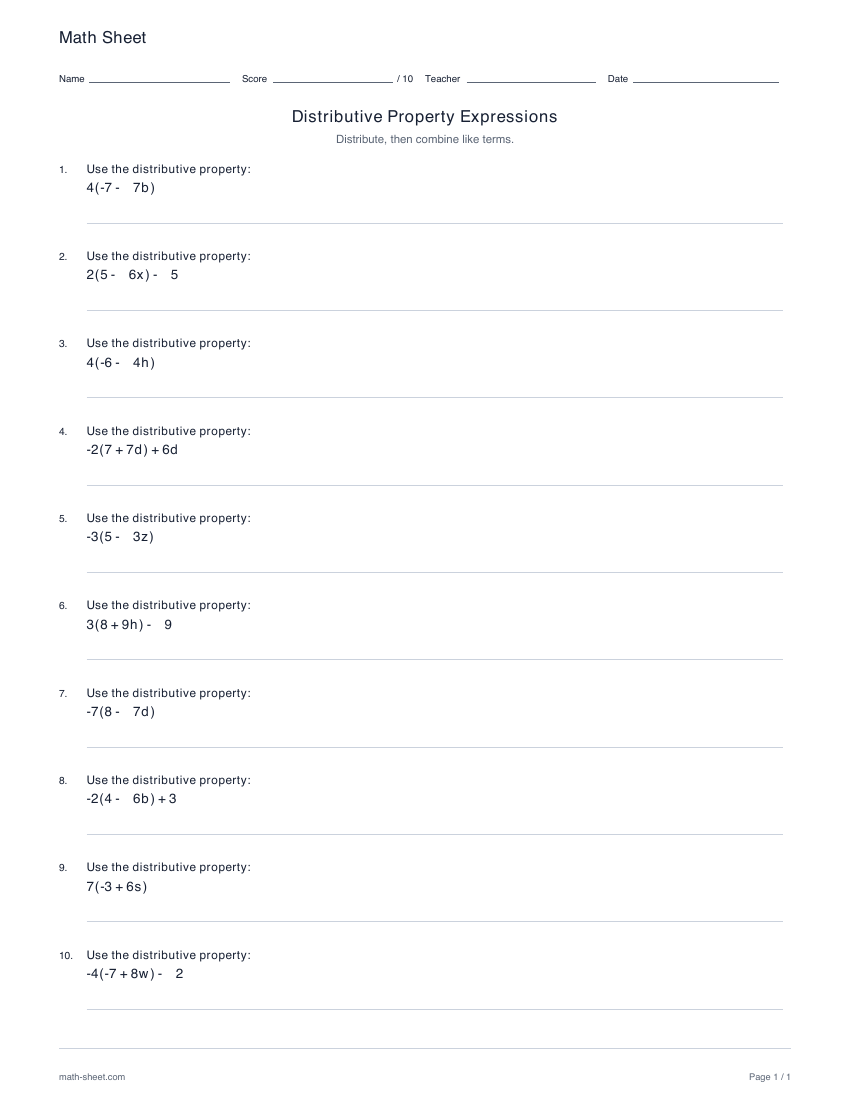
Start with the three-term grouped multiplication form and the 2–9 range. These problems contain an outside signed factor and a two-term group, so learners can focus on multiplying the factor by every term.
Move to the four-term form to add an outside constant or like variable term that must be combined after distributing. The 10–19 and 2–19 ranges increase the coefficient magnitudes without changing the algebraic steps.
Which settings are best for a first distributive property worksheet?
Choose Three terms: grouped multiplication and the 2–9 range. Each problem has one factor outside a two-term group, with no extra term to combine afterward.
How should a negative factor be distributed?
Multiply the negative factor by every term inside the parentheses, including each term’s sign. Write the full expansion first, then combine any like terms.