Statistics practice

Normal Conjugate Priors worksheets

Update a normal mean with known observation variance using precision weights and verify sequential consistency.

Ready-made English PDF · fixed settings

Customization below makes a separate PDF.

Fixed English ready-made files. Custom settings below apply only to the configured PDF.

Ready to print

Start with a ready-made worksheet

Treat the second normal parameter as variance. Data precision is n divided by known observation variance.

Download the practice pages alone, or include a separate answer key or teacher model. Longer activities may use more than one page.

Customize this worksheet

Paper sizes and printing help · More statistics activities

Keep every inferential role visible

Problems label parameters, observed data, likelihoods, priors, evidence, and posteriors before calculation. Bounded counts and printed reference values keep the work reproducible on paper.

Learning objective

What this activity builds

Combine prior precision and sample precision to obtain a normal posterior mean and variance.

Worked example

Prior N(0,4), observation x=2 with variance 4. Find posterior.

N(1,2).

Equal precisions average the means and double total precision.

Teaching notes

Make the practice count

  • Label data, hypothesis, prior, and likelihood before calculating.
  • Normalize only after forming every Bayes numerator.
  • Interpret the posterior in the parameter context.

Make it yours

Customize the practice

Choose your options, update the preview, then download the exact same pages.

Choose bounded question modes, models where offered, problem count, paper, and a reproducible seed. Worked keys use the same resolved document as the preview.

Worksheet settings

Question types
Page note and reproducible seed

The same settings and seed make the same questions. Shared links include your page note; leave personal information out.

Configured PDF · Normal Conjugate Priors · US Letter

Preview ready. Download includes these exact pages.

4 student pages
Enlarged pages scroll. PDF size stays the same.
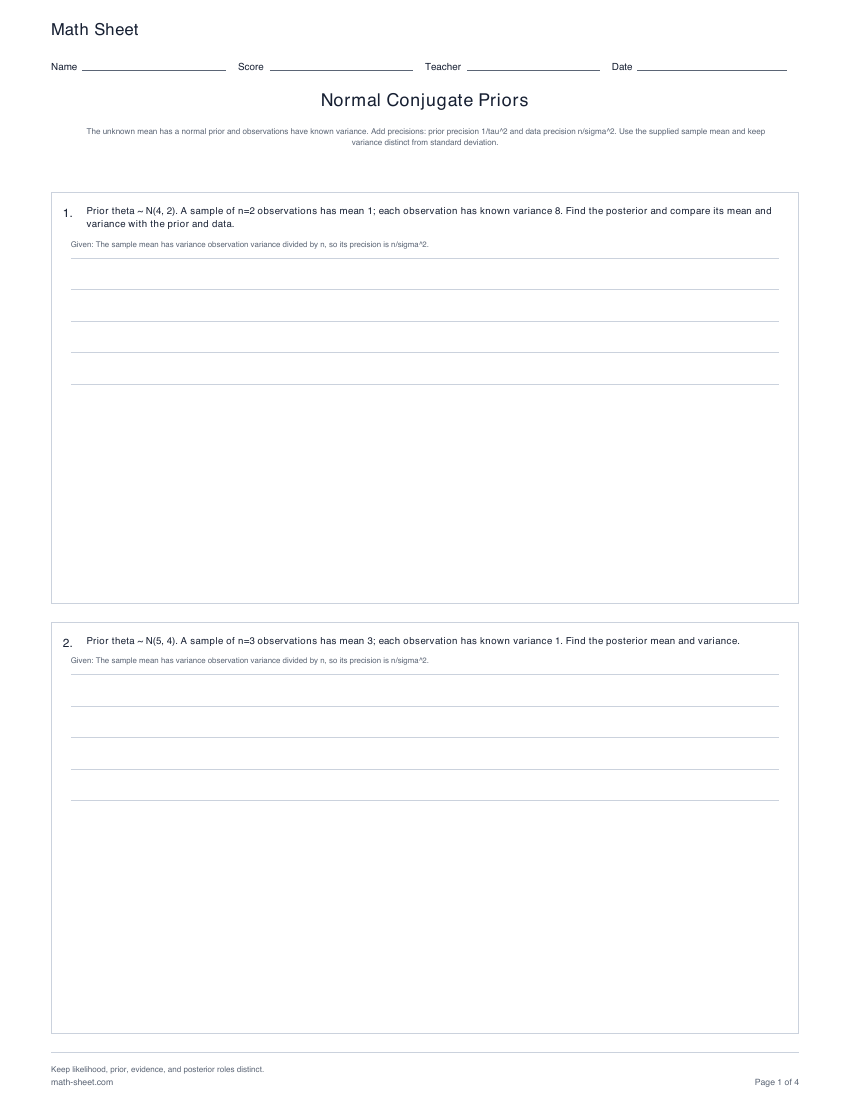
Math SheetNameScoreTeacherDateNormal Conjugate PriorsThe unknown mean has a normal prior and observations have known variance. Add precisions: prior precision 1/tau^2 and data precision n/sigma^2. Use the supplied sample mean and keepvariance distinct from standard deviation.1.Prior theta ~ N(4, 2). A sample of n=2 observations has mean 1; each observation has known variance 8. Find the posterior and compare its mean andvariance with the prior and data.Given: The sample mean has variance observation variance divided by n, so its precision is n/sigma^2.2.Prior theta ~ N(5, 4). A sample of n=3 observations has mean 3; each observation has known variance 1. Find the posterior mean and variance.Given: The sample mean has variance observation variance divided by n, so its precision is n/sigma^2.Keep likelihood, prior, evidence, and posterior roles distinct.math-sheet.comPage 1 of 4
Math SheetNameScoreTeacherDateNormal Conjugate PriorsThe unknown mean has a normal prior and observations have known variance. Add precisions: prior precision 1/tau^2 and data precision n/sigma^2. Use the supplied sample mean and keepvariance distinct from standard deviation.3.Prior theta ~ N(6, 8). One observation x=6 has known variance 2. Find the posterior mean and variance.Given: The second normal parameter shown is variance. Observation variance is known.4.Prior theta ~ N(1, 1); observations 18, 20 each have known variance 4. Update sequentially and verify the batch result.Given: Observations are conditionally independent given theta.Keep likelihood, prior, evidence, and posterior roles distinct.math-sheet.comPage 2 of 4
Math SheetNameScoreTeacherDateNormal Conjugate PriorsThe unknown mean has a normal prior and observations have known variance. Add precisions: prior precision 1/tau^2 and data precision n/sigma^2. Use the supplied sample mean and keepvariance distinct from standard deviation.5.Prior theta ~ N(2, 2). A sample of n=6 observations has mean 3; each observation has known variance 8. Find the posterior mean and variance.Given: The sample mean has variance observation variance divided by n, so its precision is n/sigma^2.6.Prior theta ~ N(3, 4). A sample of n=2 observations has mean 5; each observation has known variance 1. Find the posterior and compare its mean andvariance with the prior and data.Given: The sample mean has variance observation variance divided by n, so its precision is n/sigma^2.Keep likelihood, prior, evidence, and posterior roles distinct.math-sheet.comPage 3 of 4
Math SheetNameScoreTeacherDateNormal Conjugate PriorsThe unknown mean has a normal prior and observations have known variance. Add precisions: prior precision 1/tau^2 and data precision n/sigma^2. Use the supplied sample mean and keepvariance distinct from standard deviation.7.Prior theta ~ N(4, 8). One observation x=3 has known variance 2. Find the posterior mean and variance.Given: The second normal parameter shown is variance. Observation variance is known.8.Prior theta ~ N(5, 1); observations 22, 24 each have known variance 4. Update sequentially and verify the batch result.Given: Observations are conditionally independent given theta.Keep likelihood, prior, evidence, and posterior roles distinct.math-sheet.comPage 4 of 4

A useful next step

Related activities

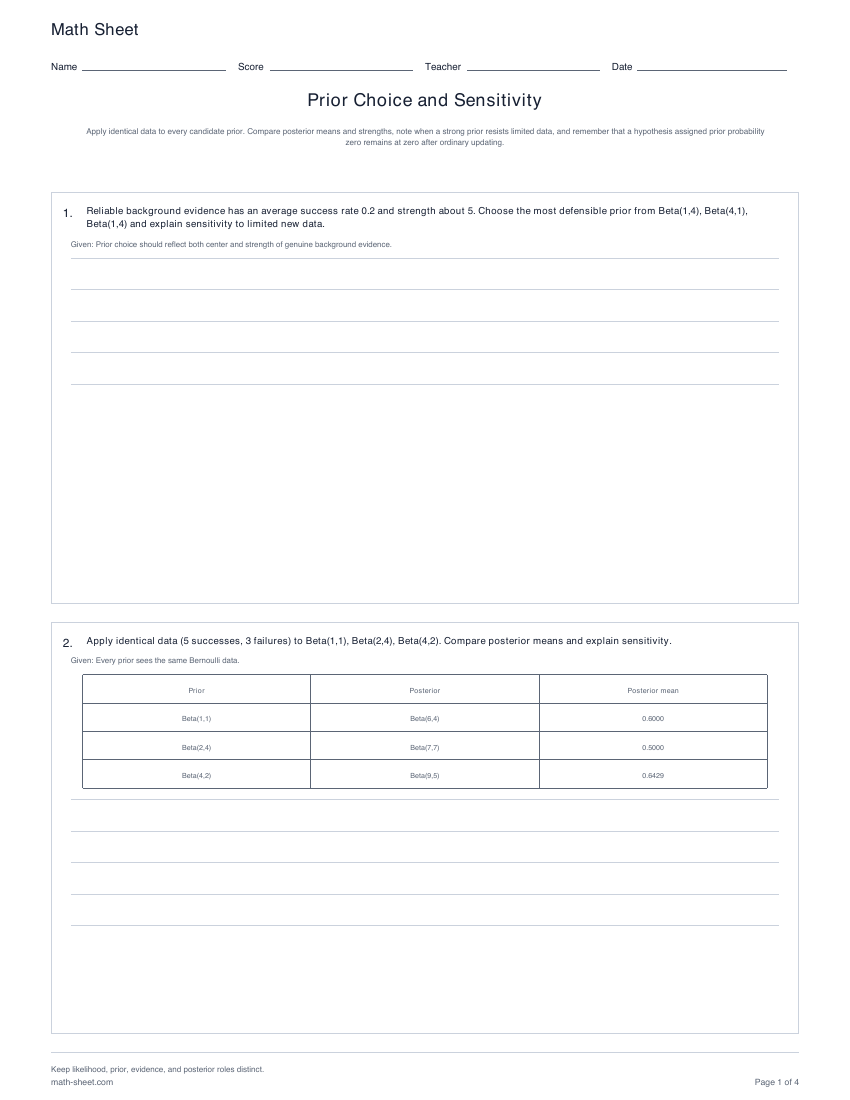
Printable prior choice and sensitivity worksheets preview

Statistics

Prior Choice and Sensitivity worksheets

Compare priors under identical data, contrast weak and strong priors, preserve zero prior mass, and justify prior choices.

Preview and download