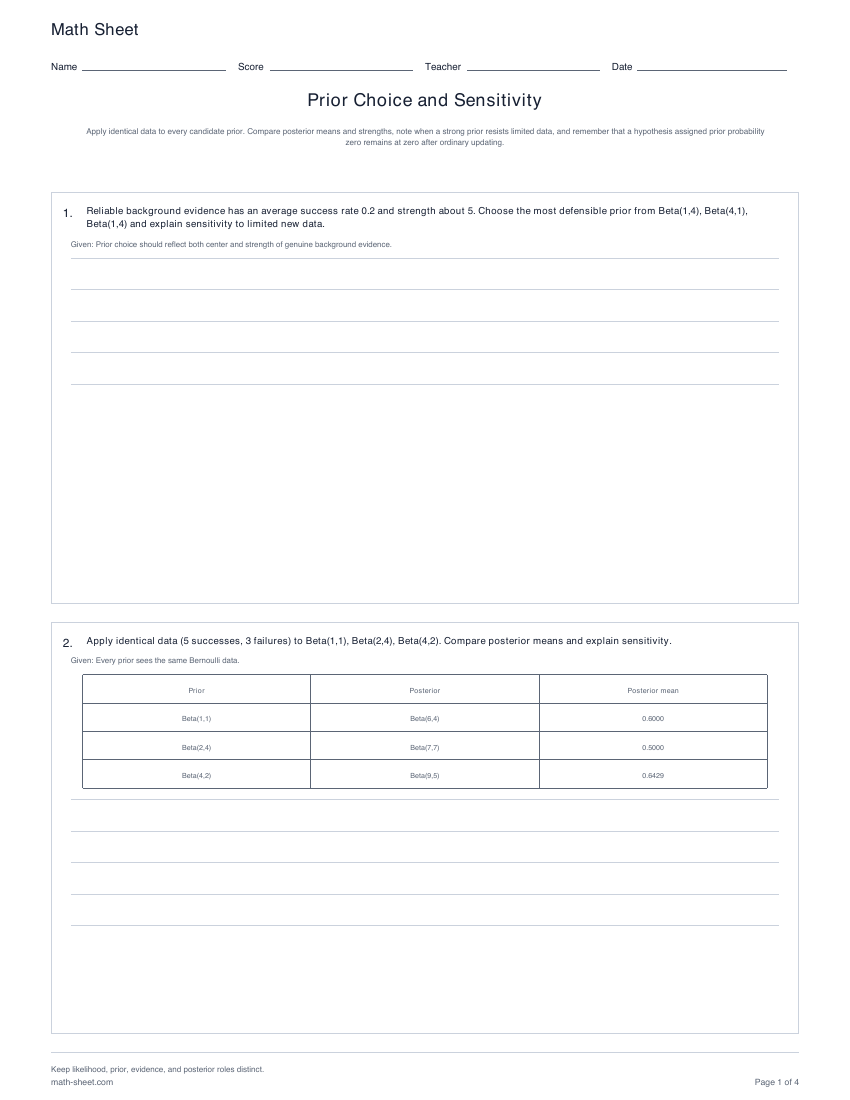
Math Sheet Name Score Teacher Date Prior Choice and Sensitivity Apply identical data to every candidate prior. Compare posterior means and strengths, note when a strong prior resists limited data, and remember that a hypothesis assigned prior probability zero remains at zero after ordinary updating. 1. Reliable background evidence has an average success rate 0.2 and strength about 5. Choose the most defensible prior from Beta(1,4), Beta(4,1), Beta(1,4) and explain sensitivity to limited new data. Given: Prior choice should reflect both center and strength of genuine background evidence. 2. Apply identical data (5 successes, 3 failures) to Beta(1,1), Beta(2,4), Beta(4,2). Compare posterior means and explain sensitivity. Given: Every prior sees the same Bernoulli data. Prior Posterior Posterior mean Beta(1,1) Beta(6,4) 0.6000 Beta(2,4) Beta(7,7) 0.5000 Beta(4,2) Beta(9,5) 0.6429 Keep likelihood, prior, evidence, and posterior roles distinct. math-sheet.com Page 1 of 4
Math Sheet Name Score Teacher Date Prior Choice and Sensitivity Apply identical data to every candidate prior. Compare posterior means and strengths, note when a strong prior resists limited data, and remember that a hypothesis assigned prior probability zero remains at zero after ordinary updating. 3. Compare weak Beta(1,1) and strong Beta(8,8) priors after a small batch (2 successes, 1 failures) and a larger batch (4 successes, 2 failures) with the same success proportion 2/3. Given: Both priors see each batch, and the larger batch preserves the small batch's success-to-failure ratio. Prior Batch Posterior Mean Beta(1,1) small 2:1 Beta(3,2) 0.6000 Beta(1,1) large 4:2 Beta(5,3) 0.6250 Beta(8,8) small 2:1 Beta(10,9) 0.5263 Beta(8,8) large 4:2 Beta(12,10) 0.5455 4. A discrete prior over H1,H2,H3 is (0.00, 0.60, 0.40); likelihoods are (0.70, 0.60, 0.25). Find the posterior and explain whether strong evidence can revive H1. Given: Ordinary updating cannot add mass where prior mass is exactly zero. Keep likelihood, prior, evidence, and posterior roles distinct. math-sheet.com Page 2 of 4
Math Sheet Name Score Teacher Date Prior Choice and Sensitivity Apply identical data to every candidate prior. Compare posterior means and strengths, note when a strong prior resists limited data, and remember that a hypothesis assigned prior probability zero remains at zero after ordinary updating. 5. Compare weak Beta(1,1) and strong Beta(10,10) priors after a small batch (3 successes, 1 failures) and a larger batch (6 successes, 2 failures) with the same success proportion 3/4. Given: Both priors see each batch, and the larger batch preserves the small batch's success-to-failure ratio. Prior Batch Posterior Mean Beta(1,1) small 3:1 Beta(4,2) 0.6667 Beta(1,1) large 6:2 Beta(7,3) 0.7000 Beta(10,10) small 3:1 Beta(13,11) 0.5417 Beta(10,10) large 6:2 Beta(16,12) 0.5714 6. A discrete prior over H1,H2,H3 is (0.00, 0.80, 0.20); likelihoods are (0.90, 0.60, 0.15). Find the posterior and explain whether strong evidence can revive H1. Given: Ordinary updating cannot add mass where prior mass is exactly zero. Keep likelihood, prior, evidence, and posterior roles distinct. math-sheet.com Page 3 of 4
Math Sheet Name Score Teacher Date Prior Choice and Sensitivity Apply identical data to every candidate prior. Compare posterior means and strengths, note when a strong prior resists limited data, and remember that a hypothesis assigned prior probability zero remains at zero after ordinary updating. 7. Reliable background evidence has an average success rate 0.2 and strength about 15. Choose the most defensible prior from Beta(3,12), Beta(4,1), Beta(1,4) and explain sensitivity to limited new data. Given: Prior choice should reflect both center and strength of genuine background evidence. 8. Apply identical data (6 successes, 1 failures) to Beta(1,1), Beta(2,4), Beta(4,2). Compare posterior means and explain sensitivity. Given: Every prior sees the same Bernoulli data. Prior Posterior Posterior mean Beta(1,1) Beta(7,2) 0.7778 Beta(2,4) Beta(8,5) 0.6154 Beta(4,2) Beta(10,3) 0.7692 Keep likelihood, prior, evidence, and posterior roles distinct. math-sheet.com Page 4 of 4