Statistics practice

Likelihood and MLE worksheets

Write and compare likelihoods, find bounded analytic MLEs, and handle normal variance and support-dependent uniform endpoints.

Ready-made English PDF · fixed settings

Customization below makes a separate PDF.

Fixed English ready-made files. Custom settings below apply only to the configured PDF.

Ready to print

Start with a ready-made worksheet

State parameter support and model assumptions. Keep the normal MLE variance divisor n and check boundary or support-dependent maxima.

Download the practice pages alone, or include a separate answer key or teacher model. Longer activities may use more than one page.

Customize this worksheet

Paper sizes and printing help · More statistics activities

Keep every inferential role visible

Problems label parameters, observed data, likelihoods, priors, evidence, and posteriors before calculation. Bounded counts and printed reference values keep the work reproducible on paper.

Learning objective

What this activity builds

Treat observed data as fixed while comparing or maximizing likelihood across Bernoulli, binomial, exponential, normal, and uniform models.

Worked example

Three successes occur in five Bernoulli trials. Find the MLE of p.

p-hat=3/5.

The Bernoulli likelihood is maximized by the observed success proportion.

Teaching notes

Make the practice count

  • Label data, hypothesis, prior, and likelihood before calculating.
  • Normalize only after forming every Bayes numerator.
  • Interpret the posterior in the parameter context.

Make it yours

Customize the practice

Choose your options, update the preview, then download the exact same pages.

Choose bounded question modes, models where offered, problem count, paper, and a reproducible seed. Worked keys use the same resolved document as the preview.


Worksheet settings

Question types
Models for candidate, likelihood, and analytic tasks
Page note and reproducible seed

The same settings and seed make the same questions. Shared links include your page note; leave personal information out.

Configured PDF · Likelihood and Maximum Likelihood · US Letter

Preview ready. Download includes these exact pages.

4 student pages
Enlarged pages scroll. PDF size stays the same.
Math SheetNameScoreTeacherDateLikelihood and Maximum LikelihoodKeep the observed data fixed while treating likelihood as a function of the parameter. State the parameter support, use natural log-likelihood when requested, check endpoints or supportrestrictions, and distinguish the MLE variance divisor n from the sample-variance divisor n-1.1.An ordered Bernoulli sequence produced 2 successes in 8 fixed trials. Compare p = , 0.3 by likelihood and choose the best listed value.Given: The observed data are fixed while p varies. A binomial coefficient is common to all listed candidates and does not change their ranking.prelative likelihood0.20.0104860.350.0092392.The total of 4 independent exponential waiting times is 12 hours. Find the MLE of the rate lambda in events per hour.Given: Waiting times are independent exponential(lambda), lambda > 0.Keep likelihood, prior, evidence, and posterior roles distinct.math-sheet.comPage 1 of 4
Math SheetNameScoreTeacherDateLikelihood and Maximum LikelihoodKeep the observed data fixed while treating likelihood as a function of the parameter. State the parameter support, use natural log-likelihood when requested, check endpoints or supportrestrictions, and distinguish the MLE variance divisor n from the sample-variance divisor n-1.3.A binomial count has 4 successes and 4 failures. Write L(p) and log L(p), including terms that depend on p.Given: Trials are independent with a common unknown success probability 0 <= p <= 1.4.Data 40, 41, 42, 43 are independent from Uniform(0, theta), with theta >= 1. Find the MLE and explain the support endpoint.Given: The likelihood is theta^(-n) when theta is at least every observation, and 0 otherwise.Keep likelihood, prior, evidence, and posterior roles distinct.math-sheet.comPage 2 of 4
Math SheetNameScoreTeacherDateLikelihood and Maximum LikelihoodKeep the observed data fixed while treating likelihood as a function of the parameter. State the parameter support, use natural log-likelihood when requested, check endpoints or supportrestrictions, and distinguish the MLE variance divisor n from the sample-variance divisor n-1.5.An ordered Bernoulli sequence has 5 successes and 5 failures. Write L(p) and log L(p), including terms that depend on p.Given: Trials are independent with a common unknown success probability 0 <= p <= 1.6.Find the MLE of p after 5 successes in 11 independent Bernoulli trials. Check boundary cases.Given: The parameter support is 0 <= p <= 1.Keep likelihood, prior, evidence, and posterior roles distinct.math-sheet.comPage 3 of 4
Math SheetNameScoreTeacherDateLikelihood and Maximum LikelihoodKeep the observed data fixed while treating likelihood as a function of the parameter. State the parameter support, use natural log-likelihood when requested, check endpoints or supportrestrictions, and distinguish the MLE variance divisor n from the sample-variance divisor n-1.7.5 fixed exponential waiting times total 12 hours. Compare candidate rates lambda = 1, 1.5 events per hour and choose the best listed value.Given: For fixed nonnegative waiting times, L(lambda) is proportional to lambda^n exp(-lambda times the sample sum), with lambda > 0.lambdarelative likelihood10.0000061.50.0000008.Data 74, 75, 76, 77 are independent from Uniform(0, theta), with theta >= 0. Find the MLE and explain the support endpoint.Given: The likelihood is theta^(-n) when theta is at least every observation, and 0 otherwise.Keep likelihood, prior, evidence, and posterior roles distinct.math-sheet.comPage 4 of 4

A useful next step

Related activities

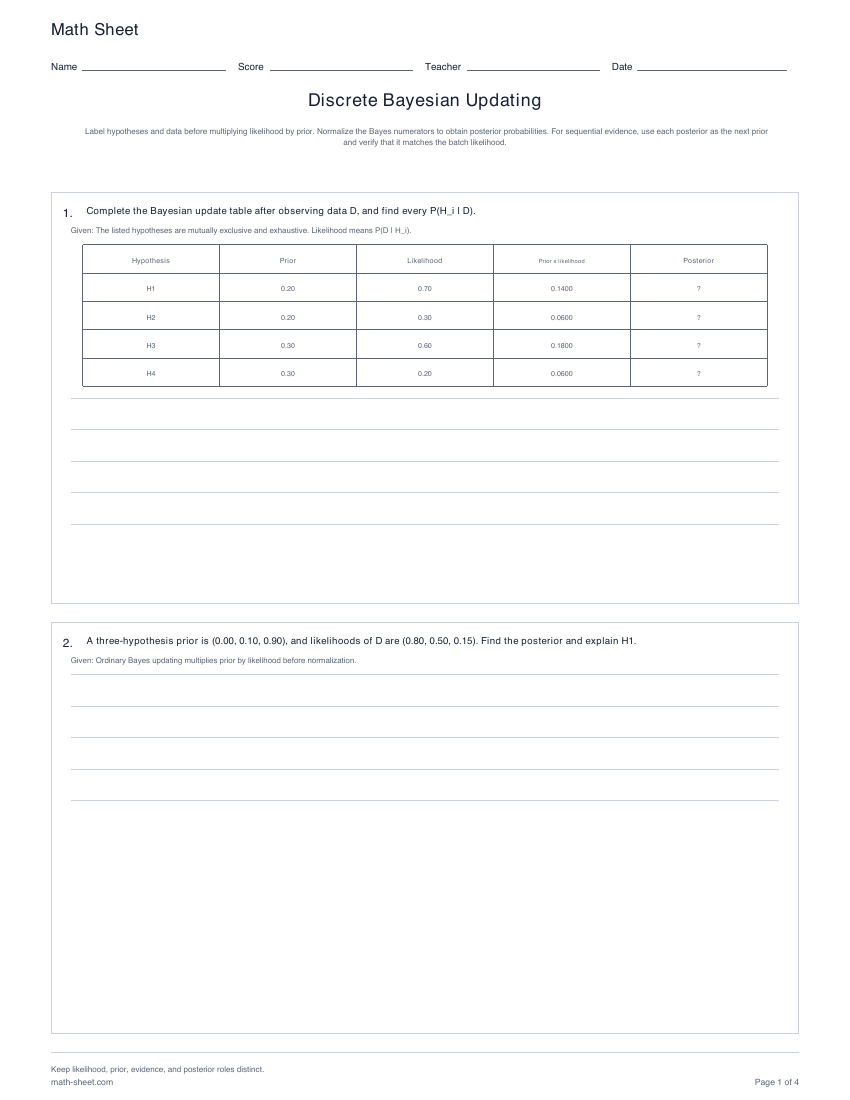
Printable discrete bayesian updating worksheets preview

Statistics

Discrete Bayesian Updating worksheets

Complete prior-likelihood-posterior tables, compare sequential and batch evidence, and handle zero priors or impossible evidence.

Preview and download