Statistics practice

Large-Sample Confidence Intervals worksheets

Use conservative proportion bounds, the approximate 95% rule, and CLT intervals for general means.

Ready-made English PDF · fixed settings

Customization below makes a separate PDF.

Fixed English ready-made files. Custom settings below apply only to the configured PDF.

Ready to print

Start with a ready-made worksheet

State independence and large-sample conditions. Label conservative and rule-of-thumb intervals as approximations.

Download the practice pages alone, or include a separate answer key or teacher model. Longer activities may use more than one page.

Customize this worksheet

Paper sizes and printing help · More statistics activities

Keep assumptions beside the interval

Every task states the sampling model, standard-error source, quantile convention, and rounding reference needed to reproduce the worked endpoint.

Learning objective

What this activity builds

Construct and compare large-sample intervals while stating independence, finite-variance, and approximation conditions.

Worked example

What is the conservative proportion margin at 95%?

1.96/(2 square root n), approximately 1/square root n.

The Bernoulli variance is at most one fourth.

Teaching notes

Make the practice count

  • Keep endpoints within zero and one.
  • Call the 1/square root n rule approximate.
  • Do not use n=30 as a universal CLT guarantee.

Make it yours

Customize the practice

Choose your options, update the preview, then download the exact same pages.

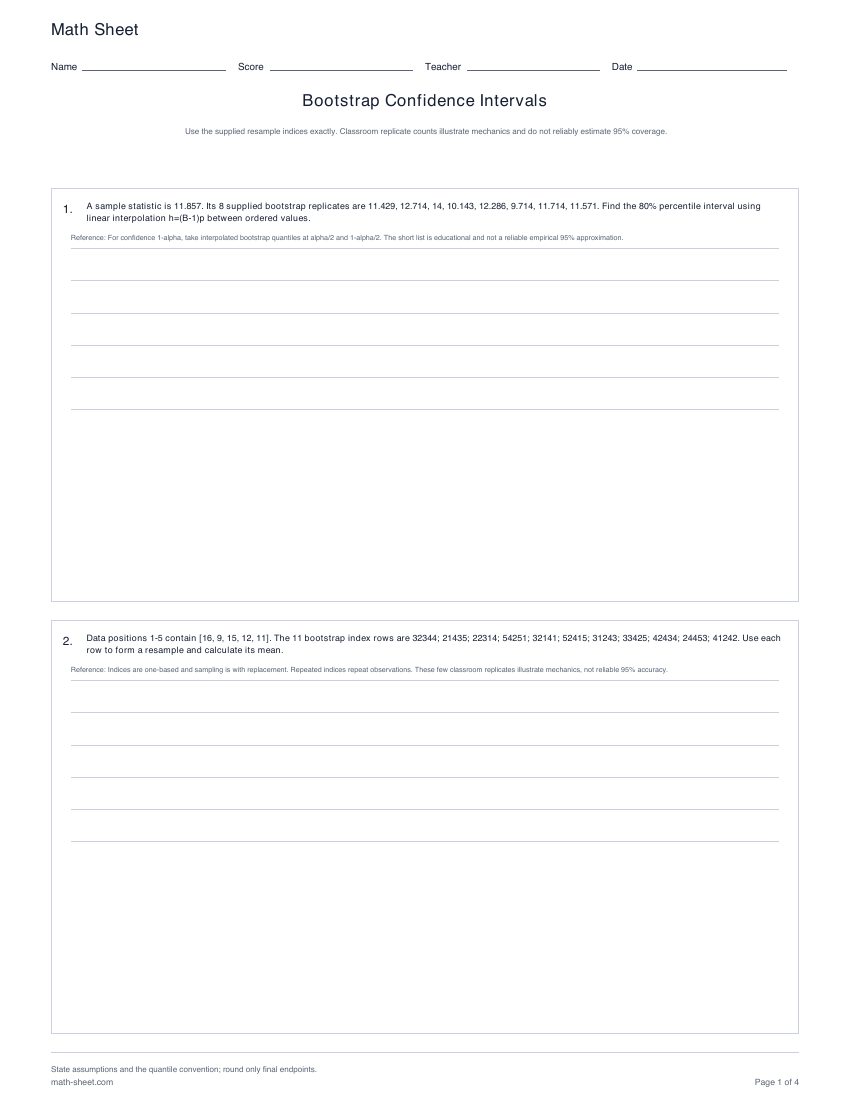
Choose interval or bootstrap modes, problem count, paper size, and seed.

Worksheet settings

Question types
Page note and reproducible seed

The same settings and seed make the same questions. Shared links include your page note; leave personal information out.

Configured PDF · Large-Sample Confidence Intervals · US Letter

Preview ready. Download includes these exact pages.

4 student pages
Enlarged pages scroll. PDF size stays the same.
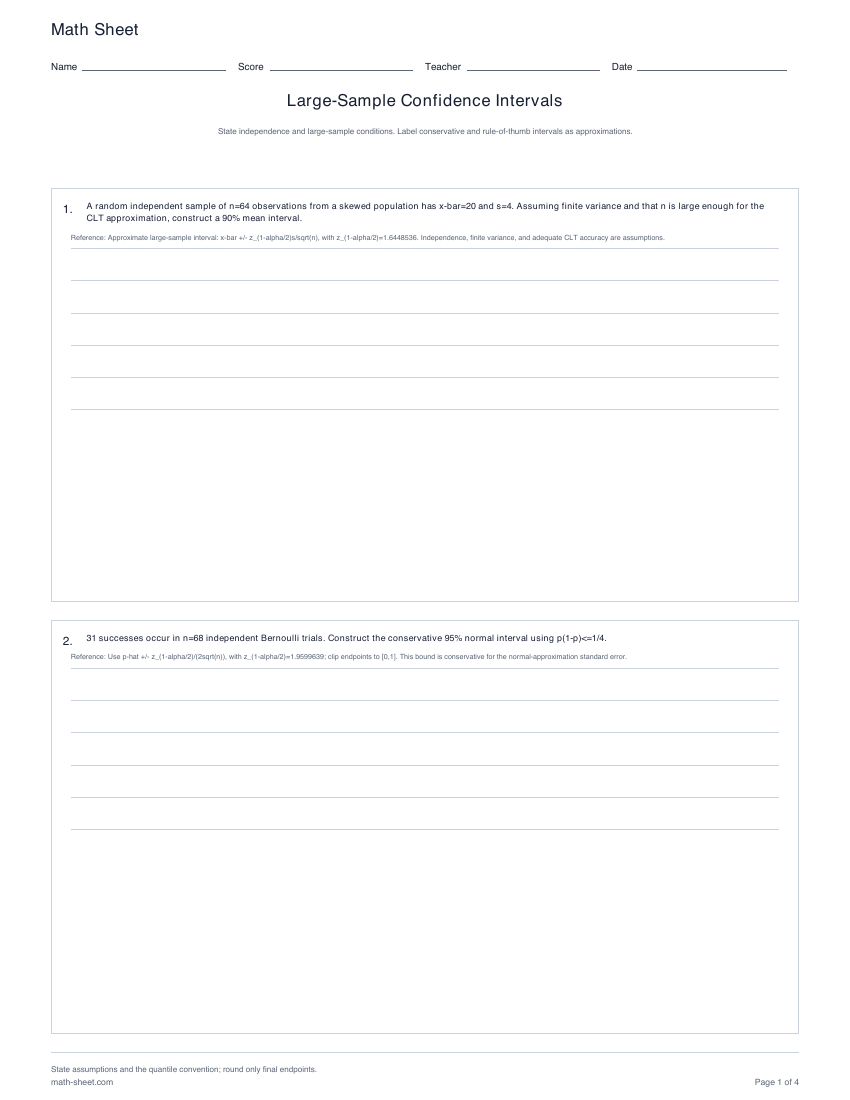
Math SheetNameScoreTeacherDateLarge-Sample Confidence IntervalsState independence and large-sample conditions. Label conservative and rule-of-thumb intervals as approximations.1.A random independent sample of n=64 observations from a skewed population has x-bar=20 and s=4. Assuming finite variance and that n is large enough for theCLT approximation, construct a 90% mean interval.Reference: Approximate large-sample interval: x-bar +/- z_(1-alpha/2)s/sqrt(n), with z_(1-alpha/2)=1.6448536. Independence, finite variance, and adequate CLT accuracy are assumptions.2.31 successes occur in n=68 independent Bernoulli trials. Construct the conservative 95% normal interval using p(1-p)<=1/4.Reference: Use p-hat +/- z_(1-alpha/2)/(2sqrt(n)), with z_(1-alpha/2)=1.9599639; clip endpoints to [0,1]. This bound is conservative for the normal-approximation standard error.State assumptions and the quantile convention; round only final endpoints.math-sheet.comPage 1 of 4
Math SheetNameScoreTeacherDateLarge-Sample Confidence IntervalsState independence and large-sample conditions. Label conservative and rule-of-thumb intervals as approximations.3.Two comparable independent proportion studies use n=72 and n=288. Under the same conservative 95% approximation, compare margin widths and state whennominal coverage may be unreliable.Reference: Conservative margin is about 1/sqrt(n), so multiplying sample size by 4 halves the margin. Normal coverage can be poor with dependence or inadequate success/failure counts.4.36 of n=76 independent trials succeed. Use the approximate 95% rule p-hat +/- 1/sqrt(n), and label the result as a rule of thumb.Reference: The 1/sqrt(n) margin approximates the conservative 95% normal margin because 1.96/2 is about 1. It is not exact.State assumptions and the quantile convention; round only final endpoints.math-sheet.comPage 2 of 4
Math SheetNameScoreTeacherDateLarge-Sample Confidence IntervalsState independence and large-sample conditions. Label conservative and rule-of-thumb intervals as approximations.5.39 successes occur in n=80 independent Bernoulli trials. Construct the conservative 95% normal interval using p(1-p)<=1/4.Reference: Use p-hat +/- z_(1-alpha/2)/(2sqrt(n)), with z_(1-alpha/2)=1.9599639; clip endpoints to [0,1]. This bound is conservative for the normal-approximation standard error.6.42 of n=84 independent trials succeed. Use the approximate 95% rule p-hat +/- 1/sqrt(n), and label the result as a rule of thumb.Reference: The 1/sqrt(n) margin approximates the conservative 95% normal margin because 1.96/2 is about 1. It is not exact.State assumptions and the quantile convention; round only final endpoints.math-sheet.comPage 3 of 4
Math SheetNameScoreTeacherDateLarge-Sample Confidence IntervalsState independence and large-sample conditions. Label conservative and rule-of-thumb intervals as approximations.7.A random independent sample of n=88 observations from a skewed population has x-bar=26 and s=10. Assuming finite variance and that n is large enough for theCLT approximation, construct a 90% mean interval.Reference: Approximate large-sample interval: x-bar +/- z_(1-alpha/2)s/sqrt(n), with z_(1-alpha/2)=1.6448536. Independence, finite variance, and adequate CLT accuracy are assumptions.8.Two comparable independent proportion studies use n=92 and n=368. Under the same conservative 95% approximation, compare margin widths and state whennominal coverage may be unreliable.Reference: Conservative margin is about 1/sqrt(n), so multiplying sample size by 4 halves the margin. Normal coverage can be poor with dependence or inadequate success/failure counts.State assumptions and the quantile convention; round only final endpoints.math-sheet.comPage 4 of 4

A useful next step

Related activities