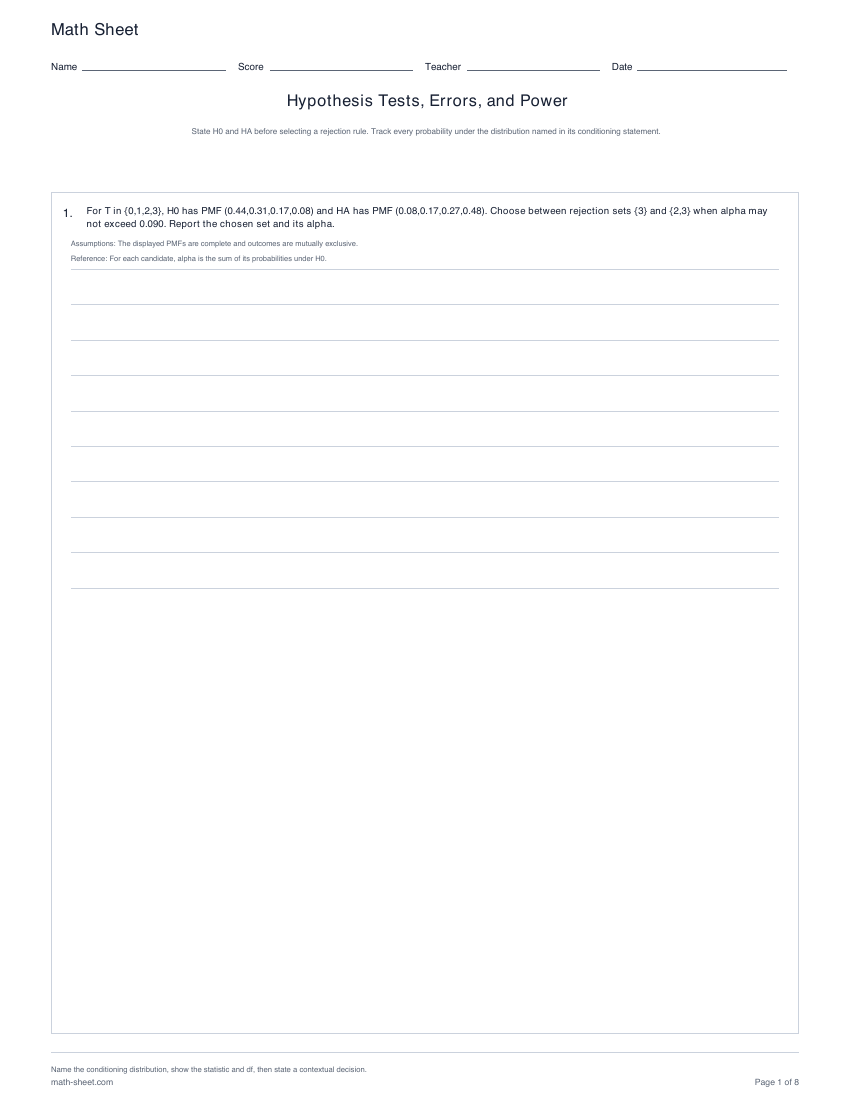
Math Sheet Name Score Teacher Date Hypothesis Tests, Errors, and Power State H0 and HA before selecting a rejection rule. Track every probability under the distribution named in its conditioning statement. 1. For T in {0,1,2,3}, H0 has PMF (0.44,0.31,0.17,0.08) and HA has PMF (0.08,0.17,0.27,0.48). Choose between rejection sets {3} and {2,3} when alpha may not exceed 0.090. Report the chosen set and its alpha. Assumptions: The displayed PMFs are complete and outcomes are mutually exclusive. Reference: For each candidate, alpha is the sum of its probabilities under H0. Name the conditioning distribution, show the statistic and df, then state a contextual decision. math-sheet.com Page 1 of 8
Math Sheet Name Score Teacher Date Hypothesis Tests, Errors, and Power State H0 and HA before selecting a rejection rule. Track every probability under the distribution named in its conditioning statement. 2. A valid test of H0 versus HA reports p=0.056 at alpha=0.05. State the decision and write a conclusion that does not treat failure to reject as proof of H0. Assumptions: The test design and assumptions were checked before the p-value was calculated. Reference: Reject when p<=alpha; otherwise fail to reject. Name the conditioning distribution, show the statistic and df, then state a contextual decision. math-sheet.com Page 2 of 8
Math Sheet Name Score Teacher Date Hypothesis Tests, Errors, and Power State H0 and HA before selecting a rejection rule. Track every probability under the distribution named in its conditioning statement. 3. For T in {0,1,2,3}, H0 has PMF (0.46,0.27,0.19,0.08) and HA has PMF (0.10,0.21,0.28,0.41). Reject H0 when T is in {3}. Find alpha, beta, and power. Assumptions: The displayed hypotheses specify the full sampling distributions. Reference: alpha=P(reject|H0); beta=P(fail to reject|HA); power=1-beta=P(reject|HA). Name the conditioning distribution, show the statistic and df, then state a contextual decision. math-sheet.com Page 3 of 8
Math Sheet Name Score Teacher Date Hypothesis Tests, Errors, and Power State H0 and HA before selecting a rejection rule. Track every probability under the distribution named in its conditioning statement. 4. Independent measurements follow N(mu, 49) with known variance 49. Investigators ask whether the population mean exceeds 54. State H0 and HA, classify each as simple or composite, and name the tail direction. Assumptions: Measurements are iid normal with unknown fixed mean mu and known sigma=7. Reference: A one-sided null includes its boundary and all parameter values opposite HA. Name the conditioning distribution, show the statistic and df, then state a contextual decision. math-sheet.com Page 4 of 8
Math Sheet Name Score Teacher Date Hypothesis Tests, Errors, and Power State H0 and HA before selecting a rejection rule. Track every probability under the distribution named in its conditioning statement. 5. Test H0: mu=55 against HA: mu>55 with known sigma=8, n=25, and alpha=0.05. Find the critical sample mean and power at mu=59. Assumptions: Observations are independent normal measurements and sigma is known. Reference: Normal reference: z_(1-alpha)=1.644853492. At mu=59, the printed cutoff standardizes to z=-0.855146508, with P(Z>-0.855146508)=0.8037650223. Name the conditioning distribution, show the statistic and df, then state a contextual decision. math-sheet.com Page 5 of 8
Math Sheet Name Score Teacher Date Hypothesis Tests, Errors, and Power State H0 and HA before selecting a rejection rule. Track every probability under the distribution named in its conditioning statement. 6. Independent measurements follow N(mu, 81) with known variance 81. Investigators ask whether the population mean exceeds 56. State H0 and HA, classify each as simple or composite, and name the tail direction. Assumptions: Measurements are iid normal with unknown fixed mean mu and known sigma=9. Reference: A one-sided null includes its boundary and all parameter values opposite HA. Name the conditioning distribution, show the statistic and df, then state a contextual decision. math-sheet.com Page 6 of 8
Math Sheet Name Score Teacher Date Hypothesis Tests, Errors, and Power State H0 and HA before selecting a rejection rule. Track every probability under the distribution named in its conditioning statement. 7. A valid test of H0 versus HA reports p=0.121 at alpha=0.01. State the decision and write a conclusion that does not treat failure to reject as proof of H0. Assumptions: The test design and assumptions were checked before the p-value was calculated. Reference: Reject when p<=alpha; otherwise fail to reject. Name the conditioning distribution, show the statistic and df, then state a contextual decision. math-sheet.com Page 7 of 8
Math Sheet Name Score Teacher Date Hypothesis Tests, Errors, and Power State H0 and HA before selecting a rejection rule. Track every probability under the distribution named in its conditioning statement. 8. Test H0: mu=58 against HA: mu>58 with known sigma=11, n=25, and alpha=0.05. Find the critical sample mean and power at mu=65. Assumptions: Observations are independent normal measurements and sigma is known. Reference: Normal reference: z_(1-alpha)=1.644853492. At mu=65, the printed cutoff standardizes to z=-1.536964690, with P(Z>-1.536964690)=0.9378490030. Name the conditioning distribution, show the statistic and df, then state a contextual decision. math-sheet.com Page 8 of 8