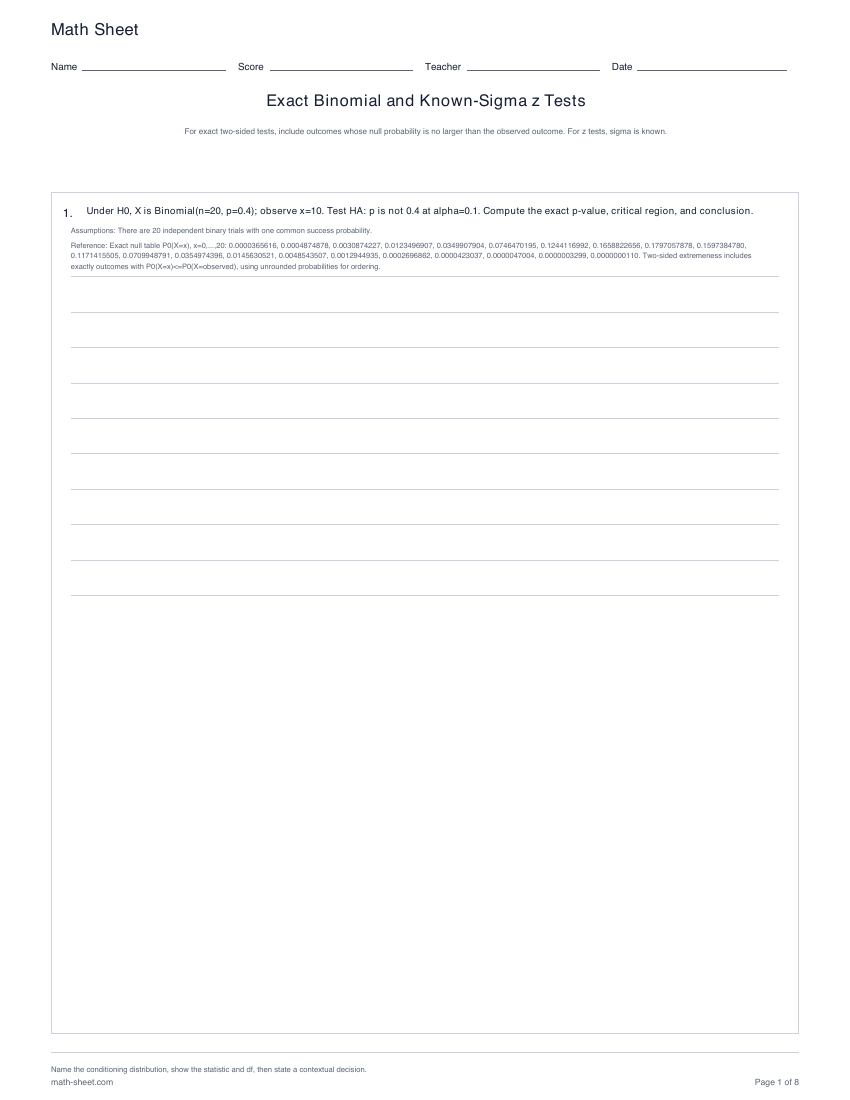
Math Sheet Name Score Teacher Date Exact Binomial and Known-Sigma z Tests For exact two-sided tests, include outcomes whose null probability is no larger than the observed outcome. For z tests, sigma is known. 1. Under H0, X is Binomial(n=20, p=0.4); observe x=10. Test HA: p is not 0.4 at alpha=0.1. Compute the exact p-value, critical region, and conclusion. Assumptions: There are 20 independent binary trials with one common success probability. Reference: Exact null table P0(X=x), x=0,...,20: 0.0000365616, 0.0004874878, 0.0030874227, 0.0123496907, 0.0349907904, 0.0746470195, 0.1244116992, 0.1658822656, 0.1797057878, 0.1597384780, 0.1171415505, 0.0709948791, 0.0354974396, 0.0145630521, 0.0048543507, 0.0012944935, 0.0002696862, 0.0000423037, 0.0000047004, 0.0000003299, 0.0000000110. Two-sided extremeness includes exactly outcomes with P0(X=x)<=P0(X=observed), using unrounded probabilities for ordering. Name the conditioning distribution, show the statistic and df, then state a contextual decision. math-sheet.com Page 1 of 8
Math Sheet Name Score Teacher Date Exact Binomial and Known-Sigma z Tests For exact two-sided tests, include outcomes whose null probability is no larger than the observed outcome. For z tests, sigma is known. 2. Data are 22, 23, 24, 25, 27. With known sigma=4, test H0: mu=21 against HA: mu>mu0 at alpha=0.01. Assumptions: The observations are independent and normal, or n is adequate for the mean; population sigma is known. Reference: Normal reference at printed z=1.788854382: P(Z>=|z|)=0.0368190849. Critical z=2.326347015. Name the conditioning distribution, show the statistic and df, then state a contextual decision. math-sheet.com Page 2 of 8
Math Sheet Name Score Teacher Date Exact Binomial and Known-Sigma z Tests For exact two-sided tests, include outcomes whose null probability is no larger than the observed outcome. For z tests, sigma is known. 3. Under H0, X is Binomial(n=11, p=0.6); observe x=4. Test HA: p<0.6 at alpha=0.05. Compute the exact p-value, critical region, and conclusion. Assumptions: There are 11 independent binary trials with one common success probability. Reference: Exact null table P0(X=x), x=0,...,11: 0.0000419430, 0.0006920602, 0.0051904512, 0.0233570304, 0.0700710912, 0.1471492915, 0.2207239373, 0.2364899328, 0.1773674496, 0.0886837248, 0.0266051174, 0.0036279706. Use the directed tail including the observed count. Name the conditioning distribution, show the statistic and df, then state a contextual decision. math-sheet.com Page 3 of 8
Math Sheet Name Score Teacher Date Exact Binomial and Known-Sigma z Tests For exact two-sided tests, include outcomes whose null probability is no larger than the observed outcome. For z tests, sigma is known. 4. A sample has x-bar=25.1, n=16. With known sigma=6, test H0: mu=23 against HA: mu<mu0 at alpha=0.1. Assumptions: The observations are independent and normal, or n is adequate for the mean; population sigma is known. Reference: Normal reference at printed z=1.400000000: Phi(z)=0.9192432862. Critical z=-1.281551956. Name the conditioning distribution, show the statistic and df, then state a contextual decision. math-sheet.com Page 4 of 8
Math Sheet Name Score Teacher Date Exact Binomial and Known-Sigma z Tests For exact two-sided tests, include outcomes whose null probability is no larger than the observed outcome. For z tests, sigma is known. 5. Under H0, X is Binomial(n=13, p=0.4); observe x=8. Test HA: p>0.4 at alpha=0.01. Compute the exact p-value, critical region, and conclusion. Assumptions: There are 13 independent binary trials with one common success probability. Reference: Exact null table P0(X=x), x=0,...,13: 0.0013060694, 0.0113192681, 0.0452770726, 0.1106772886, 0.1844621476, 0.2213545771, 0.1967596241, 0.1311730827, 0.0655865414, 0.0242913116, 0.0064776831, 0.0011777606, 0.0001308623, 0.0000067109. Use the directed tail including the observed count. Name the conditioning distribution, show the statistic and df, then state a contextual decision. math-sheet.com Page 5 of 8
Math Sheet Name Score Teacher Date Exact Binomial and Known-Sigma z Tests For exact two-sided tests, include outcomes whose null probability is no larger than the observed outcome. For z tests, sigma is known. 6. Under H0, X is Binomial(n=14, p=0.5); observe x=10. Test HA: p>0.5 at alpha=0.05. Compute the exact p-value, critical region, and conclusion. Assumptions: There are 14 independent binary trials with one common success probability. Reference: Exact null table P0(X=x), x=0,...,14: 0.0000610352, 0.0008544922, 0.0055541992, 0.0222167969, 0.0610961914, 0.1221923828, 0.1832885742, 0.2094726563, 0.1832885742, 0.1221923828, 0.0610961914, 0.0222167969, 0.0055541992, 0.0008544922, 0.0000610352. Use the directed tail including the observed count. Name the conditioning distribution, show the statistic and df, then state a contextual decision. math-sheet.com Page 6 of 8
Math Sheet Name Score Teacher Date Exact Binomial and Known-Sigma z Tests For exact two-sided tests, include outcomes whose null probability is no larger than the observed outcome. For z tests, sigma is known. 7. A sample has x-bar=23.7, n=16. With known sigma=9, test H0: mu=26 against HA: mu<mu0 at alpha=0.1. Assumptions: The observations are independent and normal, or n is adequate for the mean; population sigma is known. Reference: Normal reference at printed z=-1.022222222: Phi(z)=0.1533378861. Critical z=-1.281551956. Name the conditioning distribution, show the statistic and df, then state a contextual decision. math-sheet.com Page 7 of 8
Math Sheet Name Score Teacher Date Exact Binomial and Known-Sigma z Tests For exact two-sided tests, include outcomes whose null probability is no larger than the observed outcome. For z tests, sigma is known. 8. Under H0, X is Binomial(n=16, p=0.3); observe x=7. Test HA: p is not 0.3 at alpha=0.01. Compute the exact p-value, critical region, and conclusion. Assumptions: There are 16 independent binary trials with one common success probability. Reference: Exact null table P0(X=x), x=0,...,16: 0.0033232931, 0.0227882952, 0.0732480919, 0.1464961837, 0.2040482559, 0.2098782061, 0.1649043048, 0.1009618193, 0.0486780200, 0.0185440076, 0.0055632023, 0.0013004888, 0.0002322302, 0.0000306238, 0.0000028124, 0.0000001607, 0.0000000043. Two-sided extremeness includes exactly outcomes with P0(X=x)<=P0(X=observed), using unrounded probabilities for ordering. Name the conditioning distribution, show the statistic and df, then state a contextual decision. math-sheet.com Page 8 of 8